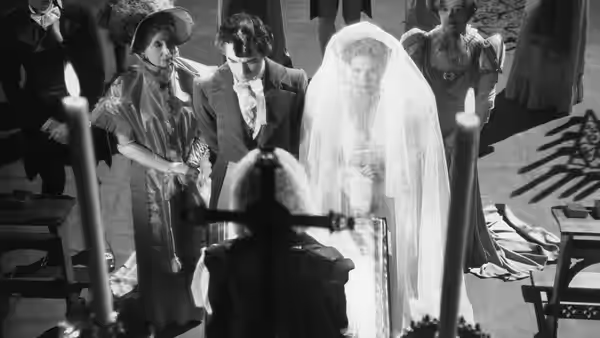
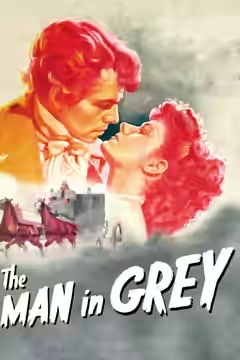
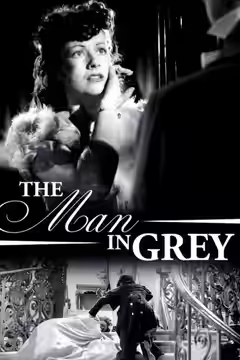
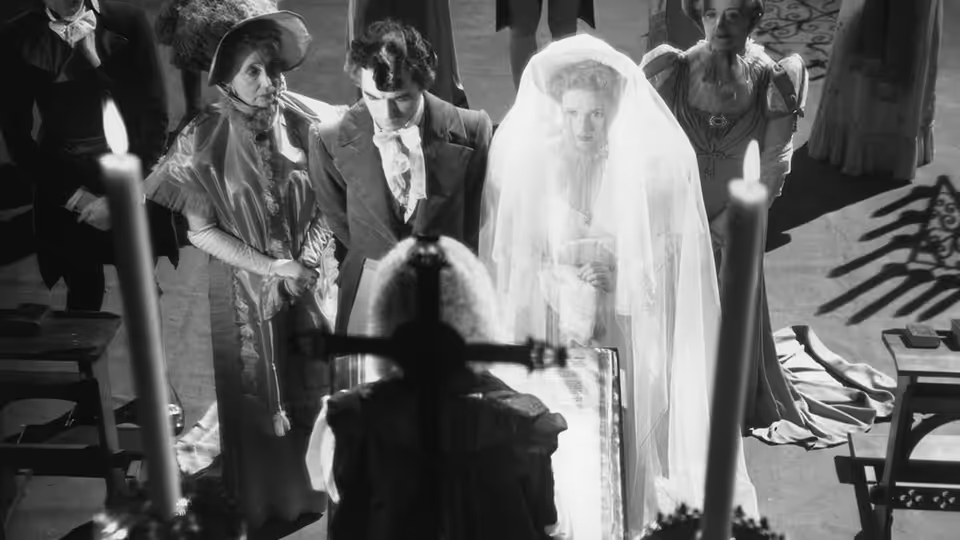
A bride and groom stand before a priest as mourners gather for their wedding ceremony
Film review

The Man in Grey

1943 · Directed by Leslie Arliss · 1h 56m

In a sentenceJames Mason behaves badly enough to make all the waiting almost worthwhile

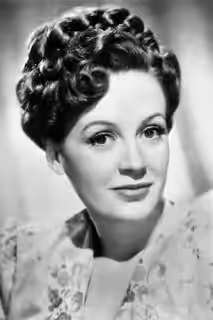
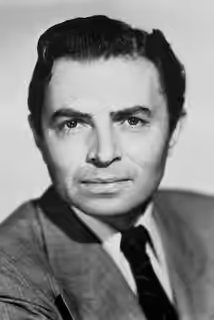
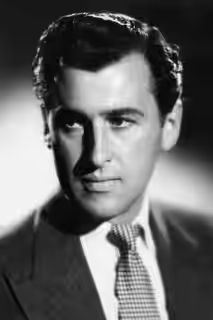
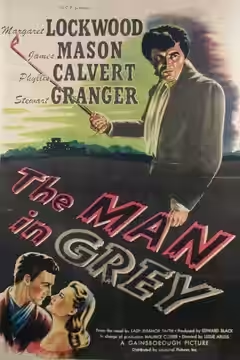
In The Man in Grey, Hesther Shaw Barbary (Margaret Lockwood), Clarissa Richmond Rohan (Phyllis Calvert), Lord Rohan (James Mason) and Swinton Rokeby (Stewart Granger) are the principal characters in an adaptation of Eleanor Smith’s novel. The drama and romance also feature Toby (Harry Scott), Miss Patchett (Martita Hunt) and Lady Rohan (Helen Haye). Raymond Lovell plays The Prince of Wales, with Nora Swinburne as Mrs. Fitzherbert and Beatrice Varley as Gypsy Fortune Teller. The screenplay is credited to Margaret Kennedy and Leslie Arliss.

Fi1m review

Margaret Lockwood and James Mason bring welcome heat to The Man in Grey, a costume melodrama that takes too long to get on with its pleasures. Worth considering chiefly for their performances.

Leslie Arliss’s The Man in Grey has enough pleasure in bad behaviour to justify a look, but only if costume melodrama is already a taste. At 116 minutes, this adaptation of Eleanor Smith’s novel asks for more patience than its romantic drama consistently earns. Margaret Lockwood and James Mason provide the strongest reasons to stay. When their performances are not supplying the excitement, the film can seem in no particular hurry to supply anything else.

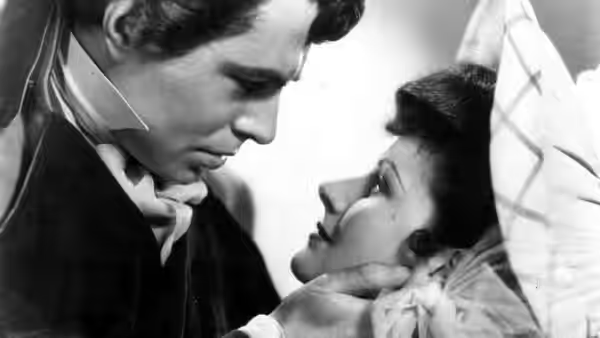
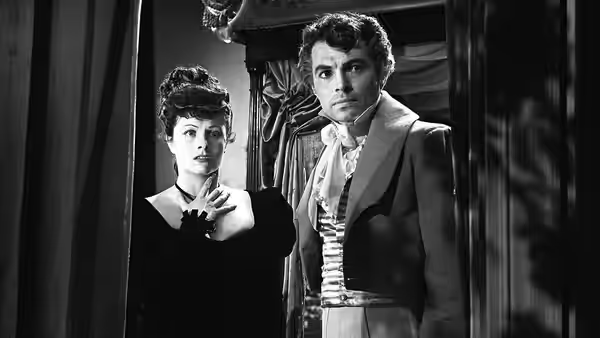
James Mason’s Lord Rohan is the chief attraction, a disagreeable man played with an assurance that makes his company surprisingly enjoyable. We enjoyed his caddishness more than we ought to have. The pleasure comes from the conviction of the performance: unpleasantness is allowed to be attractive, without requiring us to approve of it. That is useful in a melodrama, where an actor’s willingness to embrace bad behaviour can keep us watching through quite a lot of trouble elsewhere.

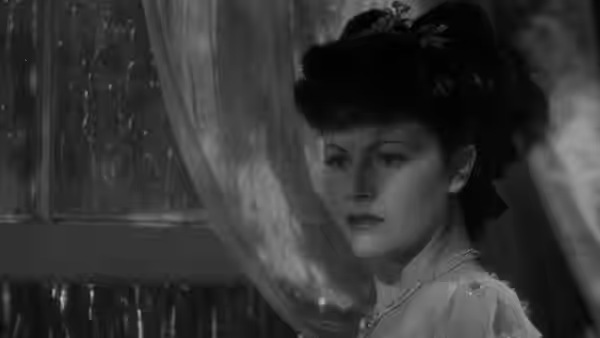
Margaret Lockwood, playing Hesther Shaw Barbary, gives the romance some welcome urgency. Her performance helps prevent the material from becoming merely dutiful, and the appeal of watching these two actors at work is easy to understand. Phyllis Calvert and Stewart Granger complete the principal quartet, giving the film a cast that encourages us to persist through its less rewarding passages. The difficulty is sustaining that interest across the full running time, rather than repeatedly having to recover it.

Arthur Crabtree’s cinematography, Elizabeth Haffenden’s costume design and Cedric Mallabey’s music contribute to an entertainment whose appeal depends heavily on its presentation. That is a legitimate pleasure, particularly in a costume romance. The difficulty comes when there is too little dramatic urgency to accompany it. However agreeable the presentation, we still need a reason for a scene to continue, and the film does not always provide one strong enough to justify the time it takes.

The weakness is the amount of waiting. R.E. Dearing’s editing leaves the material more room than it needs, though that cannot fairly be blamed on the editor alone. The screenplay by Margaret Kennedy and Leslie Arliss too often feels content to prolong matters after we have grasped their interest. Predictability need not damage melodrama, since anticipating trouble can be part of the enjoyment. Here, the slackness allows that anticipation to become impatience, leaving the performers to win back our attention.

The genre gives the film plenty of permission to be extravagant. Broad characterisation and excessive feeling are welcome when the scenes keep putting pressure on the people involved. This one relaxes that pressure too readily, separating its enjoyable acting with stretches that feel longer than they should. Admirers of costume romance will be better placed to forgive those stretches than anyone coming chiefly for a gripping story, especially if James Mason is already part of the attraction.

There is enough here to resist dismissing it as an exercise in dressing up. The performances have an appetite for the material that remains engaging, even when the pace makes it difficult to share that appetite continuously. But the slowness matters, and affection for the cast will not remove it. Choose The Man in Grey for an evening when a splendidly unpleasant lord will be sufficient entertainment for rather longer than he should have to be.

Critical consensus AI synthesised

3 of 6
Positive
1
Mixed
1
Negative
1
Time Out
70*

The description suggests a positive view of the film. It singles out James Mason’s caddish performance as being in fine form.

Read the full review →
Radio Times
★★★ · David Parkinson
60

The critic finds the film an enduring example of Gainsborough’s escapist costume drama, though it may not thrill modern viewers as much. Margaret Lockwood and James Mason are singled out for making the action smoulder.

Read the full review →
Eye for Film
26 January 2007 · Natasha Footman
30*

Footman finds the full-length version slow, predictable and largely forgettable, despite some mindless enjoyment. She singles out its drawn-out, pointless scenes as the main reason to prefer the shortened version.

Read the full review →

Straight answers AI written, from our review

Is The Man in Grey worth watching?
The Man in Grey is worth considering for admirers of costume melodrama and its cast, but its slow pace limits our recommendation to 61 out of 100. We enjoy James Mason’s assured caddishness and Margaret Lockwood’s urgency; anyone looking chiefly for a gripping romance may find the waiting outweighs those pleasures.
How long is The Man in Grey, and what is it rated?
The Man in Grey runs 1h 56m. It is a drama and romance film.
Where can I watch The Man in Grey in South Korea?
The Man in Grey is not on any streaming or rental service in South Korea at the moment. It is available in 5 other countries; change your country at the top of the page to see where. Availability is checked daily.
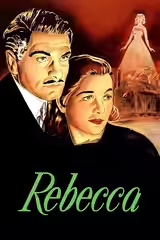
How does The Man in Grey compare to Rebecca?
The Man in Grey is the less absorbing choice beside Rebecca, offering enjoyable bad behaviour where the latter makes romantic insecurity unsettling. We recommend Rebecca for its sustained unease, despite a less precise closing stretch; The Man in Grey suits an appetite for costume melodrama and James Mason’s unpleasant lord, provided patience is not in short supply.
Is The Man in Grey based on a true story or a book?
The Man in Grey is adapted from Eleanor Smith’s novel, with a screenplay credited to Margaret Kennedy and Leslie Arliss. We recommend approaching it as a costume romance rather than a history lesson: familiarity with the book is not a prerequisite, though we make no claim for the adaptation’s faithfulness.
What should I watch after The Man in Grey?
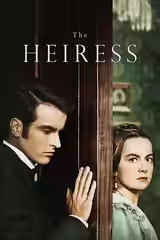
After The Man in Grey, try Rebecca (1940, Fi1m 85): Another uneasy encounter with rank, romance and people better avoided. Then The Heiress (1949, Fi1m 90): A sharper examination of money, courtship and the cost of disappointment; and The Earrings of Madame de… (1953, Fi1m 87): For aristocratic romance in which manners make every mistake more painful.

Cast

If you liked this, try…

  1. Rebecca (1940, Fi1m 85)Another uneasy encounter with rank, romance and people better avoided.

  2. The Heiress (1949, Fi1m 90)A sharper examination of money, courtship and the cost of disappointment.

  3. The Earrings of Madame de… (1953, Fi1m 87)For aristocratic romance in which manners make every mistake more painful.

  4. The Age of Innocence (1993, Fi1m 86)More tightly controlled feelings, with social rules doing much of the damage.

  5. The Handmaiden (2016, Fi1m 85)For a less decorous period romance, thick with appetite and calculation.