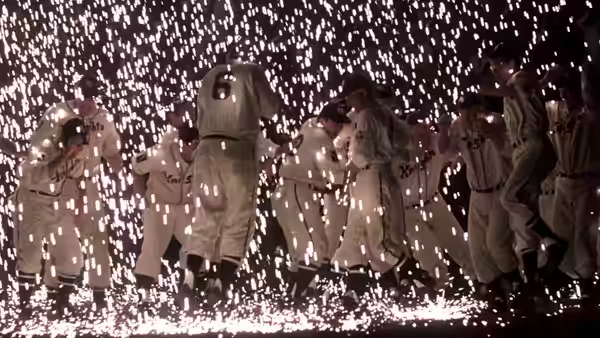
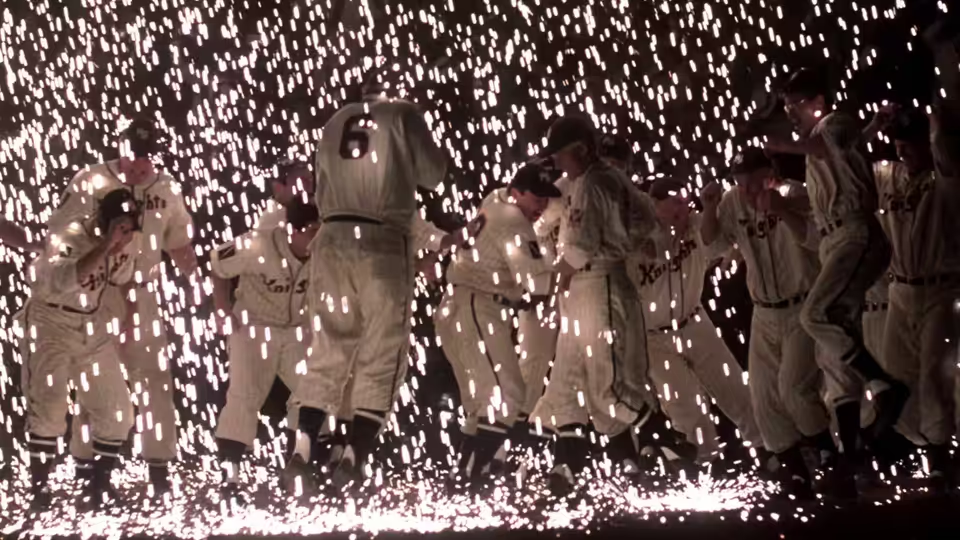
Baseball players gather beneath a shower of fireworks on the field
Film review

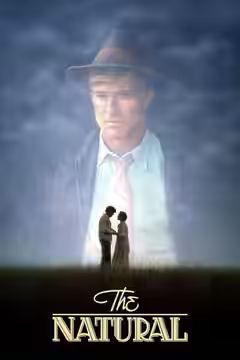
The Natural

1984 · Directed by Barry Levinson · 2h 17m

In a sentenceThe sun comes out every time Redford swings and Robert Prosky will not switch a lamp on

A farm boy, Roy Hobbs (Robert Redford), learns to pitch from his father, Ed Hobbs (Alan Fudge), and when lightning splits the tree by the house he carves a bat from the wood and burns the name Wonderboy into it. Years later he takes a train to Chicago with the scout Sam Simpson (John Finnegan) for a try-out. At a fairground stop he strikes out the champion slugger the Whammer (Joe Don Baker) on three pitches while the sportswriter Max Mercy (Robert Duvall) watches and a woman in black, Harriet Bird (Barbara Hershey), takes an interest. In a hotel room, Harriet shoots him. Sixteen years on, a greying Roy walks into the dugout of the New York Knights, a losing club managed by Pop Fisher (Wilford Brimley), and asks only to be allowed to play.

Fi1m review

Barry Levinson turns Bernard Malamud’s sour novel into a golden fable, and Caleb Deschanel lights it like a church window. It is lovely to look at and it wants to be wept at, and we held out for most of two hours and then did not.

Bernard Malamud’s novel is a bitter book about a gifted man who wastes the gift. Barry Levinson’s film, from a screenplay by Roger Towne and Phil Dusenberry, keeps the story and reverses the weather. Where the book is grey, the film is gold. The result is a handsome, slow, openly sentimental 137 minutes that is worth your evening if you like baseball, or Robert Redford, or being told that goodness wins. If you like none of those, it will feel like a long sermon with a good organist.

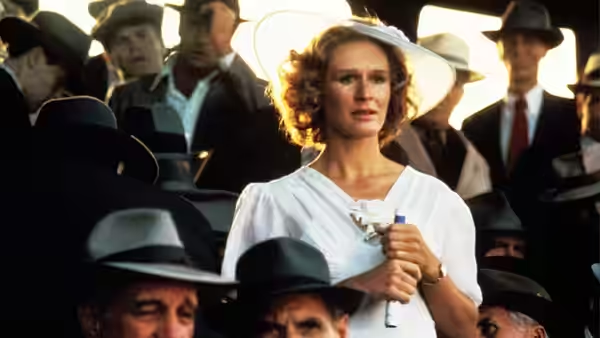
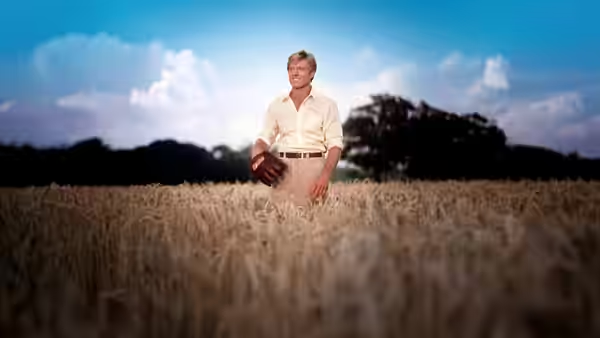
The organist is Caleb Deschanel. He shoots the farm at the hour when wheat glows, the train at dusk, and the ballpark under a late sun that turns the Knights’ cream flannel to butter. The Judge (Robert Prosky), who owns the club and wants it to lose, sits in an office with the blinds drawn and one lamp he keeps turned off. Angelo P. Graham and Mel Bourne build a stadium of wooden seats, hand-painted advertisements and a scoreboard worked by men with numbers, and Bernie Pollack and Gloria Gresham put Kim Basinger’s Memo Paris in white satin and Glenn Close’s Iris Gaines in a white dress and a wide hat, so we know which white is which.

Randy Newman’s score does a great deal of the work. The brass fanfare that goes with the bat is the sort of tune that gets into the walls of a house, and Newman plays it sparingly enough that it still lands the sixth time. Christopher Holmes and Stu Linder cut the baseball well: the swing, a beat, the fielders looking up, then the crowd, so that the ball is barely seen and its effect is everything. The first time Pop tells Roy to knock the cover off the ball and he does exactly that, we laughed out loud, and the film has earned the laugh.

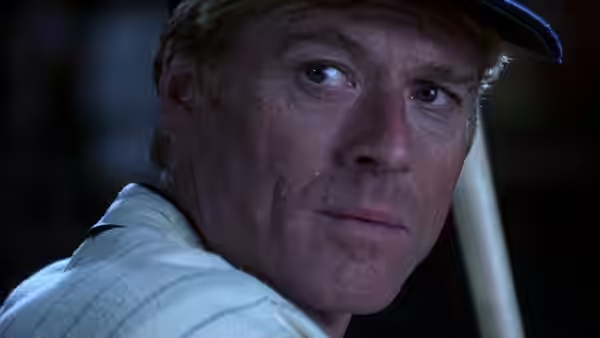
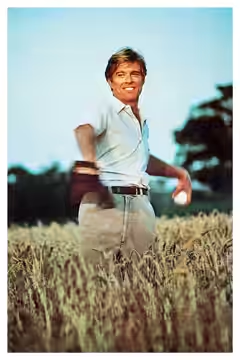
Redford plays Roy as a man who has decided not to explain himself, and it suits him. He does not tell the team where he has been for sixteen years and the film does not tell us much more. Wilford Brimley’s Pop is the best thing on the bench, a manager chewing on decades of grievance who sees his last chance walk in wearing a suit that does not fit. Richard Farnsworth, as the coach Red Blow, says little and is right about all of it. Robert Duvall gives Max Mercy, the columnist who remembers the boy from the fairground, a bright, nosy menace the script never quite uses.

The women are where the writing gives out. Iris is the light and Memo is the dark and Harriet Bird is a symbol holding a pistol, and none of them is given a reason to be there beyond what Roy needs from her. Close does more with a look from the stands than Towne and Dusenberry give her in a page of dialogue.

Here is what happened to us. Roy is in a slump, in Chicago, and a woman in white stands up in the afternoon crowd with the sun behind her hat while everyone around her stays seated. We knew precisely what was being done to us, and our throat tightened regardless. It happened again near the end, in a sequence we will not describe. Between those two moments there is a long, soft middle hour of gamblers and hospital beds that we spent admiring the lampshades.

Levinson’s previous film, Diner (1982), was all talk in a booth. This one barely talks and does not trust a quiet scene without brass under it. Malamud’s ending has been changed, and you will guess the direction of the change from the first shot of the wheat. Most critics have found it too sweet, and they are not wrong; we simply did not mind as much as we should have.

See it on the largest screen you have, in the dark, with someone who will not pretend afterwards that they were unmoved. It carries a PG and runs 137 minutes, of which about fifteen belong to the Judge’s office and could go.
Critical consensus AI synthesised

62
Positive
1
Mixed
4
Negative
1

The reviews lean mixed rather than hostile. Most critics agree the film is handsomely made and that Robert Redford is well cast as Roy Hobbs; his performance is the one thing praised almost across the board. Several find the baseball itself has a mythic pull, and the more generous reviews call the film wistful and memorable, treating the game as something close to magic.

The reservations cluster on sentiment. Most critics think the film too soft, and those who know the novel object that it is a good deal gentler than its source. The spread is wide for a film this widely liked in outline: Radio Times is the only clear recommendation, while Empire is the only firm rejection, finding an otherwise sound sports fantasy weighed down by sentimentality. The AV Club, reviewing the director’s cut, calls it overlong, and Variety finds the female characters schematic.

Radio Times
★★★★ · Joanna Berry
80

Berry describes the film as wistful and often memorable, viewing baseball as something magical. She particularly praises Robert Redford, who is at his best as Roy Hobbs.

Read the full review →
Time Out
· CPea
67*

The review presents the adaptation as upbeat, while suggesting its effect depends on the viewer’s mood and generosity. The available description singles out that contrast with the source’s grittier allegory.

Read the full review →
RogerEbert.com
65*

The page shows a browser-check message, so the critic’s verdict and any specific praise or complaint are unavailable. The review’s details cannot be verified from the accessible content.

Read the full review →
Variety
1 January 1984 · Variety Staff
60*

The review calls the film impeccably made but a strange fable about success and failure. It praises Robert Redford’s casting while criticizing the female characters as schematic.

Read the full review →
The AV Club
21 March 2007 · C · Scott Tobias
57

Tobias finds the director’s cut overlong and mired in sentimental sludge, despite the film’s mythic appeal. He singles out its spectacularly triumphant final swing as a powerful sequence, even while noting its irony.

Read the full review →
Empire
1 January 2014 · William Thomas
40*

The review finds the sports fantasy otherwise fine but weighed down by excessive sentimentality. It praises the film’s cast and epic imagery, while noting that its ending softens the novel’s cynical sorrow.

Read the full review →

Straight answers AI written, from our review

Is The Natural worth watching?
The Natural is worth watching if you like baseball, Robert Redford, or being told that goodness wins, and we scored it 67. It is handsome, slow and openly sentimental, with a soft middle hour of gamblers and hospital beds, but it got past our guard twice. Anyone allergic to brass under a quiet scene should look elsewhere.
How long is The Natural, and what is it rated?
The Natural runs 2h 17m. It is a drama film.
Where can I watch The Natural in Romania?
The Natural is not on any streaming or rental service in Romania at the moment. It is available in 24 other countries; change your country at the top of the page to see where. Availability is checked daily.
How does The Natural compare to Field of Dreams?
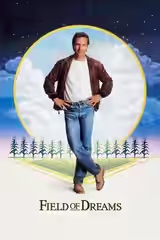
The Natural is the more handsome of the two and Field of Dreams the warmer and funnier. Levinson's film is a golden fable with villains in dark offices; Robinson's is a gentler fantasy with ghosts and speeches, and it is the more convincing about second chances. Pick The Natural for spectacle and Field of Dreams if you want to be moved with less effort.
Is The Natural based on a true story or a book?
The Natural is based on Bernard Malamud's novel of the same name, not on a true story. The book is bitter, about a gifted man who wastes the gift; the film keeps the story and reverses the tone, turning grey to gold and changing the ending. You do not need to have read Malamud, though readers will notice how far the film has softened him.
What should I watch after The Natural?
After The Natural, try Field of Dreams (1989, Fi1m 83): The other great baseball weepie; more ghosts, fewer villains, the same cornfield light. Then The Hustler (1961, Fi1m 88): Talent, gamblers and a woman in the way, shot in black and white without the halo.

Cast

Awards

Academy Awards, 1985

Nominated
Best Cinematography
Nominated
Best Original Score
Nominated
Best Production Design
Nominated
Best Supporting Actress

If you liked this, try…

  1. Field of Dreams (1989, Fi1m 83)The other great baseball weepie; more ghosts, fewer villains, the same cornfield light.

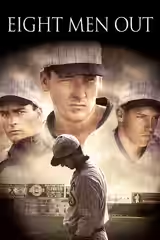
  2. Eight Men Out (1988) · not on Fi1m yetJohn Sayles on the 1919 fix, for those who wanted the Judge to win.

  3. The Hustler (1961, Fi1m 88)Talent, gamblers and a woman in the way, shot in black and white without the halo.

  4. Lagaan (2001) · not on Fi1m yetIndian villagers learn cricket to beat the Raj; three hours, and every over counts.

  5. Sugar (2008) · not on Fi1m yetA Dominican pitcher’s minor-league year; the same dream with the gold removed.

The Natural (1984) review: a lovely baseball myth, too sweet (Romania) | Fi1m