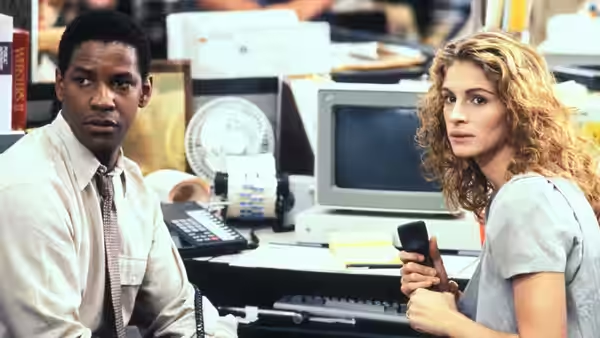
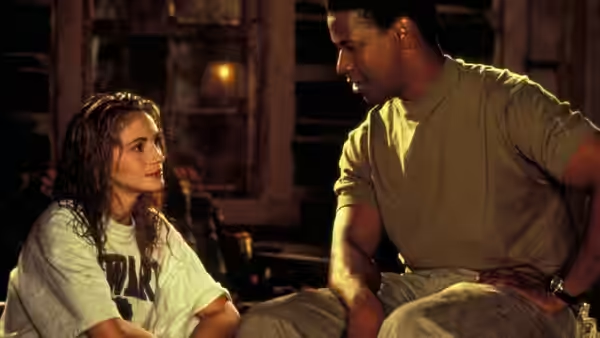
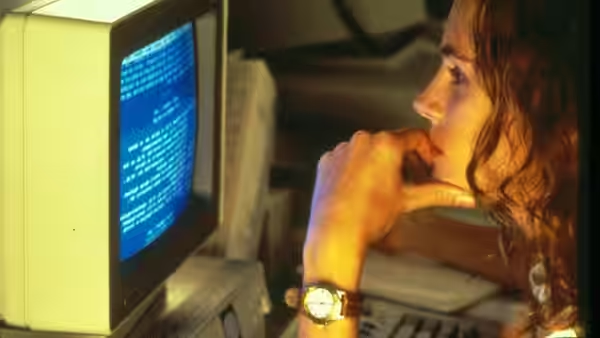
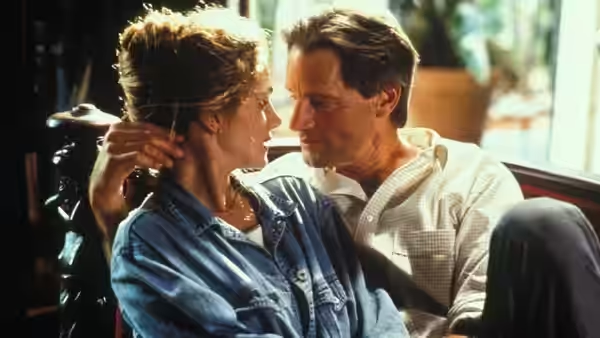
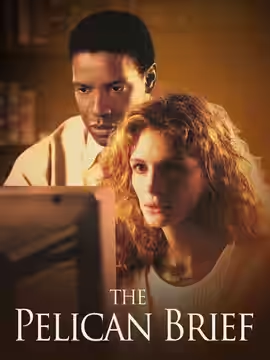
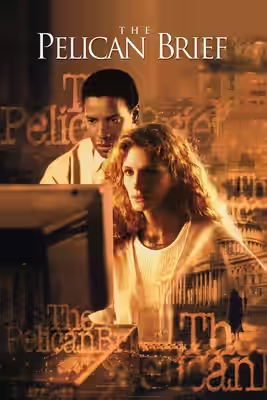
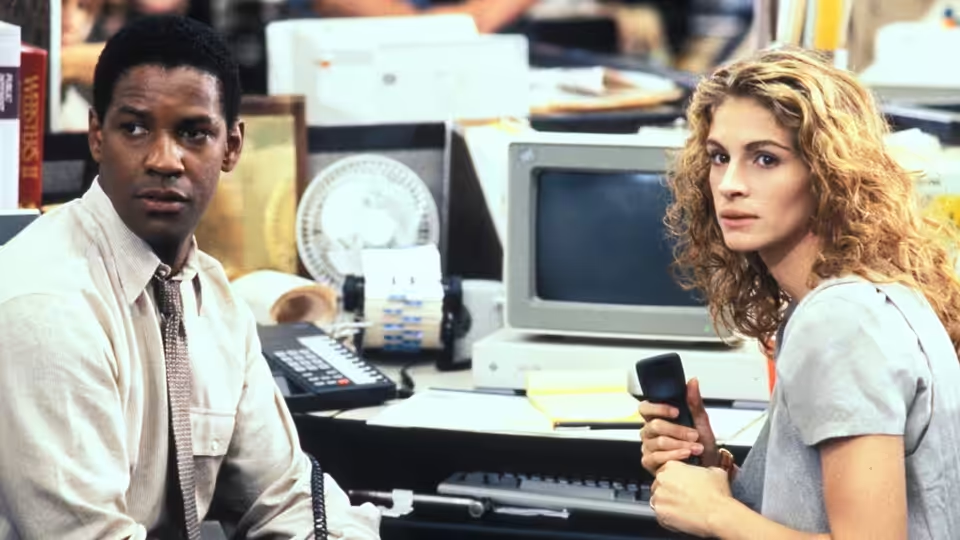
Gray Grantham (Denzel Washington) and Darby Shaw (Julia Roberts) sit beside computers in a newsroom
Film review

The Pelican Brief

1993 · Directed by Alan J. Pakula · 2h 21m

In a sentenceEveryone in Washington is lying and Denzel Washington is the only one taking notes

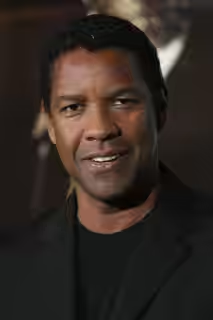
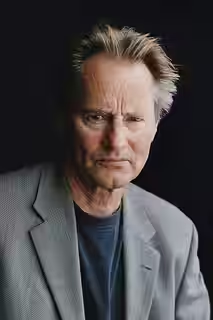
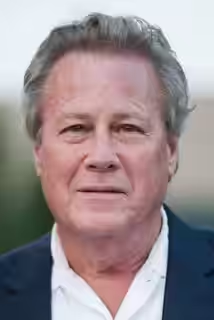
Washington, DC. Two Supreme Court justices, among them the elderly Justice Rosenberg (Hume Cronyn), are murdered on the same night by a hired killer, Khamel (Stanley Tucci). In New Orleans, Tulane law student Darby Shaw (Julia Roberts) spends a weekend in the library and writes a speculative brief tying the killings to a court case about pelican habitat and the oil beneath it. Her professor and lover Thomas Callahan (Sam Shepard) passes it to an FBI friend, Gavin Vereek (John Heard), and from there it travels to the White House and the chief of staff, Fletcher Coal (Tony Goldwyn). Then a car bomb goes off outside a New Orleans bar, and Darby runs. In Washington, Herald reporter Gray Grantham (Denzel Washington) is taking calls from a frightened source who will give only the name Garcia.

Plays from YouTube when you press play; nothing loads from them until then.

Fi1m review

Alan J. Pakula brings his old paranoid-thriller skills to John Grisham’s airport novel, and for an hour it works: handsome, tense, properly frightening. Then it settles into explanation, keeps its two stars apart too long, and runs twenty minutes past its welcome.

Two Supreme Court justices are killed in one night, a law student in New Orleans works out why, and everyone who reads her theory starts dying. That is John Grisham’s novel, and Alan J. Pakula, who made All the President’s Men, is the right man to film it: nobody has shot Washington’s corridors with more dread. The Pelican Brief is a decent, good-looking thriller with two stars who are a pleasure to watch. It is also 141 minutes long, and for the second half of them it is mostly people in rooms telling each other what we already know.

The opening is the best of it. Stephen Goldblatt lights Justice Rosenberg’s house so that the old man (Hume Cronyn, asleep in a chair with a blanket over his knees) is a small pale shape in a brown room, and Stanley Tucci’s Khamel comes out of the dark behind him without a sound. Tucci says almost nothing and is the more alarming for it. We were properly frightened in those first ten minutes, and it was the quiet that did it: no music, no struggle, a killer who knows exactly where everything is.

Julia Roberts carries the next hour on her own, and she is good at being hunted. Her Darby Shaw is clever, but mostly she is scared, in doorways and hotel lobbies and on the back of a streetcar, and Roberts plays fear as something that makes a person precise rather than hysterical. She cuts her hair short and dyes it dark, and Albert Wolsky puts her in borrowed-looking jackets and bought-this-morning dresses so that she looks like someone else every twenty minutes. Denzel Washington’s Gray Grantham is introduced early and then visited in fragments while the film waits for the plot to bring the two of them together.

When it does, the film lifts. Washington is relaxed, amused, listening more than he talks, and he makes a reporter’s patience look like a kind of strength. John Lithgow, as his editor Smith Keen, is drily good, a man who wants the story and the lawyers kept happy in the same breath. The scenes of Darby and Gray in hotel rooms, on the phone, in a library with a stack of filings, are the film’s warmest and sharpest. Pakula also refuses to let them touch. There is a moment near a window where any other film of the period would have cut to a kiss, and this one cuts to a car.

The conspiracy is explained in meetings. Tony Goldwyn’s Fletcher Coal runs the White House with a smile that never reaches his voice, Robert Culp’s President is vague and golfing and happy to be managed, and James Sikking’s FBI director Voyles and William Atherton’s CIA man Gminski trade warnings across a table. All well played, all there to say a paragraph of plot. Philip Rosenberg gives them handsome offices, dark wood and green lamps and venetian blinds, and Goldblatt shoots the capital in long lenses from across streets, as though someone were always watching. What is missing is the sense, so strong in All the President’s Men, that the buildings themselves are in on it. Here the menace is in the dialogue, and dialogue can be paused.

James Horner’s score is piano and low synthesiser, a mournful tune for Darby and a tick for the chases, and it is mixed with tact. Tom Rolf and Trudy Ship cut the pursuits cleanly, and cut the rest as if under instruction not to lose a single clause. Somewhere around the two-hour mark we were working out how much was left, and we were a little cross about it, because the film had earned our attention in its first hour and was now spending it on a man reading a document aloud.

It is not a bad evening. The leads are good together and the villains are a well-stocked cupboard of 1990s character actors. Watch it at home on a wet night, where the hotel-room stretches feel companionable rather than slow, and forgive it the length. It carries a 12 certificate and almost no blood, which, given how many people it kills, is rather Washington’s style too.

Critical consensus AI synthesised

61
Positive
2
Mixed
5
Negative
2

Most critics land in the middle on this one, and what warmth there is goes almost entirely to the two leads. Roberts and Washington are singled out repeatedly, even by reviewers who think little of the film around them; Turan at the Los Angeles Times, no admirer of the picture, still likes their rapport. The dense plotting and legal detail carried over from Grisham earn credit, as does the supporting cast. Variety stands alone in calling the execution close to flawless.

The reservations cluster on pace and structure. Several reviews find the plot murky and the film slow to catch fire, and Empire notes that Washington is kept off screen too long, a complaint the Guardian sharpens into a wasted part. The spread is wide, from outright enthusiasm to two dismissals, with a later home-video notice calling it plainly mediocre. The consensus is a competent, star-led thriller that few critics defend with much energy.

Variety
12 December 1993 · Brian Lowry
91*

Lowry gives the thriller an enthusiastic verdict, praising its taut, intelligent adaptation and near-flawless execution. He especially singles out Julia Roberts and Denzel Washington, whose performances anchor the film.

Read the full review →
Radio Times
★★★★ · John Ferguson
80

Ferguson describes the film as following a formula established by earlier Grisham adaptations. He singles out its dense plotting, legal detail, charismatic leads and star-studded supporting cast.

Read the full review →
Empire
1 January 2000 · Angie Errigo
65*

Errigo finds the adaptation solid, intelligent and entertaining, though ultimately unspectacular. She praises the casting and highlights its nail-biting set pieces, while noting structural shakiness that keeps Denzel Washington off screen too long.

Read the full review →
The New Yorker
27 December 1993 · Anthony Lane
64*

Anthony Lane’s Current Cinema column reviews The Pelican Brief alongside Philadelphia. The available page does not show his verdict or what he singles out for praise or complaint.

Read the full review →
The New York Times
17 December 1993 · Janet Maslin
64*

The page is inaccessible, so the critic’s verdict cannot be verified. The headline frames the film as a contemporary Nancy Drew story, but the review’s specific praise or complaints are unavailable.

Read the full review →
Time Out
· TCh
64*

The accessible page provides no verdict. It does not reveal what the critic singled out for praise or complaint.

Read the full review →

Straight answers AI written, from our review

Is The Pelican Brief worth watching?
The Pelican Brief is worth watching for anyone who likes a handsome 1990s conspiracy thriller and can forgive a slow second half, and we scored it 63. The opening hour is tense and properly frightening, and Julia Roberts and Denzel Washington are good together once the plot finally lets them meet. It runs 141 minutes and spends too many of them in rooms explaining itself.
How long is The Pelican Brief, and what is it rated?
The Pelican Brief runs 2h 21m. It is a thriller and crime film.
Where can I watch The Pelican Brief in Norway?
The Pelican Brief is streaming on Netflix in Norway, and it is also available to rent from Amazon Prime Video from kr 39.00. Availability is checked daily; the links above go straight to each service.
Is The Pelican Brief based on a true story or a book?
The Pelican Brief is based on John Grisham's novel of the same name, not on a true story; the murdered justices, the law student and the oil conspiracy are fiction. Alan J. Pakula's film follows the book's airport-thriller plot, and reading it first is not necessary, though it may help you keep track of who is briefing whom in the second half.
What should I watch after The Pelican Brief?
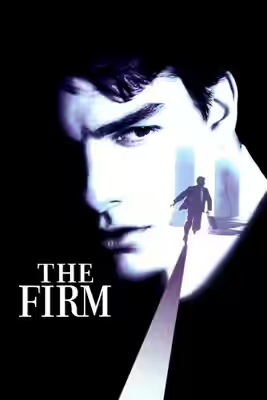
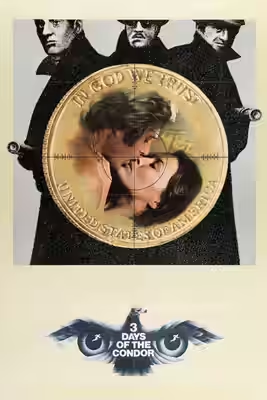
After The Pelican Brief, try All the President's Men (1976, Fi1m 90): Pakula’s own reporters-in-a-newsroom thriller, where the dread lives in the architecture. Then The Firm (1993, Fi1m 71): The other Grisham film of its year, slicker, sillier and better paced; and Three Days of the Condor (1975, Fi1m 80): Robert Redford reads books for the CIA and comes back from lunch to find everyone dead.

Cast

If you liked this, try…

  1. All the President's Men (1976, Fi1m 90)Pakula’s own reporters-in-a-newsroom thriller, where the dread lives in the architecture.

  2. The Firm (1993, Fi1m 71)The other Grisham film of its year, slicker, sillier and better paced.

  3. Three Days of the Condor (1975, Fi1m 80)Robert Redford reads books for the CIA and comes back from lunch to find everyone dead.

  4. Z (1969, Fi1m 84)Costa-Gavras on a political assassination and the lies told afterwards, at a sprint.

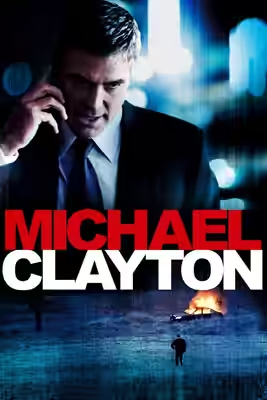
  5. Michael Clayton (2007, Fi1m 86)A law firm, a cover-up and George Clooney at his most tired; grown-up and unhurried.

Free account

Know what to watch tonight

Two lists that know where things are streaming, collections you can share, your own score beside ours, and Discover that remembers what you have seen.

  • Want to see, sorted by what is streaming now
  • Seen, with your score out of ten
  • No adverts, ever