Wojciech Has’s three-hour film is a set of stories folded inside other stories, played straight and shot beautifully. It is funny, strange and long, and it loses us for a stretch in the middle, but it is a film we would send people to.
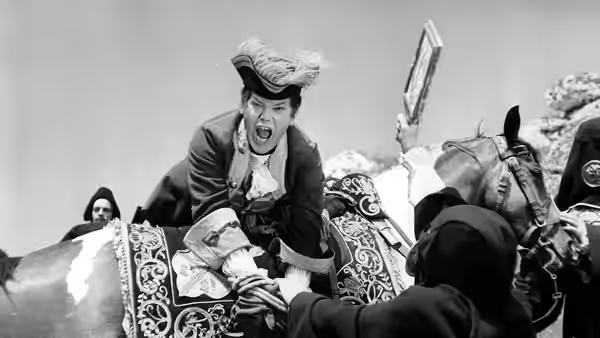
Wojciech Has opens with the siege of Saragossa. Two officers on opposite sides take cover in the same empty house, find a large illustrated book, and sit down together to read it while the guns go on outside. The book tells of Alfonse Van Worden, a captain of the Walloon Guard who wants to reach Madrid by the shortest road, through the mountains, and will not hear that they are haunted. From there the film runs 183 minutes, in black and white, and by our count is at one point six stories deep. It is built almost entirely out of people sitting down to tell each other things, and it is the most enjoyable film of that kind we know.
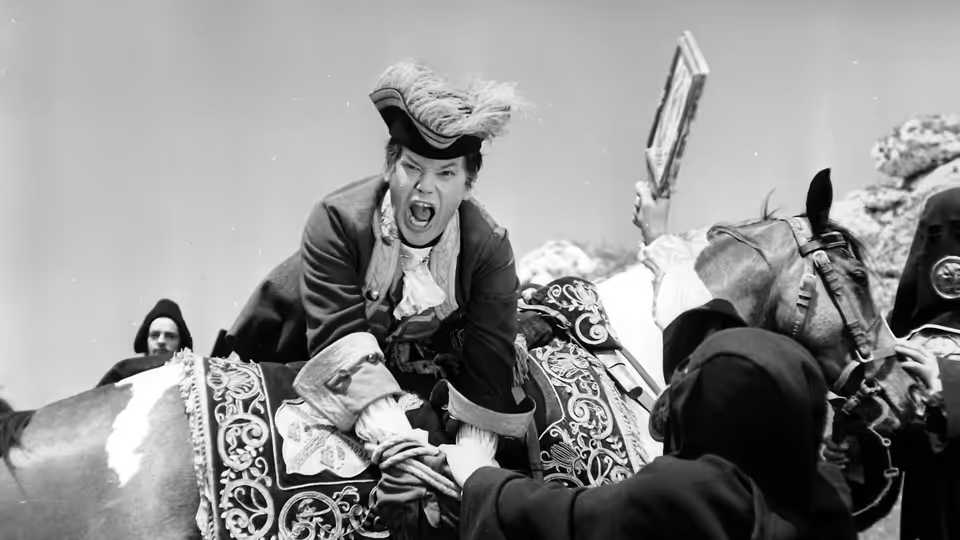
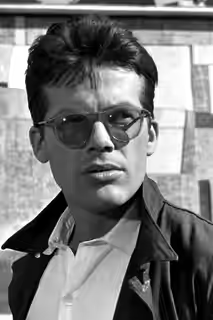
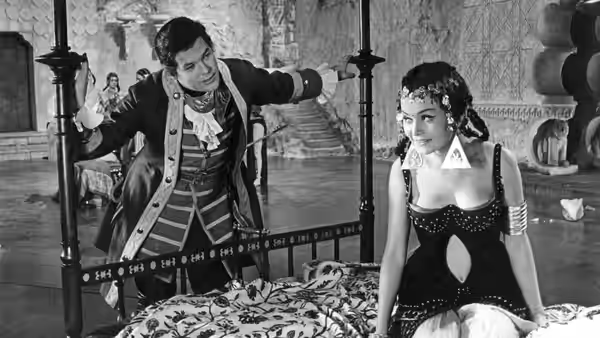
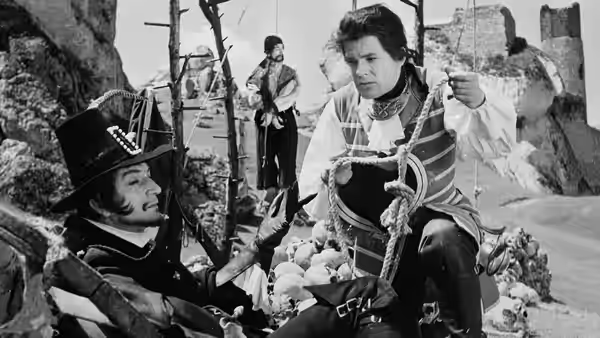
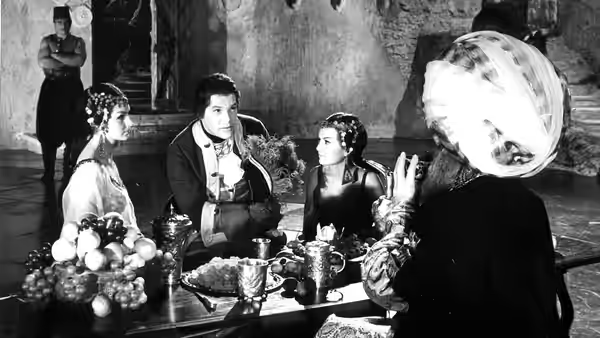
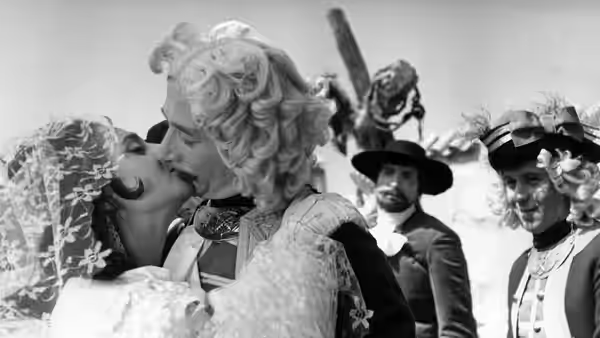
Zbigniew Cybulski plays Van Worden with a stiff, slightly baffled dignity. His father (Sławomir Lindner) has drilled him in honour and duels, and he spends the film trying to behave like a brave man while the world declines to behave like a world. At the inn of Venta Quemada two princesses, Emina (Iga Cembrzyńska) and Zibelda (Joanna Jędryka), feed him, call him cousin and hand him a skull to drink from. He wakes under a gallows next to two hanged men. He rides on, meets a hermit, and it happens again. Cybulski is funniest when he is most composed, straightening his coat while a corpse slumps against him.
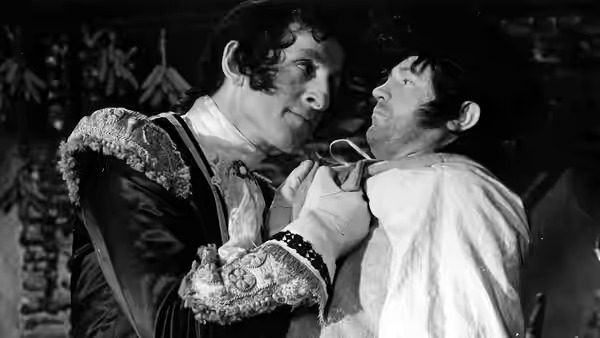
The second half moves to a castle where the guests tell stories over dinner, and each story contains a story. Don Pedro Velasquez (Gustaw Holoubek), a mathematician, tries to draw the whole thing as a diagram and gives up. Camilla de Tormez (Barbara Krafftówna), Donna Frasquetta Salero (Elżbieta Czyżewska), Senor Toledo (Bogumił Kobiela) and Don Lopez Soarez (Krzysztof Litwin) appear in tales that belong to other people and then walk into the tale we thought we were in. Tadeusz Kwiatkowski’s screenplay, from Jan Potocki’s novel, does not tidy any of this. It keeps the nesting, and trusts us to remember whose voice we are hearing.
Mieczysław Jahoda shoots the mountains as white rock under a hard sun, with figures small against it, and the interiors in deep focus, so that a table of food, a skull and a man standing by the far wall are all sharp at once. The gallows is filmed from the same low angle each time it returns, which is why the joke keeps working. Tadeusz Myszorek and Jerzy Skarżyński fill the inn and the castle with objects that look owned rather than dressed: chess pieces, bottles, a bed with far too many hangings. Jerzy and Lidia Skarżyńska put Van Worden in a uniform that gets no dirtier however many times he wakes on the ground, which is its own small joke. Krzysztof Penderecki’s music is used sparingly, harpsichord fragments and low electronic hums, and it is at its best when it simply stops. Krystyna Komosińska cuts between levels of the story without a dissolve or a caption, and the film would be far less alive if she had softened it.
Here is what we felt. We laughed at the gallows the second time. The third time the laugh caught in our throat and turned into something nearer vertigo, because the film was plainly not going to explain the repetition, and we realised we no longer wanted it to. Later, deep in the second half, we were lost and tired, and we say so.
The tiredness has a location. The stretch of farce around Toledo, Soarez and the Salero household runs perhaps forty minutes, and for much of it we could not have said whose story we were inside, and did not much care. It is the one section where the nesting feels like a habit rather than a design. Then Has cuts back to Van Worden, still on his road, and the film snaps to attention again.
Cybulski had been the restless young man of Ashes and Diamonds (1958); here he is the still point that a whole mad structure turns around, and he is good enough that we never lost hold of him even when we had lost everything else. See it in one sitting, with an interval, and do not try to keep a map. It is not a film that rewards note-taking. It rewards giving in.