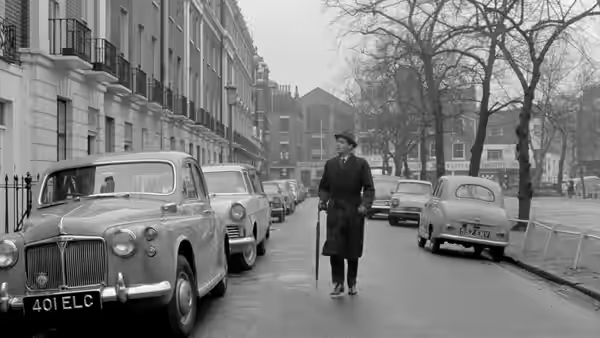
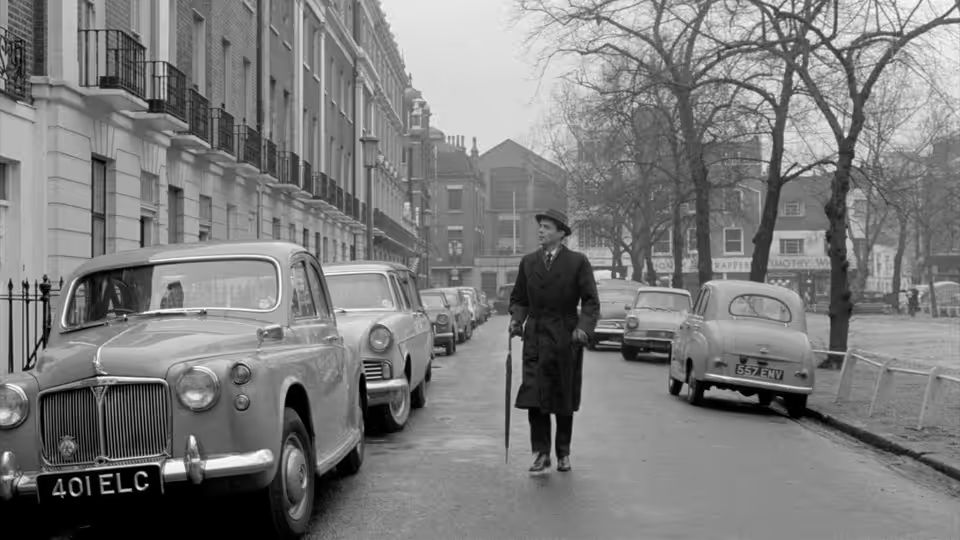
Hugo Barrett (Dirk Bogarde) walks along a London street between parked cars
Film review

The Servant

1963 · Directed by Joseph Losey · 1h 56m

In a sentenceThe staircase is the battlefield and the butler has the high ground

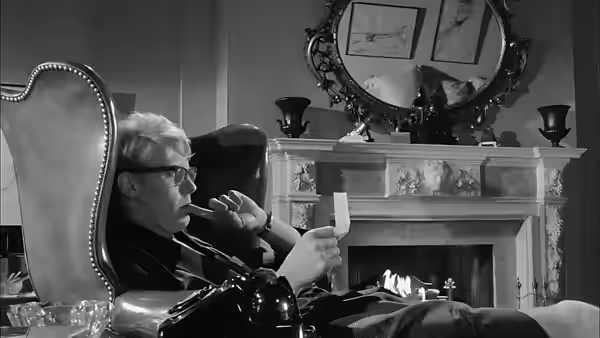
London, in winter. Tony (James Fox), a young man with money and no occupation to speak of, has bought a tall, empty house in Chelsea and needs someone to run it. Hugo Barrett (Dirk Bogarde) arrives for interview and finds his prospective employer asleep in a deckchair in the bare drawing room. Barrett is hired. He cooks, he chooses the paint, he knows where everything is. Tony’s girlfriend, Susan Stewart (Wendy Craig), dislikes him on sight and lets him know it. Tony, meanwhile, talks of a scheme to build cities in the Brazilian jungle and does nothing about it. Then Barrett asks whether his sister, Vera (Sarah Miles), might come to work as a maid, and she moves into the attic.

Plays from YouTube when you press play; nothing loads from them until then.

Fi1m review

Joseph Losey’s film about a young gentleman and the manservant who takes his house from him, room by room, is as cold and as good as its reputation. Only the last half hour, which turns the screw too hard, keeps us from the top mark.

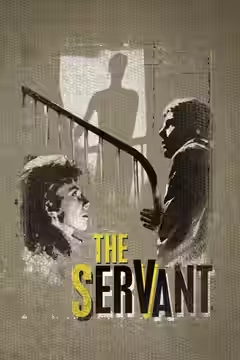
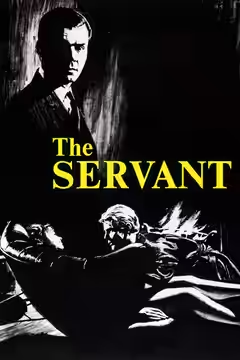
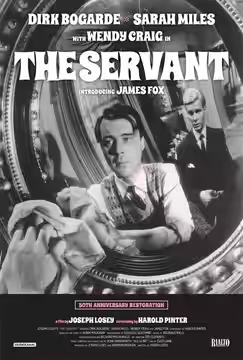
Joseph Losey made The Servant from a novel by Robin Maugham, with a screenplay by Harold Pinter, and the story fits in a sentence. Tony (James Fox), young, rich and idle, buys a house in Chelsea and hires a manservant, Hugo Barrett (Dirk Bogarde), who, without raising his voice or breaking a rule anyone could name, ends up in charge of it. The poster called it a terrifyingly beautiful motion picture and gave the phrase an exclamation mark. We do not usually take posters at their word. This one was close, and the film is as good as its reputation.

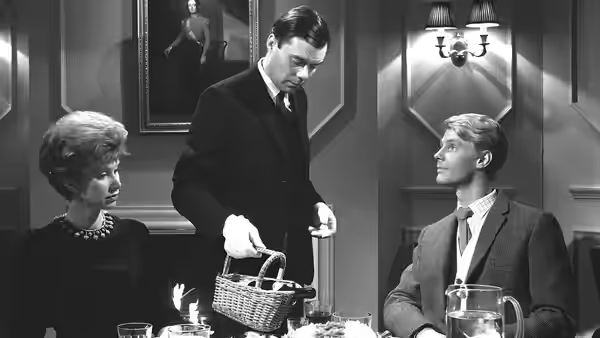
Bogarde is the reason to see it. Barrett arrives in a dark coat with a bowler in his hand, finds his new employer asleep in a deckchair in an empty room, and waits. For most of the first hour he plays at half volume: the “yes, sir”, the small bow, the eyes that stay a moment too long on the back of Tony’s head. Watch the scene in which Tony and Susan are on the sofa and Barrett keeps finding reasons to come in, with flowers, with the curtains, with a tray. Nothing he does could be complained of. That is the method, and Bogarde never winks at us about it.

Wendy Craig’s Susan is the only person who sees what is happening, and she has no words for it except rudeness. She asks Barrett whether he uses a deodorant. She is also right. James Fox has the harder job, because Tony has to be pleasant enough that we mind and hopeless enough that we believe it, and he plays him as an overgrown boy who wants looking after. His one plan is to build cities in the Brazilian jungle, which he explains over dinner to Catherine Lacey’s Lady Mounset, who would rather talk about ponchos, and Richard Vernon’s Lord Mounset, who would rather not talk at all. Tony agrees with everyone.

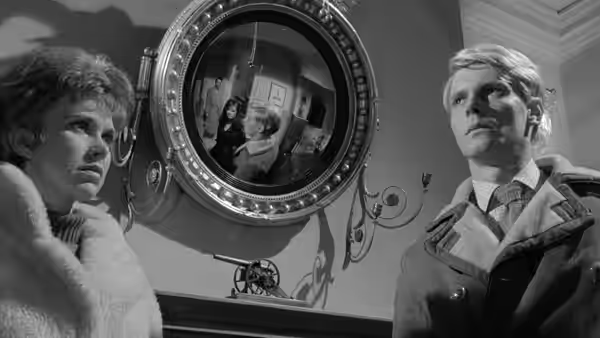
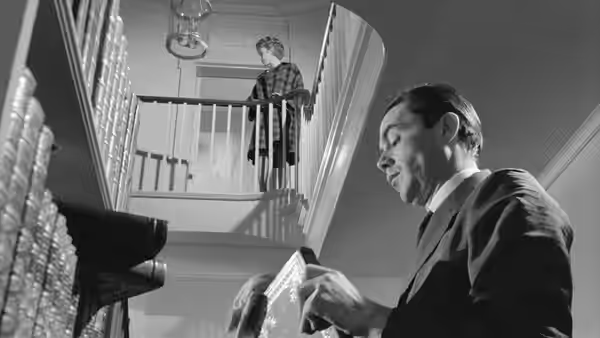
The house is the other lead. Richard Macdonald’s production design gives it a staircase that turns twice on the way up and a convex mirror in the hall that bends anyone standing near it, and Douglas Slocombe shoots the stairs from below so that whoever is on the landing has the advantage. Snow sits in the windows and the lamps light one face at a time. Reginald Mills lets scenes run past comfort in the first half, so that a pause at the foot of the stairs becomes a threat. John Dankworth’s score is cool jazz, with one song, a woman’s voice over piano, that Tony puts on the gramophone until we dreaded the needle going down. Beatrice Dawson keeps Barrett’s black jacket immaculate while Tony goes from suit to cardigan to dressing gown.

Then Barrett’s sister, Vera (Sarah Miles), arrives to be the maid, and the film has its best scene. Tony comes down to the kitchen late. Vera is at the sink, a tap is dripping, the radiator is up too high, and she says it is hot in here. Miles plays it with a blank appetite, and Fox sweats. We watched Tony cross that kitchen and wanted to shout at the screen, which we do not make a habit of. The tap did it: Losey holds on it, drip after drip, while a man’s life is rearranged for him.

The second half takes a turn we will not describe, and then another. What we can say is that the film’s tone, exact for most of its 116 minutes, goes broad at the end. The house fills with bored people lying about, Bogarde is allowed to slur and sprawl, and the camera roves as though the point had been made and only the volume needed raising. Most critics take this as the climax. We think it is where Losey stopped trusting the tray and the tap. There is also the question of what Barrett wants from Tony, which the film knows and will not say aloud. It could not, in 1963.

Losey made Accident and The Go-Between with Pinter afterwards, both quieter and more grown-up. Neither has a scene as frightening as a man asking whether he may draw the curtains. It is a 12 certificate. There is no blood in it. We came out feeling as though there had been.

Critical consensus AI synthesised

82
Positive
8
Mixed
2
Negative
0

The reviews lean firmly positive: eight of ten recommend the film and none dismiss it. Most critics describe it as a cold, unsettling study of class and power that has not softened with age, and the praise clusters around Dirk Bogarde’s performance as Barrett, which The Guardian ranks among his greatest. Douglas Slocombe’s black-and-white photography is the other recurring compliment, several reviews noting how the shadows and spaces of the house track who holds the upper hand. Harold Pinter’s dialogue and James Fox’s louche employer also draw approving mention.

The reservations are mild but real. Variety, reviewing on release, finds the atmosphere fades and the ending less convincing than what precedes it. Empire, decades later, admires the film but calls it a museum piece, its treatment of class and desire too deliberately inscrutable. Slant Magazine, otherwise a rave, flags a troubling portrayal of queerness. The spread of scores is wide, from the mid-fifties to full marks, though the warmest notices come from the restoration-era reviews.

Slant Magazine
22 July 2013 · ★★★★/4 · Matthew Connolly
100

Connolly regards the film as a thrilling, stylish masterwork while noting its troubling portrayal of queerness. He especially praises the cinematography and the way the mansion’s shadows and spaces convey shifting power.

Read the full review →
Time Out
17 August 2021 · ★★★★★ · Tom Huddleston
100

The review presents the restored film as an ice-cold British classic. It highlights the silent class warfare between Dirk Bogarde and James Fox.

Read the full review →
Los Angeles Times
29 August 2013 · Kenneth Turan
90*

Turan calls the film brilliantly icy and praises the restoration’s ability to preserve its disturbing study of class and power. He singles out Dirk Bogarde’s performance and Douglas Slocombe’s moody black-and-white cinematography for particular praise.

Read the full review →
The Guardian
10 September 2021 · Peter Bradshaw
90*

Bradshaw praises the film as a brilliant, subversive attack on the British class system. He particularly singles out Dirk Bogarde’s performance as one of his greatest.

Read the full review →
Evening Standard
22 March 2013 · The Standard
85*

The critic finds the film powerful in its day and still resonant. They single out its charged, claustrophobic filmmaking as hard to forget.

Read the full review →
The Independent
4 April 2013 · Ben Walsh
85*

The review finds the film still disturbing and powerful decades later. It singles out James Fox’s performance as exquisitely louche.

Read the full review →

Straight answers AI written, from our review

Is The Servant worth watching?
The Servant is worth watching, and we scored it 89. Dirk Bogarde's manservant takes a Chelsea house from its idle young owner without raising his voice, and the first hour is as cold and controlled as anything in British film. Only the last half hour, which turns the screw too hard, keeps it from our top mark.
How long is The Servant, and what is it rated?
The Servant runs 1h 56m. It is a drama film.
Where can I watch The Servant in Canada?
The Servant is not on any streaming or rental service in Canada at the moment. It is available in 9 other countries; change your country at the top of the page to see where. Availability is checked daily.
How violent or frightening is The Servant, and is it suitable for children?
The Servant is a UK 12 certificate with no blood in it, and its threat comes entirely from manners, pauses and a dripping tap. It is a slow, adult drama about class and control, with an undercurrent of sexual menace, so we would not recommend it for younger children. Teenagers who can sit through a quiet film will find it chilling.
How does The Servant compare to Parasite?
The Servant and Parasite both put a poor outsider inside a rich house and make a staircase mean everything, but the earlier film is the colder and quieter of the two. Bong Joon Ho's is funnier and more openly a thriller, with plotting that grips even when the music overstates. We think Losey's first hour is the more frightening; Bong's whole film is the more even.
Is The Servant based on a true story or a book?
The Servant is based on a novel by Robin Maugham, not on a true story, with a screenplay by Harold Pinter. You do not need to have read the book; the film's power lies in Bogarde's performance and in the house itself, neither of which depends on the source. Its story fits in a sentence, and the film does the rest.
What should I watch after The Servant?
After The Servant, try Parasite (2019, Fi1m 91): A poor family in a rich house, and a staircase that means everything. Then The Remains of the Day (1993, Fi1m 88): The other kind of butler: one who serves so completely he loses his life to it.

Cast

If you liked this, try…

  1. Accident (1967) · not on Fi1m yetLosey and Pinter again, among Oxford dons this time; quieter, and no kinder.

  2. The Housemaid (1960) · not on Fi1m yetKim Ki-young’s Korean melodrama about a maid who takes a household apart from the inside.

  3. Parasite (2019, Fi1m 91)A poor family in a rich house, and a staircase that means everything.

  4. Teorema (1968) · not on Fi1m yetPasolini sends a stranger into a Milanese family and lets him undo each of them.

  5. The Remains of the Day (1993, Fi1m 88)The other kind of butler: one who serves so completely he loses his life to it.