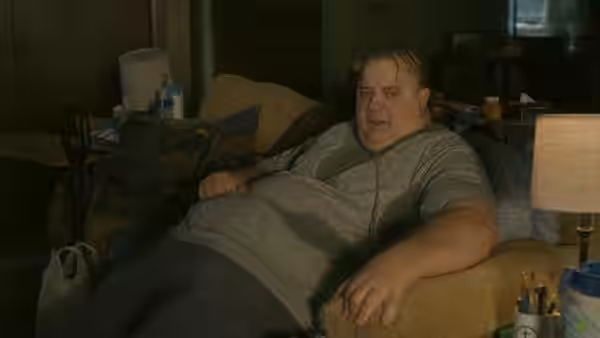
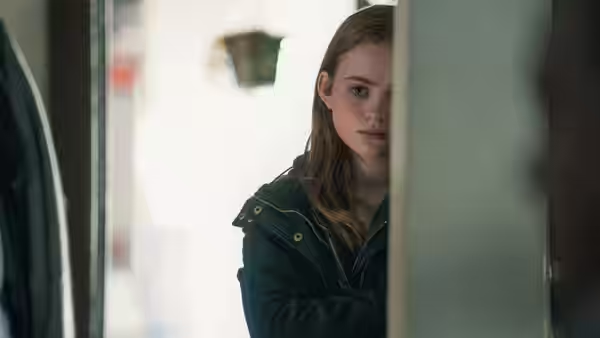
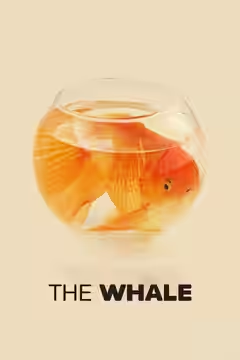
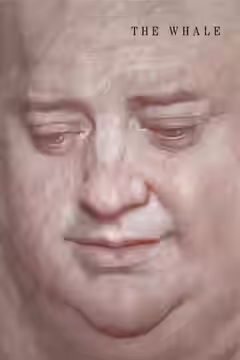
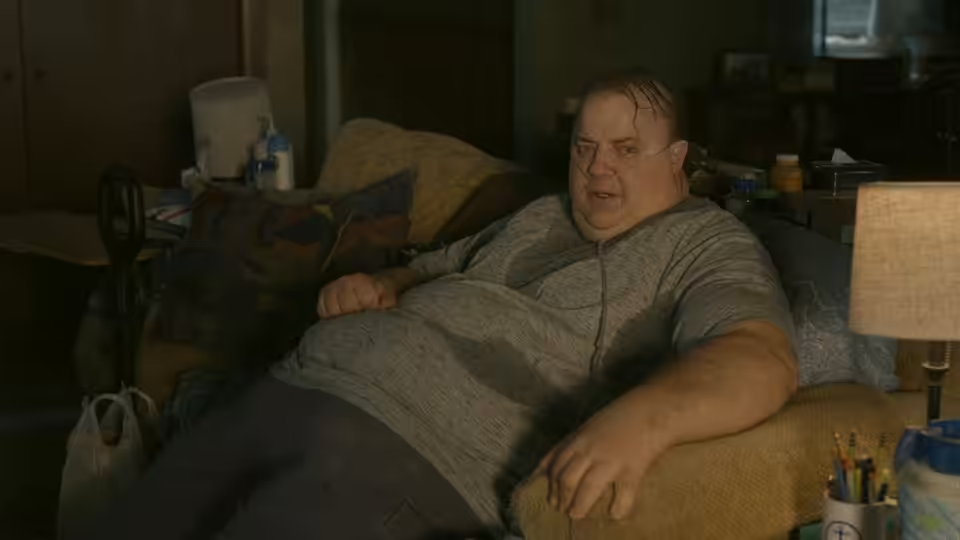
Charlie (Brendan Fraser) reclines on a couch in his cluttered apartment
Film review

The Whale

2022 · Directed by Darren Aronofsky · 1h 57m

In a sentenceEvery knock at the door is another speech, and the man on the sofa has to hear them all

Charlie (Brendan Fraser) teaches writing online with his camera switched off, is severely obese, and has not left his flat in years. When a chest pain nearly kills him, the person at the door is Thomas (Ty Simpkins), a young missionary who keeps coming back. Liz (Hong Chau), his nurse and only friend, tells him he is in heart failure and will be dead within the week unless he goes to hospital. He refuses. Instead he contacts his daughter Ellie (Sadie Sink), whom he has not seen since he left her mother Mary (Samantha Morton) years earlier, and offers her his savings to spend time with him. Dan (Sathya Sridharan) delivers pizza. Charlie keeps asking people to read him an essay about Moby-Dick.

Plays from YouTube when you press play; nothing loads from them until then.

Fi1m review

Brendan Fraser is tender and precise as a dying man in a flat, and Hong Chau is better still. Around them Darren Aronofsky has made a filmed play in which everyone shouts and the camera cannot stop staring at him.

Darren Aronofsky has spent his career on people wrecking their own bodies: the addicts of Requiem for a Dream, the wrestler, the ballerina. The Whale gives him his most literal case. Charlie (Brendan Fraser) is severely obese, teaches writing online with his camera switched off, and has been told by the one person who checks on him that his heart will give out within the week. Samuel D. Hunter has adapted his own stage play and the film keeps the play’s shape: one flat, a handful of visitors, a week of knocks at the door. It is sincere, it is often clumsy, and it has in Fraser and Hong Chau two performances better than the film around them.

Fraser works under prosthetics that cover him to the neck, so what he has left is the eyes, the voice and a breath that catches before he tries to stand. He plays Charlie as a man who apologises for existing and means it every time. When Ellie (Sadie Sink), the daughter he has not seen in years, tells him he is disgusting, he agrees with her mildly, and it is not a bid for pity; he thinks she is right. The performance is small, patient and kind, and the kindness is the film’s one real idea. Fraser carries it more or less alone, and he does most of it from the sofa.

Chau’s Liz, the nurse who brings a sandwich and a blood-pressure cuff in the same visit, is the only person in the flat who behaves as somebody would. Chau plays her as furious and practical, a woman who has watched this before and has stopped pretending otherwise. Whenever she leaves, the film gets louder and worse. Her scenes with Fraser have the rhythm of old friends who ran out of tactful things to say years ago.

The trouble is the writing. Hunter’s script has come from the stage with its habits intact, so everybody arrives with a position and states it. Thomas (Ty Simpkins), the young missionary, is there to be argued with about God. Ellie is written as a monster whose cruelty the film insists is honesty; Sink plays what is on the page and has nowhere else to go. Samantha Morton’s Mary, Charlie’s ex-wife, gets one scene late on, and it is the best-written stretch in the film, two people who hurt each other talking about it quietly over a drink. It moved us more than we expected, because for ten minutes nobody was making a speech. Then the door goes again.

Matthew Libatique shoots in a nearly square frame, so the flat is always cramped and Charlie fills most of it, and he keeps the light low and grey with rain on the windows for most of the week. Robert Pyzocha and Mark Friedberg fill the flat with the detail of a place nobody has left in years: takeaway boxes, a walking frame, a grab rail by the sofa, books in every corner. Danny Glicker keeps Charlie in the same grey sweatshirt all week and puts Thomas in a white shirt too clean for the flat. This is careful work, and Aronofsky undoes much of it whenever Charlie eats. He shoots the meals with the lurching close-ups and thudding sound he used for heroin in Requiem for a Dream, and we flinched, and then noticed that the flinch was what the shot was for. We felt got at, and not in a way we respected. The camera pushes in on his mouth and stays there.

Rob Simonsen’s score swells under each confession to tell us how to feel, as though the actors had not already done it. Andrew Weisblum cuts the middle hour patiently, which suits the play. We will not describe the ending. We will say that it reaches for something the previous hundred minutes had not earned, and that we sat through it dry-eyed and slightly embarrassed on the film’s behalf. The last minutes are cut and scored like a hymn, and Simonsen’s strings are at their loudest there.

The Wrestler (2008) let Mickey Rourke’s battered body make its own case while the camera kept a respectful distance. Here the camera cannot stay back, and the film is worse for it. See it for Fraser, who has waited a long time for a part like this and does not waste it, and for Chau, who is the one person on screen you would want at your bedside. It runs 117 minutes and carries a 15.

Critical consensus AI synthesised

57
Positive
11
Mixed
9
Negative
12

The critics split almost down the middle on The Whale, and the divide is sharp: the reviews run from raves to outright hostility, with the mixed verdicts barely outnumbered by either camp. What nearly everyone agrees on is Brendan Fraser. His performance as Charlie is called gentle, humane and heartbreaking by reviewers who otherwise cannot stand the film, and it is the reason several lukewarm notices still say it is worth seeing. Hong Chau, as Liz, is the other name that keeps recurring, credited with making the film feel human when the writing does not.

The reservations cluster around Darren Aronofsky’s handling of the material. Many find the film stage-bound, its dialogue theatrical and its score pushy. The deeper quarrel is over Charlie’s body: some critics read the film as compassionate, while Polygon and Slant argue that it treats fatness as a grotesque spectacle and calls it empathy. The warmest notices come from the trade papers at the festival; The Guardian is among the harshest.

The Hollywood Reporter
4 September 2022 · festival review · David Rooney
90*

Rooney finds the drama intensely affecting, grounded by its compassion and emotional honesty. He singles out Brendan Fraser’s deeply humane, heart-wrenching performance as its triumph.

Read the full review →
Radio Times
24 January 2023 · Alan Jones
85*

The review describes the film as an eloquent, powerful story of redemption. It singles out Brendan Fraser’s barnstorming performance for praise.

Read the full review →
The Independent
3 February 2023 · ★★★★ · Geoffrey Macnab
80

The critic finds the film stagy and mawkish but ultimately effective, despite its heavy-handed emotional manipulation. Brendan Fraser’s sad-eyed performance and the film’s big-heartedness are singled out for appeal.

Read the full review →
Time Out
11 October 2022 · ★★★★ · Dan Jolin
80

The review is strongly positive, calling the drama heartfelt. It singles out Brendan Fraser’s performance as the film’s defining strength.

Read the full review →
Total Film
4 September 2022 · ★★★★ · Jane Crowther
80

Crowther finds the film emotionally powerful and unusually compassionate, despite some concerns about its simplifications and manipulative score. She singles out Brendan Fraser’s moving performance as the film’s great strength.

Read the full review →
Vulture
5 September 2022 · festival review · Bilge Ebiri
75*

Ebiri finds the film tonally muddled at first but ultimately moving and honest. He especially praises Brendan Fraser’s compassionate, seemingly perfect fit for the lead role.

Read the full review →

Straight answers AI written, from our review

Is The Whale worth watching?
The Whale is worth watching for Brendan Fraser and Hong Chau, and not for much else, and we scored it 54. Samuel D. Hunter's script arrives from the stage with every visitor making a speech, and Darren Aronofsky films Charlie's meals like a heroin binge. Fraser is tender and precise from the sofa; the film around him is loud and clumsy.
How long is The Whale, and what is it rated?
The Whale runs 1h 57m. It is a drama film.
Where can I watch The Whale in Malaysia?
The Whale is not on any streaming or rental service in Malaysia at the moment. It is available in 34 other countries; change your country at the top of the page to see where. Availability is checked daily.
How violent or frightening is The Whale, and is it suitable for children?
The Whale is a 15 in the UK and an R in the US, and it contains no violence to speak of. What earns the certificate is the subject matter: a severely obese man in heart failure, filmed eating in lurching close-up, and a daughter who tells him he is disgusting. It is not for children, and the squeamish will flinch at the meals.
How does The Whale compare to The Wrestler?
The Wrestler is the better film, and The Whale is Aronofsky telling much the same story with a camera that cannot leave the man alone. Both centre on a wrecked body and an estranged daughter, but Mickey Rourke's film keeps a respectful distance and lets the body make its own case. Fraser is as good as Rourke; the writing and the direction around him are not.
What should I watch after The Whale?
After The Whale, try The Wrestler (2008, Fi1m 85): Aronofsky doing the same story with a steadier camera and a body that speaks for itself. Then Ikiru (1952, Fi1m 92): Kurosawa’s dying clerk finds one thing worth doing; no speeches, all the more moving for it; and Amour (2012, Fi1m 88): Haneke shuts two old people in a Paris flat and never once looks away or flinches.

Cast

If you liked this, try…

  1. The Wrestler (2008, Fi1m 85)Aronofsky doing the same story with a steadier camera and a body that speaks for itself.

  2. Ikiru (1952, Fi1m 92)Kurosawa’s dying clerk finds one thing worth doing; no speeches, all the more moving for it.

  3. Amour (2012, Fi1m 88)Haneke shuts two old people in a Paris flat and never once looks away or flinches.

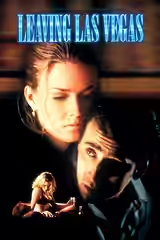
  4. Leaving Las Vegas (1995, Fi1m 82)A man drinking himself to death, and a film that lets him without moralising.

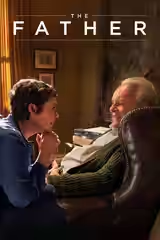
  5. The Father (2020, Fi1m 89)Another play turned film about a failing body in a flat, and it solves the staging problem.