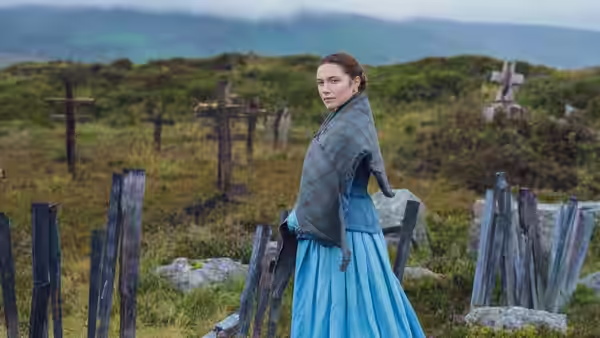
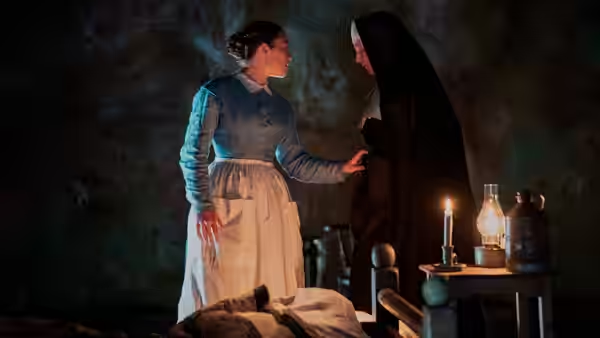
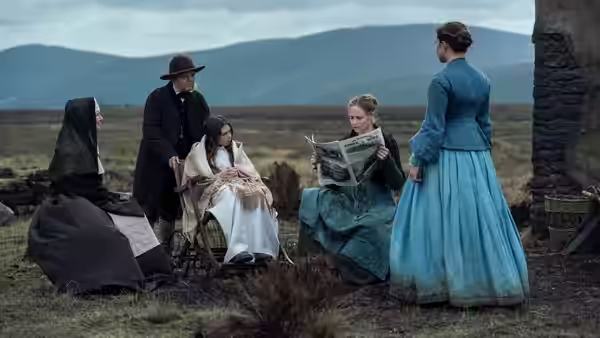
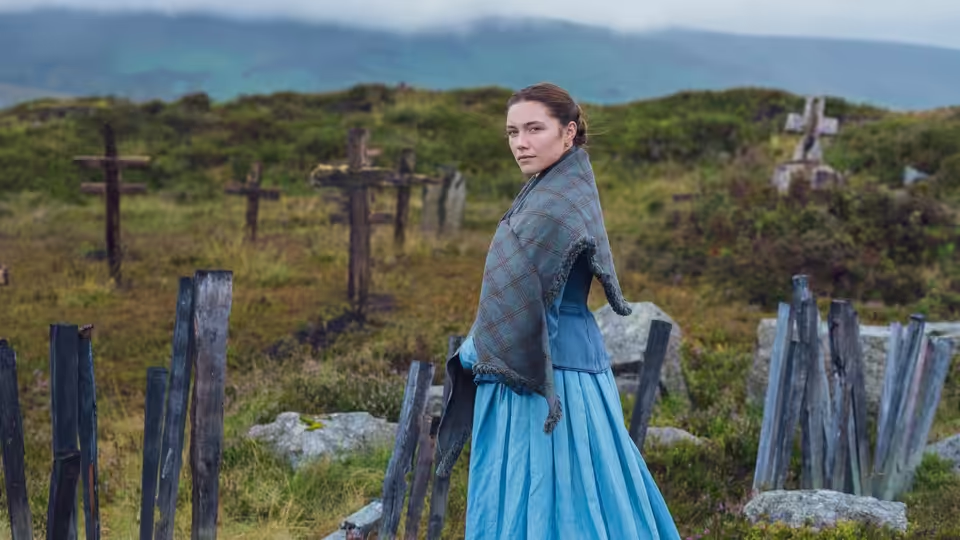
Lib Wright (Florence Pugh) looks back among weathered gravestones on a hillside
Film review

The Wonder

2022 · Directed by Sebastián Lelio · 1h 48m

In a sentenceA nurse, a nun, a fasting girl and a narrator who keeps reminding us it is only a film

The Irish Midlands, 1862, thirteen years after the famine. Lib Wright (Florence Pugh), an English nurse who served in the Crimea, is hired by a committee of village men, among them the doctor, McBrearty (Toby Jones), and the priest, Father Thaddeus (Ciarán Hinds), to watch an eleven-year-old girl, Anna O’Donnell (Kíla Lord Cassidy), who says she has not eaten in four months and lives on manna from heaven. Lib is to observe and report, not to feed or treat, sharing shifts with a nun, Sister Michael (Josie Walker). Anna’s parents, Rosaleen (Elaine Cassidy) and Malachy (Caolan Byrne), admit pilgrims to the cottage; a London journalist, Will Byrne (Tom Burke), arrives to expose a fraud. Lib wants to find out how the child is being fed. The village wants a miracle.

Plays from YouTube when you press play; nothing loads from them until then.

Fi1m review

Sebastián Lelio’s adaptation of Emma Donoghue’s novel is beautifully shot and anchored by Florence Pugh. It is also wrapped in a framing device that keeps tapping us on the shoulder, and the last half hour gives away much of what the first hour built.

The film opens not in Ireland but on a soundstage: scaffolding, lamps, plywood, and a woman’s voice (Niamh Algar) telling us that this is a film called The Wonder and that its people believe their stories completely. Then the camera finds a ship’s hold and a woman eating her dinner. It is a bold way in, and it tells you what Sebastián Lelio thinks his film is about: not whether a girl is eating but why a village needs her not to be. It is also a mistake.

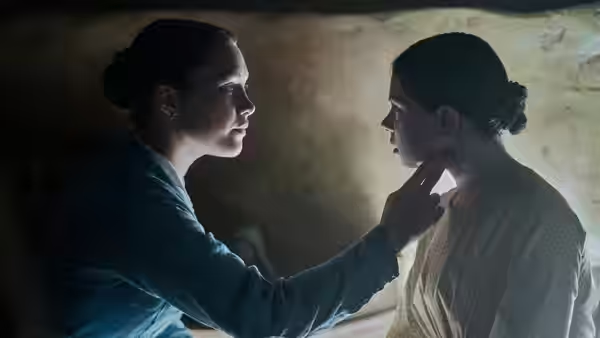
What follows for an hour is fine, cold, patient storytelling. It is 1862, the Irish Midlands, thirteen years after the famine, and Lib Wright (Florence Pugh), an English nurse, is hired to watch an eleven-year-old, Anna O’Donnell (Kíla Lord Cassidy), who says she has not eaten in four months. Pugh plays Lib with her chin set and her eyes doing the work. She trusts what she can measure, and Pugh shows how much of that is armour: alone at the inn she counts out drops of laudanum, pricks her finger with a needle, and eats. Cassidy is uncanny without effort, a child who recites her prayers as if they were a comfort nobody else in the house has.

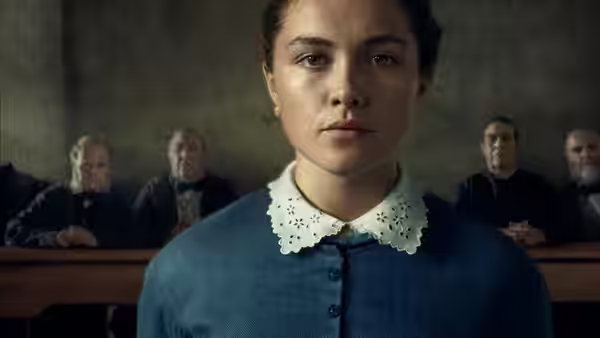
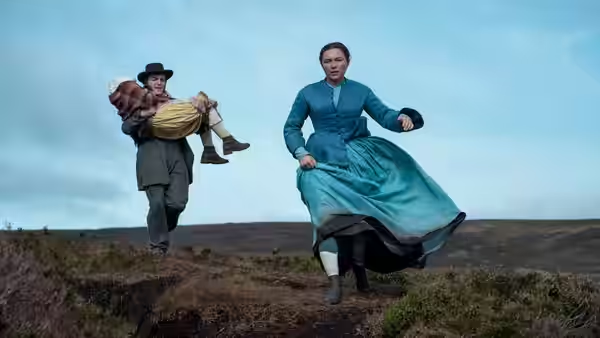
Ari Wegner shoots the bog and the sky in one flat, greenish grey, so that Lib’s deep blue dress is the only strong colour in the county. Grant Montgomery gives the O’Donnell cottage low ceilings and one small window, and the committee a long table with the men ranged along one side. Matthew Herbert’s score is mostly voices, breath and hums and a wordless choir that does not sound like church music, and it unsettles more than any image. Kristina Hetherington cuts the watching slowly and the meals sharply.

Around the two women, Lelio, Donoghue and Alice Birch have arranged a village. Toby Jones’s doctor wants the girl to be a scientific marvel and Ciarán Hinds’s priest wants her to be a saint, and neither will say so. Elaine Cassidy, as Anna’s mother Rosaleen, is the hardest figure to read, a woman whose love for her daughter and her faith in God look the same from outside. Tom Burke plays the journalist Will Byrne rumpled, clever and a little too pleased with both. Josie Walker’s Sister Michael takes the other shift and says almost nothing.

For most of that first hour we were properly gripped. We watched Anna as Lib watched her: the bedclothes, the mother’s kiss, the hands. Later, when Lib draws a conclusion and acts on it, the consequence is shown on Anna’s face and body, and Cassidy’s work in those scenes is the best thing in the film. It frightened us. The evidence arrives, and then the question is what a decent person does with it.

Then the framing device comes back. The film pauses more than once to remind us that we are watching a story, and each time the stillness it has worked for drains away. What was meant to say that everyone in this village lives inside a story reads instead as hedging, as if Lelio did not trust the plain version to carry the weight. The last half hour, which we will not describe, settles the mystery and the moral problem together, and we said, oh come on. The critics who have called it preposterous have a case; we would put it at convenient.

Two smaller caveats. The famine is present as a fact and an ache, but the film is not much interested in who caused it, and an English nurse arriving to talk sense to the Irish is a shape some viewers will find harder to swallow than the film realises. At 108 minutes it counts the days, and there are more days than there is incident.

It is worth your evening if Pugh is your reason, and she should be; this and Lady Macbeth (2016) are her best work. Watch it at home with the lights off, where Herbert’s voices come close and the soundstage matters less. Do not expect a wonder. Expect a good hour of watching, and then an argument.

Critical consensus AI synthesised

65
Positive
11
Mixed
7
Negative
5

Most critics come down on the film’s side, though not by a wide margin: eleven positive notices against seven mixed and five negative. The praise gathers almost entirely around Florence Pugh, whose performance is described as commanding and layered even by reviewers who dislike the film around her. Ari Wegner’s misty Irish landscapes and the eerie score are the next most frequent compliments, and several critics single out Kíla Lord Cassidy as Anna.

The reservations are about the storytelling. The self-conscious framing device draws complaints from admirers and detractors alike, and a number of reviews find the middle stretch slow or repetitive and the ideas about faith thinner than they first appear. The spread is wide, running from strong recommendations to rejection. Variety judges the resolution preposterous and says it mishandles the film’s central ethical conflict, while Paste objects that the portrayal of the Irish is callous and leaves out British responsibility for the famine.

The Hollywood Reporter
3 September 2022 · festival review · Stephen Farber
90*

Farber finds the film illuminating and powerful, with Florence Pugh’s performance as its chief strength. He also praises the dark-tinged cinematography and eerie score, while noting some supporting roles feel underwritten.

Read the full review →
The Guardian
14 September 2022 · festival review · Benjamin Lee
85*

The critic finds the film a persuasive, involving drama, despite an ineffective framing device. Florence Pugh’s commanding performance is singled out as its central strength.

Read the full review →
The AV Club
2 November 2022 · B+ · Jack Smart
83

The review finds the film atmospheric and compelling, praising Sebastián Lelio’s handling of its mystery without sacrificing ambiguity. It particularly singles out Florence Pugh’s mesmerizing performance and the film’s striking visuals and music.

Read the full review →
Evening Standard
2 November 2022 · ★★★★ · Charlotte O'Sullivan
80

O'Sullivan finds the film tense and compelling, with its cast and bold direction outweighing screenplay flaws. She especially praises Florence Pugh's performance and the atmospheric cinematography and score.

Read the full review →
Little White Lies
2 November 2022 · 3/4/3 · Lillian Crawford
80

The review finds the film compelling in its performances and setting, but says its self-conscious framing undermines the story. It praises Florence Pugh and Kíla Lord Cassidy’s performances and Ari Wegner’s misty Irish landscapes.

Read the full review →
Radio Times
★★★★ · Molly Moss
80

The review praises the film as an eerie period drama about the dangers of blind faith. It singles out Florence Pugh’s mesmerising performance as the film’s anchor.

Read the full review →

Straight answers AI written, from our review

Is The Wonder worth watching?
The Wonder is worth watching for Florence Pugh's performance and a strong, cold first hour, and we scored it 63. Sebastián Lelio's adaptation of Emma Donoghue's novel is handsomely made, but a framing device keeps reminding us it is only a film and the last half hour settles the mystery too conveniently. Watch it for Pugh, not for the answer.
How long is The Wonder, and what is it rated?
The Wonder runs 1h 48m. It is a drama and mystery film.
Where can I watch The Wonder in Spain?
The Wonder is streaming on Netflix in Spain. Availability is checked daily; the links above go straight to each service.
How violent or frightening is The Wonder, and is it suitable for children?
The Wonder has no UK certificate and is rated R in America, and it is a slow period drama rather than a violent or gory one. The unease comes from watching a child who says she has not eaten, a nurse dosing herself with laudanum, and a wordless choral score; one late stretch showing the girl's decline frightened us. It is not for young children, and teenagers may find the pace harder going than the content.
How does The Wonder compare to Ordet?
The Wonder and Ordet both ask a household to believe in a miracle, but Carl Theodor Dreyer plays his farmhouse story completely straight while Sebastián Lelio keeps interrupting his to remind us we are watching a film. Dreyer's is the finer and more unnerving work, though its long, formal speeches ask more patience. Choose The Wonder for Florence Pugh and a brisker mystery; choose Ordet if you can settle into slowness.
Is The Wonder based on a true story or a book?
The Wonder is based on a novel by Emma Donoghue, who also worked on the screenplay with Sebastián Lelio and Alice Birch. It is a self-contained mystery about an English nurse hired to watch a fasting girl in the Irish Midlands in 1862, and you do not need to have read the book to follow it. Our review does not judge how closely the film follows the page.
What should I watch after The Wonder?
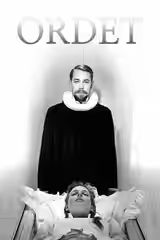
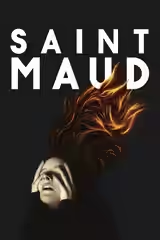
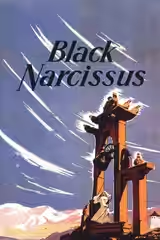
After The Wonder, try Ordet (1955, Fi1m 86): Dreyer’s farmhouse miracle, played completely straight, and all the more unnerving for it. Then Saint Maud (2019, Fi1m 82): A nurse, a patient and a faith that will not be argued with; ninety brisk minutes; and Black Narcissus (1947, Fi1m 88): Nuns in the mountains, colour that burns, and belief coming apart at altitude.

Cast

If you liked this, try…

  1. Ordet (1955, Fi1m 86)Dreyer’s farmhouse miracle, played completely straight, and all the more unnerving for it.

  2. Saint Maud (2019, Fi1m 82)A nurse, a patient and a faith that will not be argued with; ninety brisk minutes.

  3. Black Narcissus (1947, Fi1m 88)Nuns in the mountains, colour that burns, and belief coming apart at altitude.

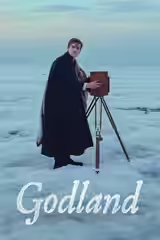
  4. Godland (2022, Fi1m 84)A Danish priest walks across Iceland and the landscape wins; patient, cold and beautiful.

  5. Gloria (2013) · not on Fi1m yetLelio before the period costumes: one woman, watched closely, without a framing device in sight.

The Wonder (2022) review: Pugh carries a handsome drama that hedges (Spain) | Fi1m