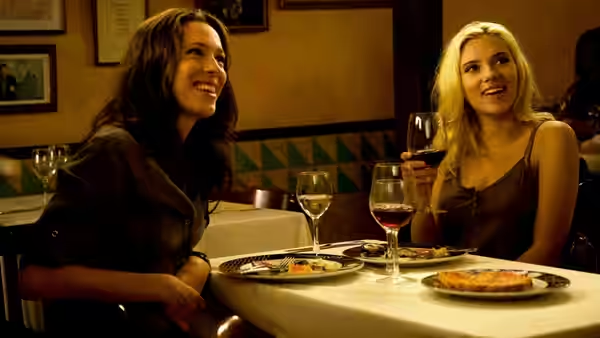
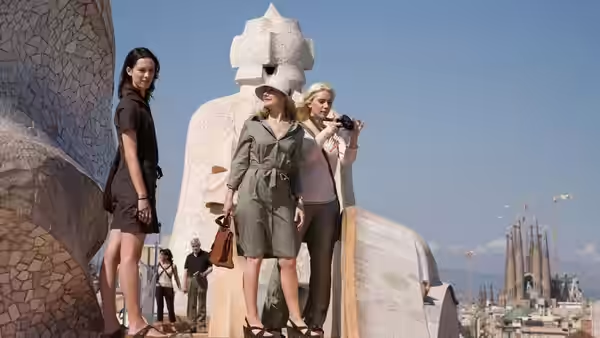
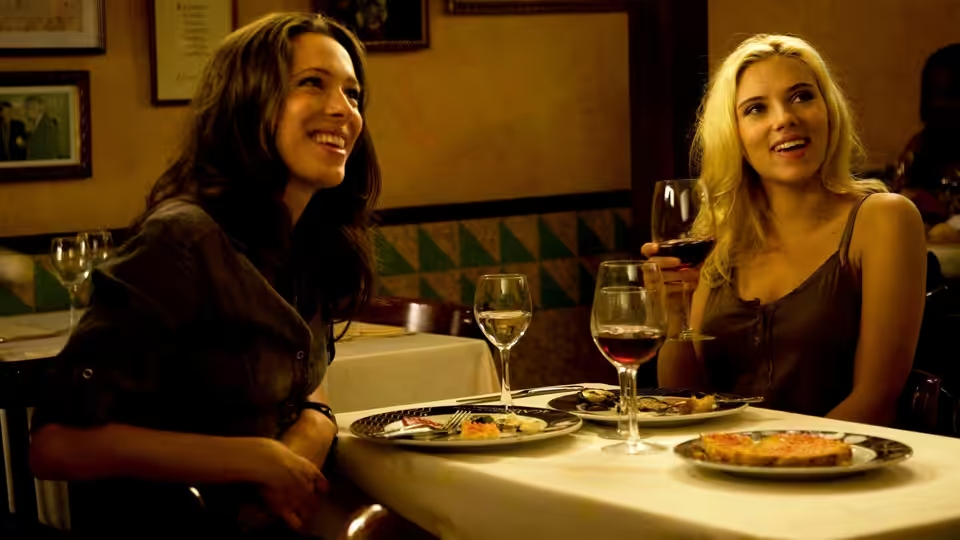
Cristina (Scarlett Johansson) and Vicky (Rebecca Hall) share dinner at a restaurant
Film review

Vicky Cristina Barcelona

2008 · Directed by Woody Allen · 1h 36m · Medietilsynet 12

In a sentencePenélope Cruz turns up halfway through and the film finally stops describing itself

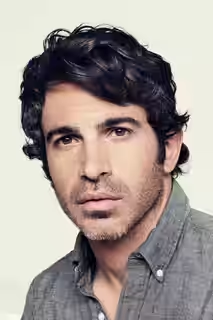
Barcelona, one summer. Vicky (Rebecca Hall) and Cristina (Scarlett Johansson) arrive to stay with Judy and Mark Nash (Patricia Clarkson and Kevin Dunn), distant relations of Vicky’s with a large flat and a quiet marriage. Vicky is finishing a master’s thesis on Catalan identity and is engaged to Doug (Chris Messina), who telephones from New York. Cristina has just made a short film she hates and wants something she cannot name. At a gallery opening Judy points out Juan Antonio Gonzalo (Javier Bardem), a painter whose marriage is said to have ended with a knife. Later he crosses a restaurant to invite both women to Oviedo for the weekend: sightseeing, good food and, he hopes, bed. Cristina says yes at once. Vicky goes to keep an eye on her.

Plays from YouTube when you press play; nothing loads from them until then.

Fi1m review

Woody Allen’s Spanish holiday is pleasant, sunlit and a little lazy, a film that tells us its characters’ feelings in voiceover rather than staging them. Then Penélope Cruz walks in, shouting, and for half an hour it is properly alive.

Two young American women land in Barcelona for the summer. Vicky (Rebecca Hall) is engaged, orderly and writing a thesis on Catalan identity; Cristina (Scarlett Johansson) has just finished a short film she despises and wants something she cannot put a name to. A painter, Juan Antonio Gonzalo (Javier Bardem), crosses a restaurant to invite them both to Oviedo for the weekend, to see the sights, eat well and, he hopes, share a bed. Woody Allen’s film is about what each woman does with that invitation. The consensus is that it is a pleasant, sunlit, slightly lazy 96 minutes that comes alive when Penélope Cruz is on screen and coasts when she is not.

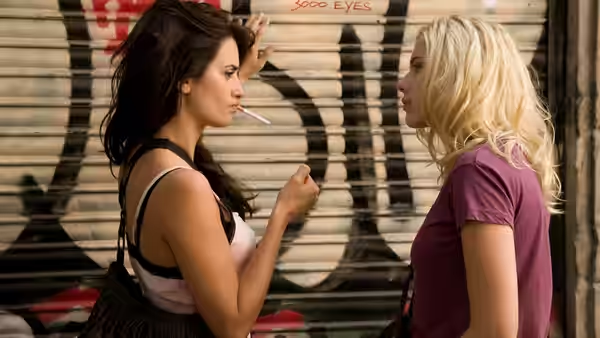
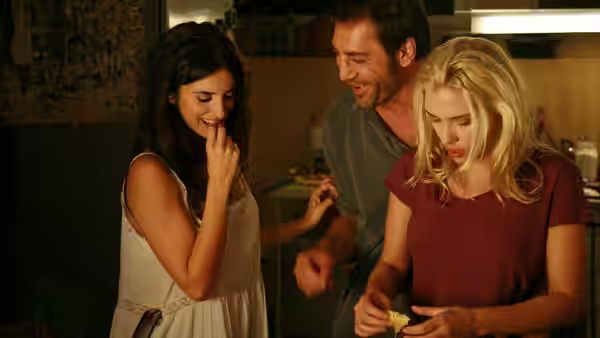
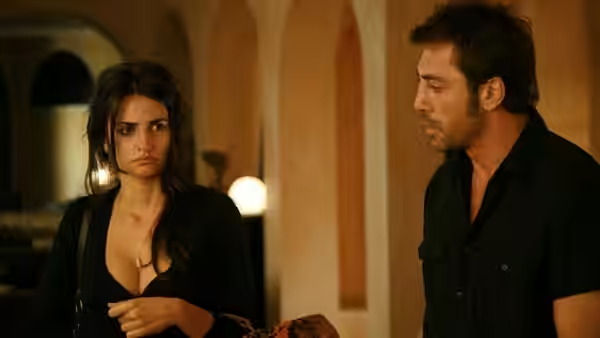
Bardem plays Juan Antonio as a man who has decided that saying exactly what he wants is a form of good manners, and he makes his proposal in the voice most men use to order wine. His ex-wife María Elena (Cruz) is spoken of long before she is seen, and a knife is usually part of the story. When she arrives, dropped into his house in the middle of the night and furious in two languages, we sat up. We had settled into the film as something warm to have on; from that scene we were awake, and we stayed awake. Cruz plays contempt and adoration in the same breath, switches into English mid-sentence whenever she wants to be understood, and pays Johansson compliments that are plainly meant to wound.

Hall is the best of the Americans. Vicky is written as the sensible one, and Hall shows a woman arguing with herself and losing, in small movements of the jaw while Juan Antonio talks and she pretends not to listen. Johansson has the harder job and less to work with. Cristina is defined entirely by what she does not want, and the script never gives her wanting a shape, so she spends the film looking lovely and waiting for something to happen to her. Chris Messina’s Doug, the fiancé, is a punchline in golf clothes. Patricia Clarkson, as the hostess Judy Nash, gets one good scene about her own marriage and plays it with more regret than the film knows what to do with.

Javier Aguirresarobe shoots Barcelona in amber, as if it were always the last hour before dinner. The Gaudí facades glow and the city looks like the brochure Vicky is pretending to study. Alain Bainée gives Juan Antonio a house of stacked canvases, paint-crusted tables and a kitchen big enough to fight in. Sonia Grande puts Cristina in loose cotton that keeps sliding off one shoulder, Vicky in things with belts and buttons, and María Elena in a man’s shirt with paint down the front. Alisa Lepselter cuts it brisk, each scene ending on its line, so the film never sits still long enough to be dull.

Then there is the narrator. Christopher Evan Welch reads Allen’s prose in a flat, faintly amused voice, and he tells us everything: that Vicky was troubled, that Cristina was unsatisfied, that the weeks went by. Hall has already shown us Vicky is troubled; the voice arrives a second later to confirm it. We were irritated, and then the irritation turned into suspicion, because the narration is also doing the work of scenes Allen did not want to write. A month of a love affair passes in voiceover over shots of bicycles. The hard conversation, the one where somebody has to say something difficult to a face, is summarised and skipped.

The film’s ideas about love are all said aloud. Juan Antonio’s father refuses to publish his poems because the world does not deserve them; Cristina explains that she knows only what she does not want. And the women are types, the sensible one, the restless one and the mad one, arranged around a man who is never asked to change. After a run of films in London, Allen is funnier here than he has been for some time, and the sun agrees with him. It is still a long way from Annie Hall (1977), where the neurosis was his own and the jokes drew blood.

Watch it on a summer evening with a bottle open and the windows up. It will give you ninety minutes of good company, one great performance and a couple of ideas you have already had yourself. Ask it for more and the narrator will explain, at length, why you should not have.

Critical consensus AI synthesised

67
Positive
14
Mixed
3
Negative
4

Most critics call this a return to form for Woody Allen, and most stop short of calling it one of his best. Fourteen of the twenty-one reviews are positive, and the praise goes mostly to the cast. Penélope Cruz is named in review after review as the film’s sharpest presence, Javier Bardem is credited with the charm the story depends on, and several critics enjoy Rebecca Hall as a fresh outlet for Allen’s neuroses. The Barcelona locations and the film’s frankness about sex come up nearly as often.

The spread is wide, from warm approval to outright rejection. The recurring complaint is the voiceover narration, which Variety and Total Film both find intrusive. The Guardian finds the whole thing slack and repetitive, the Los Angeles Times thinks the writing thin, and Slant Magazine goes furthest, calling the film’s treatment of its women reductive and condescending. Even the dissenters tend to exempt Cruz and Bardem from their complaints.

Empire
29 January 2008 · Ian Freer
85*

Freer considers the film Allen’s strongest work in recent years, praising its lively performances and spirited take on love. He singles out Penélope Cruz’s magnetic performance and the beautiful Barcelona locations.

Read the full review →
The AV Club
14 August 2008 · B+ · Scott Tobias
83

Tobias finds the film witty, ambiguous, and unaccountably romantic, despite its sadness and doubt. He praises the chemistry among the writing, cast, and Barcelona, while noting Javier Bardem’s charisma as essential to the role.

Read the full review →
Radio Times
★★★★ · Susannah Straughan
80

The critic says Woody Allen rediscovers his sense of humour in a warm, witty, surprisingly sexy comedy. She praises its humour and lively romantic entanglements.

Read the full review →
Time Out
3 February 2009 · ★★★★ · Dave Calhoun
80

The review presents the film as a funny, lusty return to form for Woody Allen. It singles out the film’s comedy and sensuality as reasons for fans to feel relieved.

Read the full review →
Total Film
9 February 2009 · ★★★★ · Total Film
80

The review calls the film a welcome return to form for Woody Allen, though not quite at the level of his best work. It praises the story’s careful judgment and the standout performances by Javier Bardem and Penélope Cruz, while faulting the excessive voiceover narration.

Read the full review →
Evening Standard
10 April 2012
75*

The critic finds the film silly but splendidly entertaining and a welcome return to form. Cruz and Hall’s performances are singled out for praise, alongside the colourful views and clever screenplay.

Read the full review →

Straight answers AI written, from our review

Is Vicky Cristina Barcelona worth watching?
Vicky Cristina Barcelona is worth watching as a warm, sunlit and slightly lazy comedy of romance, and we scored it 70. Penélope Cruz, as the painter's furious ex-wife, gives one great performance and wakes the film up for half an hour; the rest coasts on Barcelona and a narrator who explains what the actors have already shown. Best on a summer evening with a bottle open.
How long is Vicky Cristina Barcelona, and what is it rated?
Vicky Cristina Barcelona runs 1h 36m and is rated 12 by the Medietilsynet in Norway. It is a drama and romance film.
Where can I watch Vicky Cristina Barcelona in Norway?
Vicky Cristina Barcelona is not on any streaming or rental service in Norway at the moment. It is available in 18 other countries; change your country at the top of the page to see where. Availability is checked daily.
How violent or frightening is Vicky Cristina Barcelona, and is it suitable for children?
Vicky Cristina Barcelona is a UK 12 with almost no violence and nothing to frighten anyone; its adult content is talk of sex and the affairs themselves, mostly implied rather than shown. A knife figures in a marriage described in gossip, not on screen. It suits teenagers and grown-ups; younger children would be bored rather than upset.
How does Vicky Cristina Barcelona compare to Jules and Jim?
Vicky Cristina Barcelona is the lighter and lazier of the two, while Jules and Jim takes the same triangle and follows it all the way down. Allen summarises the hard conversations in voiceover; Truffaut stages them, and his film grows up in its second half where Allen's stays on holiday. Allen's is the easier evening, Truffaut's the better film.
What should I watch after Vicky Cristina Barcelona?
After Vicky Cristina Barcelona, try Jules et Jim (1962, Fi1m 88): Truffaut’s triangle, with the nerve to follow the arrangement all the way down. Then Y tu mamá también (2001, Fi1m 87): Two friends, a road trip and an older woman who understands them better than they do; and Volver (2006, Fi1m 84): Cruz at full power for Almodóvar, in a film built to hold her.

Cast

Awards

Academy Awards, 2009

Won
Best Supporting Actress

Gaudí a la millor actriu secundària, 2009

Won
Gaudí a la millor actriu secundària

Gaudí Award for Best Actor in a Leading Role, 2009

Nominated
Gaudí Award for Best Actor in a Leading Role

Gaudí Award for Best Cinematography, 2009

Nominated
Gaudí Award for Best Cinematography

Gaudí Award for Best Original Score, 2009

Won
Gaudí Award for Best Original Score

Gaudí Award for Best Sound, 2009

Nominated
Gaudí Award for Best Sound

If you liked this, try…

  1. Jules et Jim (1962, Fi1m 88)Truffaut’s triangle, with the nerve to follow the arrangement all the way down.

  2. Y tu mamá también (2001, Fi1m 87)Two friends, a road trip and an older woman who understands them better than they do.

  3. Volver (2006, Fi1m 84)Cruz at full power for Almodóvar, in a film built to hold her.

  4. Before Sunrise (1995, Fi1m 89)Two strangers talk through a European night and nobody narrates over them.

  5. Manhattan (1979, Fi1m 78)Allen’s own city, in black and white, with the neurosis kept in-house.

Vicky Cristina Barcelona (2008) review: sunny, slight, lifted by Penél (Norway) | Fi1m