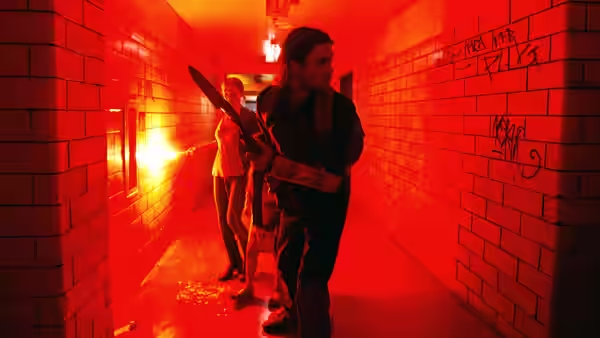
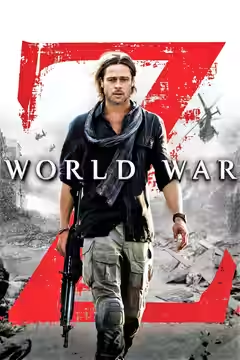
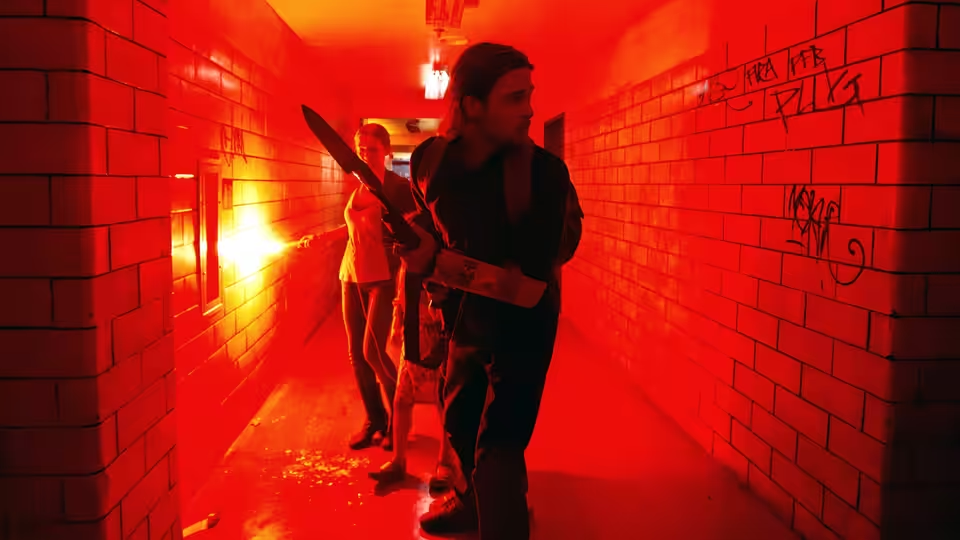
A man carrying a rifle leads a woman through a red-lit corridor
Film review

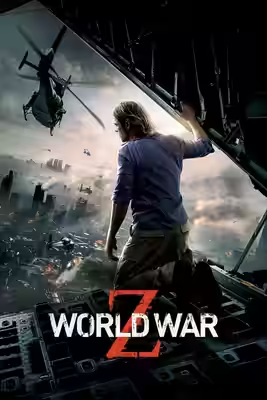
World War Z

2013 · Directed by Marc Forster · 1h 56m

In a sentenceThe zombies climb a wall like ants up a sugar bowl and the film never finds anything better to do with them

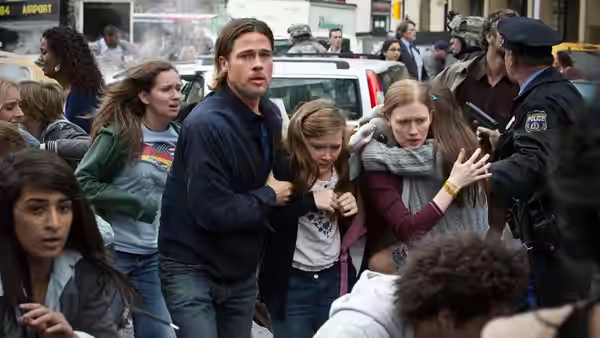
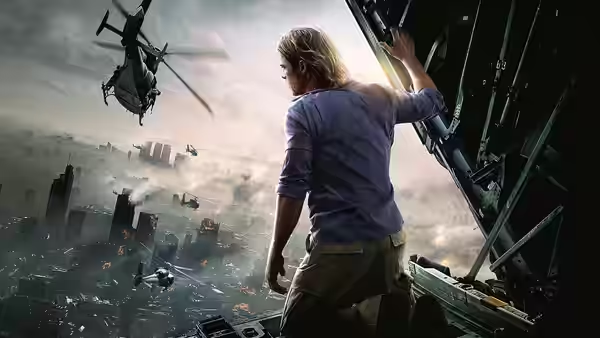
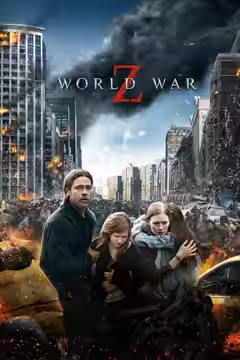
Philadelphia, a weekday morning. Gerry Lane (Brad Pitt), who used to investigate wars for the United Nations and now makes pancakes, is stuck in traffic with his wife Karen (Mireille Enos) and their daughters, one of them Constance (Sterling Jerins). Something comes through the gridlock at a run. Within minutes the city is biting itself, and Gerry counts twelve seconds between a bite and the bitten getting up again. The family is flown out to a navy ship, where Thierry Umutoni (Fana Mokoena) tells Gerry his family can stay aboard only if he goes back out to find where the outbreak began. He flies to South Korea with a young virologist, Andrew Fassbach (Elyes Gabel), and meets Captain Speke (James Badge Dale), who has learned that the dead are drawn to noise.

Plays from YouTube when you press play; nothing loads from them until then.

Fi1m review

Marc Forster’s zombie film is frightening for its first twenty minutes and impressive from the air for another twenty, and then it runs out of things to do with its enormous hordes. Brad Pitt keeps it watchable; nothing keeps it felt.

World War Z is a 116-minute attempt to do the zombie film at the scale of a disaster picture, with Brad Pitt flying from city to city as the world falls over behind him. Max Brooks’s novel was a set of interviews gathered after the war; the screenplay, credited to Matthew Michael Carnahan, Drew Goddard and Damon Lindelof, throws that away and gives us one man, one task and a clock. It is a fair trade in principle. Whether the film honours it depends on which half of it you are watching.

The first twenty minutes are the best thing here, and they frightened us. Marc Forster shoots the Philadelphia outbreak from inside a family car, so that for a long time we see only what Gerry Lane sees: a motorcycle policeman wrenching off a wing mirror, a lorry ploughing through the lane ahead, people running without knowing from what. Ben Seresin keeps the camera low and close, Roger Barton and Matt Chessé cut on movement rather than on faces, and Marco Beltrami’s score is mostly a low pulse under the sound of car alarms. When the first infected man hurls himself headfirst into a windscreen and begins to twitch, and Gerry starts counting under his breath, we were properly scared, which is not a thing this genre manages often any more.

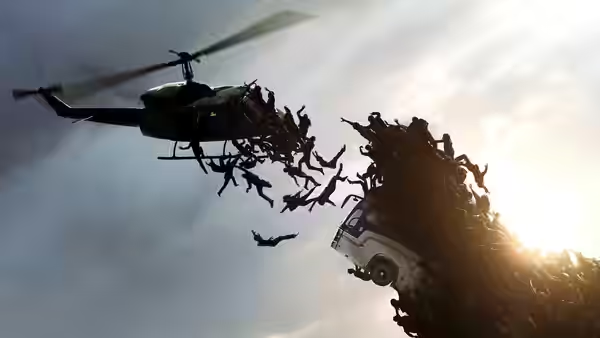
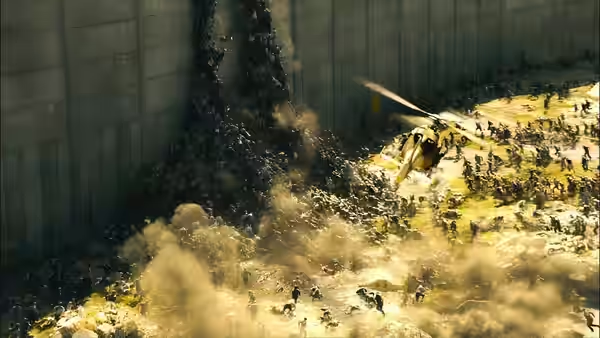
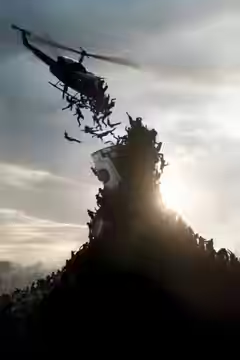
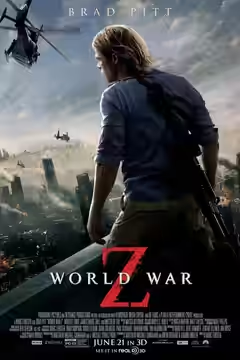
The film has one other image, and it has been in every trailer: the dead pouring against the walls of Jerusalem and climbing one another until the pile is high enough to spill over. Seen from a helicopter it is remarkable, a tide with elbows. Nigel Phelps’s production design gives the wall real weight and the streets below it real clutter, so the scale reads. Then the camera comes down to street level, the crowd becomes a blur of grey digital figures snapping their jaws, and the fear leaks out. Up close these zombies are not frightening. They are busy.

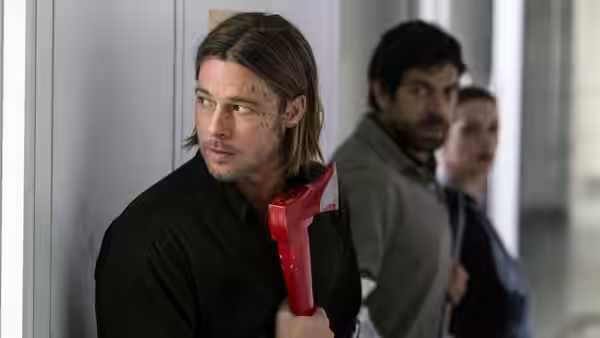
Pitt is doing something careful and it mostly works. He plays Gerry as a man who has seen bad places and learned to move through them quietly, taping magazines round his forearms before he goes out, listening before he opens a door. He never raises his voice. The problem is that the film gives him nothing to be other than competent, and competence does not change over two hours. Mireille Enos, as Karen, is handed a phone and a worried face and left on a ship. Daniella Kertesz, as the Israeli soldier Segen, gets the film’s one scene of real pain and makes it count in about four lines.

The middle sags, in South Korea especially. Forster stages a night-time refuelling on bicycles, in rain, with soldiers hissing at one another not to make a sound, and it ought to be unbearable. Instead it is murky and oddly short, and James Badge Dale’s Captain Speke, the liveliest person in the film, is gone almost as soon as we have placed him. David Morse turns up in a cell with no teeth and a conspiracy theory, delivers it well, and is not seen again.

The last half hour takes a turn we will not describe. What we can say is that it moves to a research facility, slows right down, and becomes a stealth sequence in corridors with Peter Capaldi and Pierfrancesco Favino as doctors watching on monitors. Seresin finally holds a shot. Barton and Chessé stop chopping. It is the most tense the film has been since Philadelphia, and it is tense because it is small, which is a strange lesson for a picture that has spent its money on crowds. We also noticed, in this stretch, how little blood there is. The 15 certificate is barely troubled; a film about billions of people being eaten manages to show almost nobody being eaten.

Most critics landed in the middle, and so do we, though we are a shade below the consensus because the two things that work are both over by the halfway mark. Against the genre’s own standards it is bigger than anything before it and scares less than most of them. Against Forster’s own films it is cleaner and more legible than Quantum of Solace, which is faint praise he has earned.

Worth an evening if a city-wide outbreak staged with real skill is enough for you; the opening is one of the better sequences of its kind. Watch it at home with the sound up for the first act, and expect to be checking the time by the time Pitt reaches the plane.

Critical consensus AI synthesised

54
Positive
6
Mixed
10
Negative
7

The reviews are mixed, leaning towards qualified disappointment rather than dislike. Where critics agree is on the spectacle. Most single out the set pieces: the Philadelphia outbreak that opens the film, the Jerusalem siege, and the aerial views of the undead piling up in their thousands. Several credit Marc Forster with staging these on a scale the zombie film has not seen before.

The reservations cluster on everything in between. The protagonist is thin, the family he is trying to get back to is barely sketched, and the cure plot never builds. The ending divides them: some find the laboratory finale the tensest stretch, others find it bloodless. The spread is wide. Variety and The New Yorker rate it a smart, gripping surprise, while The Guardian and the Evening Standard call it bloated and boring; the harshest notices come from the British papers.

The New Yorker
24 June 2013 · David Denby
85*

Denby calls it the most gratifying action spectacle in years, despite conventional passages and a soft ending. He praises its ability to restore genuine shock, especially in the chaotic Philadelphia outbreak and the digitally inventive Jerusalem sequence.

Read the full review →
Variety
4 June 2013 · Scott Foundas
85*

Foundas finds the film surprisingly smart, gripping, and imaginative. He praises Forster’s tense action and striking imagery, along with Brad Pitt’s grounded performance.

Read the full review →
IndieWire
18 June 2013 · B- · Eric Kohn
70

Kohn finds the film thoughtful but uneven, with its ideas often undercutting its momentum and horror. He praises the intense airplane showdown and final laboratory sequence for finally blending medical intrigue with suspense.

Read the full review →
Los Angeles Times
20 June 2013 · Kenneth Turan
70*

Turan finds the film familiar zombie fare, but says it is made with intelligence and skill. He singles out the unnerving, memorable swarming sequences and their visual centerpiece in Israel for praise.

Read the full review →
Empire
1 May 2011 · Nick de Semlyen
65*

The critic finds the film an effective but somewhat bland thrill ride. He praises its unnerving opening and vivid images, while wishing it showed more large-scale combat.

Read the full review →
The Hollywood Reporter
4 June 2013 · Todd McCarthy
65*

McCarthy finds the film an immersive, entertaining action spectacle, though its strong set pieces do not add up to a convincing story. He praises the Jerusalem siege for its scale and clarity, while faulting the adaptation for sacrificing the book’s broader political perspective.

Read the full review →

Straight answers AI written, from our review

Is World War Z worth watching?
World War Z is worth watching only for its first twenty minutes, a city-wide outbreak staged with real skill, and we scored it 55. After Philadelphia and one remarkable aerial shot of Jerusalem the film runs out of things to do with its hordes, and Brad Pitt's careful, quiet performance keeps it watchable without ever making it felt.
How long is World War Z, and what is it rated?
World War Z runs 1h 56m. It is an action and horror film.
Where can I watch World War Z in South Africa?
World War Z is available to rent from Apple TV from R34.99. Availability is checked daily; the links above go straight to each service.
How violent or frightening is World War Z, and is it suitable for children?
World War Z carries a UK 15 certificate but shows surprisingly little blood; a film about billions being eaten manages to show almost nobody being eaten. The fear is in the opening, with people running through gridlock and an infected man hurling himself into a windscreen, which is too intense for younger children, but teenagers used to the genre will find it tamer than most zombie films.
What should I watch after World War Z?
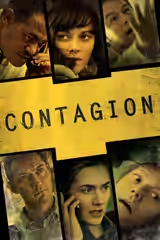
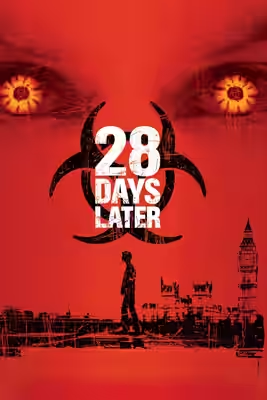
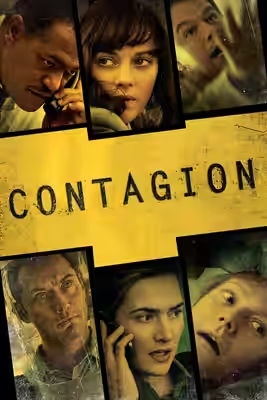
After World War Z, try 28 Days Later (2002, Fi1m 77): The running dead done on a fraction of the money, and far more frightening up close. Then Train to Busan (2016, Fi1m 84): One train, one father, one daughter; the swarm film that actually makes you care; and Contagion (2011, Fi1m 78): The epidemiologist’s version, no monsters, and a good deal more unsettling for it.

Cast

If you liked this, try…

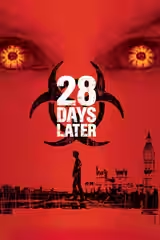
  1. 28 Days Later (2002, Fi1m 77)The running dead done on a fraction of the money, and far more frightening up close.

  2. Train to Busan (2016, Fi1m 84)One train, one father, one daughter; the swarm film that actually makes you care.

  3. Contagion (2011, Fi1m 78)The epidemiologist’s version, no monsters, and a good deal more unsettling for it.

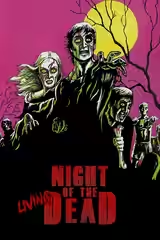
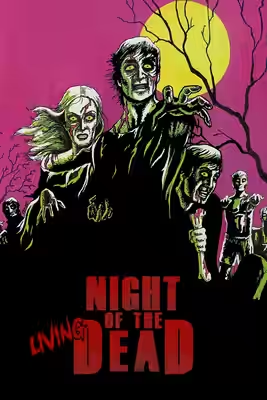
  4. Night of the Living Dead (1968, Fi1m 88)Where the rules came from, in a farmhouse, in black and white, in one night.

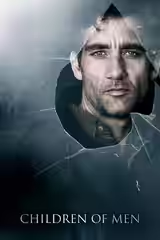
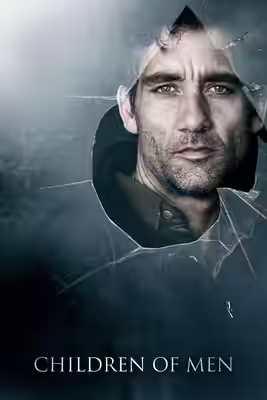
  5. Children of Men (2006, Fi1m 85)A world ending in long takes, with a reluctant man and a precious passenger.

Free account

Know what to watch tonight

Two lists that know where things are streaming, collections you can share, your own score beside ours, and Discover that remembers what you have seen.

  • Want to see, sorted by what is streaming now
  • Seen, with your score out of ten
  • No adverts, ever