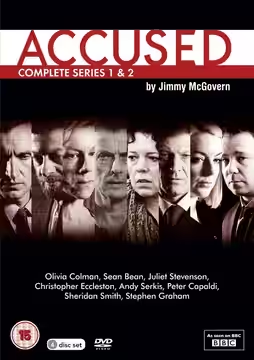
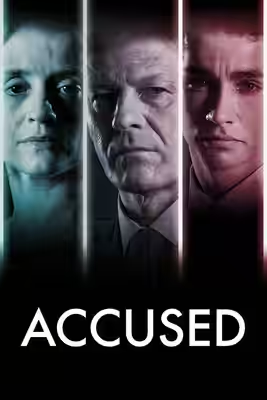
Jimmy McGovern’s anthology puts an ordinary person in the dock each week and winds the clock back to show how they got there. It is plain, humane and often hard to watch; it is also unrelentingly bleak, and ten hours of it is a lot.
The idea is simple enough to fit on a postcard. A person stands in a court. We do not know what they have done. The hour goes back to the start, follows them through the days that brought them here, and returns to the dock in time for the verdict. Jimmy McGovern, who created Accused and wrote on it, has built a whole series out of that shape, six episodes in the first run and four in the second, each a self-contained hour with its own cast. The question is never whodunit; it is whether, in their shoes, we would have done it too.
McGovern’s answer is nearly always yes, and that is the series at its best. His people are plumbers, soldiers, taxi drivers, parents, and the crimes grow out of money worries, bad luck and one wrong turn taken under pressure. Nobody is wicked. The writing, by McGovern with Carol Cullington, Shaun Duggan, Isabelle Grey, Alice Nutter, Danny Brocklehurst and Esther Wilson, is at its strongest when it stays small: a kitchen argument, a bill that cannot be paid, a joke in a barracks that lands wrong. The courtroom bookends are the weakest part, procedural and a little mechanical, as if the series knew the real drama was elsewhere and only came back to the dock out of duty.
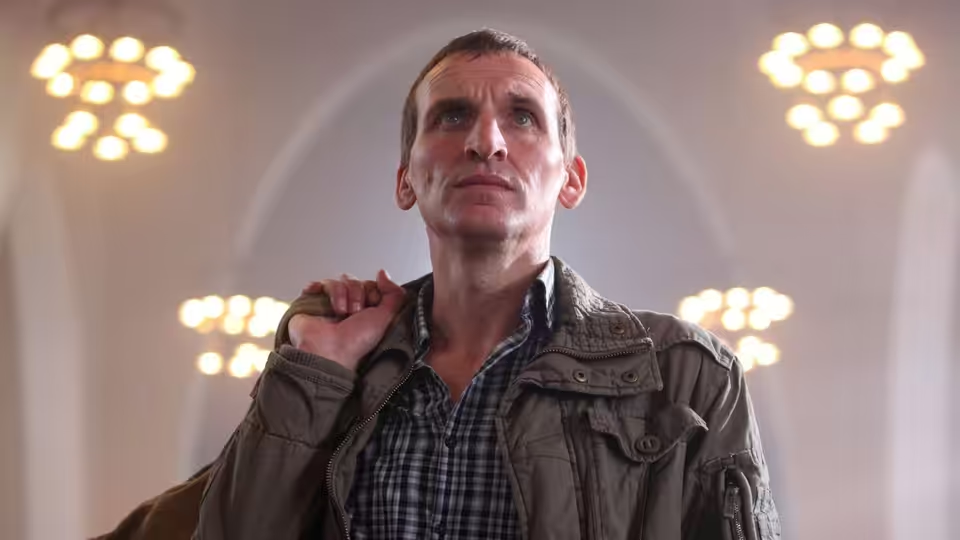
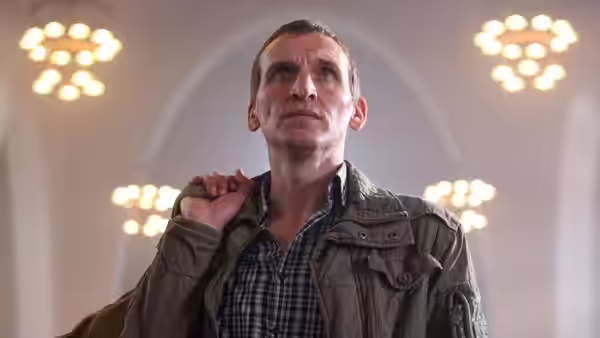
The casting is where it earns its evening. Stephen Graham, top billed as Tony Baines, does the thing he does better than almost anyone in British television, which is to let a hard face give way a fraction at a time until a frightened man is looking out of it. Marc Warren plays Kenny Armstrong with a fidgety charm that curdles the longer you watch. Mackenzie Crook, as Lance Corporal Alan Buckley, is cast against his usual gentleness and is the performance we have not been able to shake: he never raises his voice, and that is exactly why the young men around him are so afraid. Benjamin Smith’s Frankie Nash, Jodie Whittaker’s Emma Croft and Andrea Lowe’s Donna Armstrong are all good, and none of them is asked to be likeable, which helps.
We will say plainly what it did to us. Halfway through one hour, with a character we had been told from the first scene would end in that dock, we found we were leaning forward and silently urging a grown man not to go out of the door, knowing full well he would. When he went, we felt sick. McGovern does that by withholding nothing about the outcome and everything about the route, so that the dread is in the ordinary details: a phone not answered, a lift accepted, a lie that seemed kind at the time.
Fabian Wagner shoots it close and without decoration. The light is flat, the rooms are the rooms people actually live in, and the courts are dull municipal boxes rather than theatres of justice. David Blair, Richard Laxton and Ashley Pearce direct, and the hours are consistent enough that we could not have told you where one hand stopped and another began, which in an anthology is a compliment. There is no showing off anywhere. The camera watches faces and waits.
The flaw is the one the series cannot fix without becoming something else. It is relentless. Every hour is a descent, every verdict is a blow, and after three in a row the sameness of the shape starts to show through: the opening in court, the long slide, the return. Lightness, when it comes, is a joke in a pub before the worst happens. McGovern has always been more interested in how people break than in how they cope, and ten hours of breaking is more than most living rooms can take at a sitting.
Set against McGovern’s own work it is leaner than Cracker and less varied than The Street, and closer to a sermon than either. The sermon is a good one. Watch it an episode at a time, with a gap between them, and not late at night. The second series, which arrived on 14 August 2012, runs to four hours and is, if anything, harder.