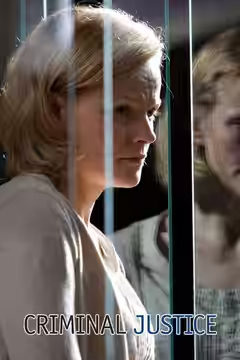
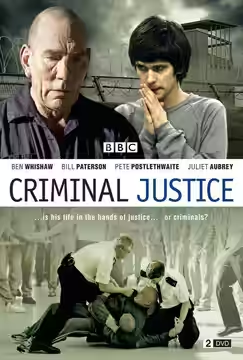
Peter Moffat’s five-part drama follows one young man from a police interview room to a remand cell and shows, with rare patience, how a system built to find the truth settles for a story instead. Ben Whishaw is remarkable; the prison strand pushes its luck.
Peter Moffat has written a five-hour drama about a single case, from the night of the killing to the end of the trial, and he has resisted almost every temptation that comes with the form. There is no team of brilliant detectives, no cross-cutting between cases, no villain who twirls anything. There is a boy, a dead woman, and a machine that starts turning the moment the handcuffs go on. It is one of the best British television dramas we know, and the reason is that nobody in it is doing anything wrong by their own lights.
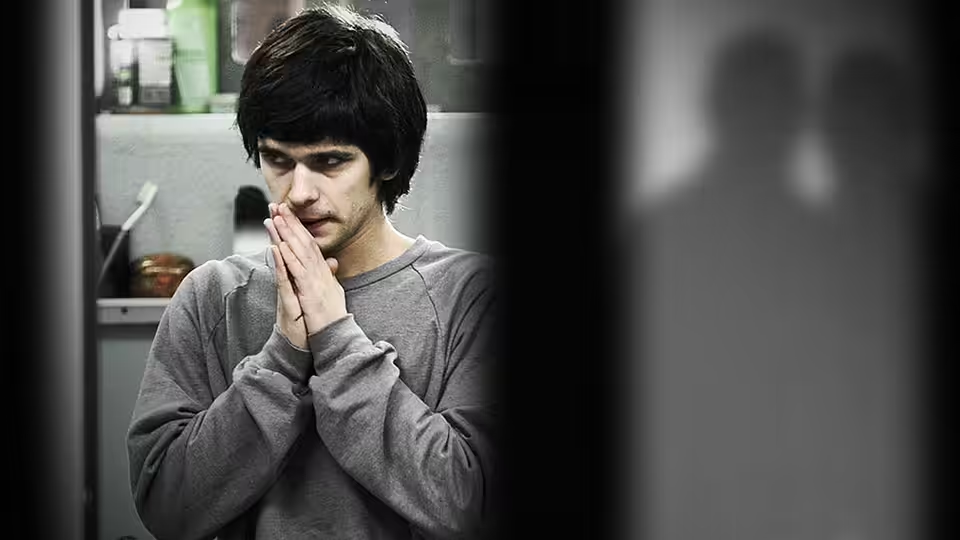
Ben Whishaw plays Ben Coulter as someone who does not know what happened either. He was in the house, he was drunk and drugged, he woke with a knife in front of him, and when Harry Box asks him a plain question his face does the work of a man searching an empty room. Whishaw hardly raises his voice across five episodes. He flinches, swallows, looks at the floor, and the series watches the police and the lawyers read those flinches as evidence. By the second hour we had stopped asking whether he did it and started asking what it would take for anyone to believe him if he had not.
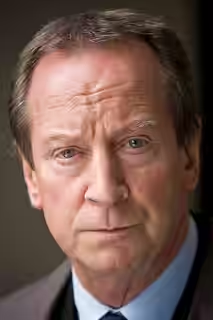
Bill Paterson is the quiet triumph. Box is tired, patient, courteous to the boy’s mother, and his job is to build a case. Paterson never plays him as a bully. He plays him as a man who has seen a hundred boys say nothing and knows what that usually means, and the horror of the series is that he is nearly always right. Lindsay Duncan’s Alison Slaughter is brisk, expensive and faintly bored, and Duncan lets us see that the boredom is a professional tool. Juliet Aubrey, as Mary Coulter, spends most of her screen time in corridors and waiting rooms, and she makes a mother’s uselessness in the face of procedure into something we could hardly bear to watch.
The photography is shared between Tat Radcliffe, Nic Knowland and Eric Maddison, and it holds to one idea: the light gets worse the further Ben travels into the system. The opening night is orange streetlamp and black water; the custody suite is flat fluorescent; the wing, as built by Cristina Casali and Will Hughes-Jones, is painted the colour of old teeth and shot on long lenses so that other men are always too close in the background. Dan Jones and John Lunn’s music is a few held notes under the interviews, and it stops when a door closes. Ian Farr, Chris Wyatt, Sarah Brewerton and St. John O’Rorke cut the interrogations without the usual reaction shots, so we are left looking at Ben’s face for exactly as long as Box is.
The moment that got at us is small and comes early. Ben climbs the stairs in the dead woman’s house, the camera stays behind him and does not cut, and we knew what was in the bedroom before he did. We were frightened for him in a way we are rarely frightened for anyone on television, and we stayed frightened for five hours.
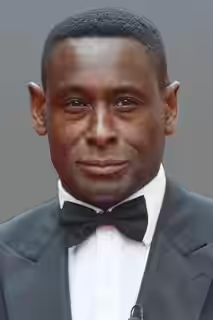
It does not all work. The prison strand, with Pete Postlethwaite’s Hooch as a self-appointed guardian and David Harewood’s Freddie Graham running the wing, drifts towards melodrama in the middle episodes. Postlethwaite is as good as ever, but the plotting around him asks us to accept a drugs economy and a protection racket that feel imported from a rougher programme. The trial is scrupulous about procedure and a little slow for it; two of the courtroom hours could have been one and a half. These faults cost the series some of our trust. They do not undo it.
A second run of five episodes followed on 5 October 2009, with a new case and Maxine Peake and Matthew Macfadyen in the leads. On the evidence of the first, Moffat was right to think the form could carry more than one story.
Watch it one episode an evening, over a week. Taken in a single sitting the prison episodes bunch up and the faults show. Spaced out, you get what we got: a week of being unsure whether a boy you have come to like did a terrible thing, and of noticing how quickly everyone around him stopped wondering.