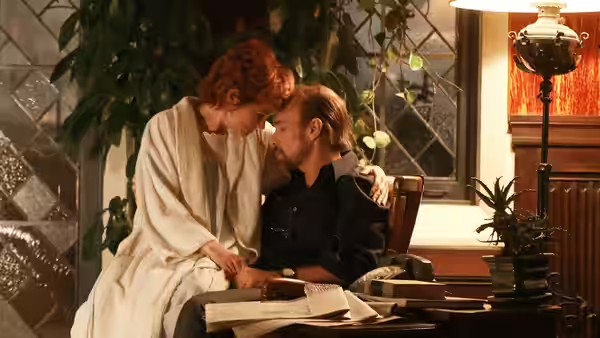
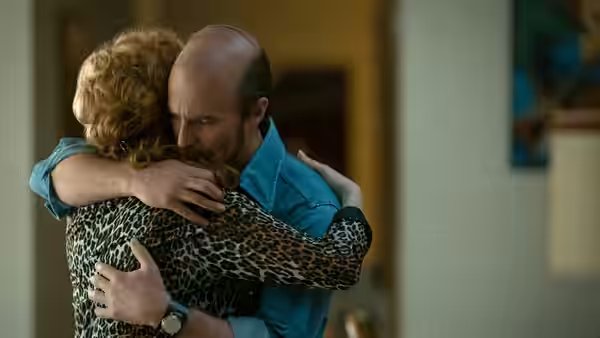
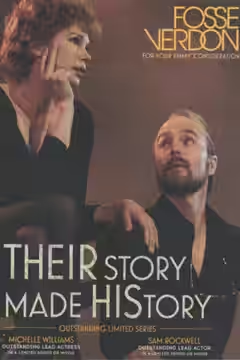
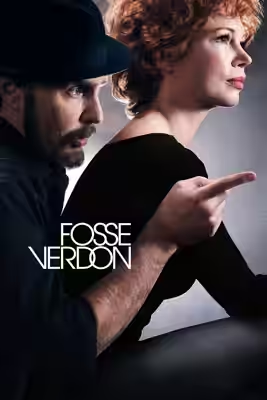
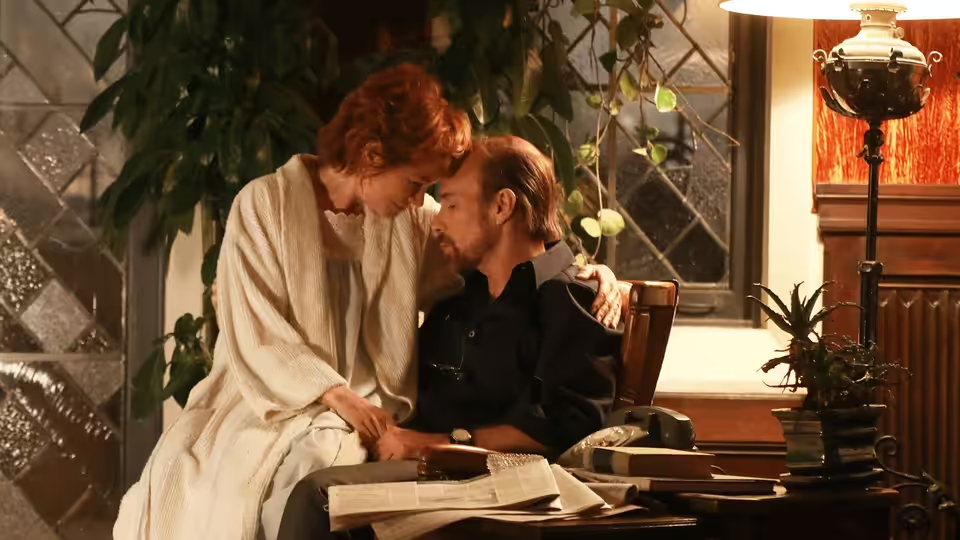
Gwen Verdon (Michelle Williams) leans toward Bob Fosse (Sam Rockwell) at a desk with open books
Series review

Fosse/Verdon

2019 · Created by Steven Levenson, Thomas Kail · Series · Statens medieråd Från 15 år

In a sentenceMichelle Williams builds a whole woman out of hairspray and posture and the show keeps cutting away to her husband

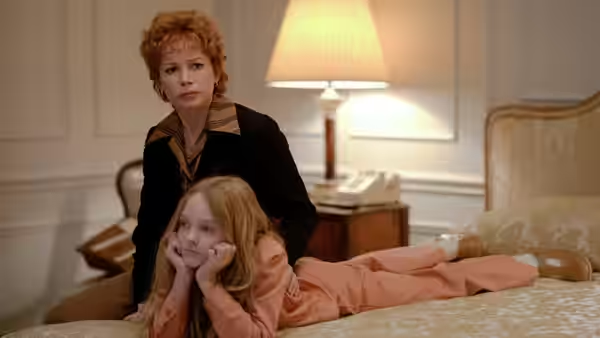
Munich, 1971. Bob Fosse (Sam Rockwell), a Broadway choreographer whose only film, Sweet Charity, has flopped, is directing Cabaret and arguing with his producer Cy Feuer (Paul Reiser) about what the film should be. His wife Gwen Verdon (Michelle Williams), the biggest dancing star on Broadway, flies in with a gorilla head in her luggage and fixes the number he cannot. Between shots the series drops back to 1955, when a young Fosse is hired to choreograph Damn Yankees and Verdon, already famous, is the star he has to win over. Around them are Paddy Chayefsky (Norbert Leo Butz), Neil and Joan Simon (Nate Corddry, Aya Cash), and a daughter, Nicole, at home in New York.

Plays from YouTube when you press play; nothing loads from them until then.

Fi1m review

Michelle Williams is the reason to watch: her Gwen Verdon is exact, funny and furious. But the series that carries her name is mostly about her husband, and eight episodes of time-hopping around one difficult man is a long way to walk for her.

Steven Levenson and Thomas Kail’s eight-part series has one idea and it is a good one: that the work the world credits to Bob Fosse was, for years, half Gwen Verdon’s, and that she did it for a man who was usually busy with somebody else. It opens in Munich in 1971, with Fosse (Sam Rockwell) directing Cabaret and Verdon (Michelle Williams) flying in from New York to fix a number he cannot. From there it moves in both directions at once, back to 1955 and forward to a death the captions count down to, and how well you follow it depends a good deal on what you already know.

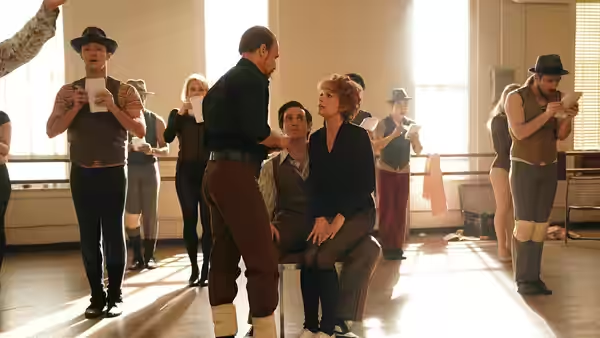
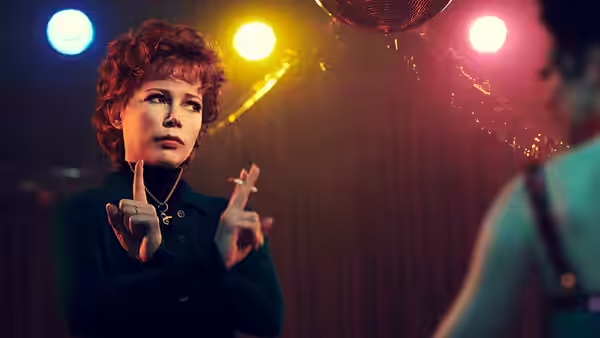
Williams is the reason to watch. She has Verdon’s small, bright, slightly cracked voice and her way of standing with the weight forward, as if the floor might be taken away, and she never lets the impression become the whole performance. Her Gwen knows exactly what she is worth and has decided, for now, to give it away. We were moved, more than we expected, by a rehearsal room in 1955: he shows her a step, she gives it back with something added, and Williams’s face does the whole marriage in advance.

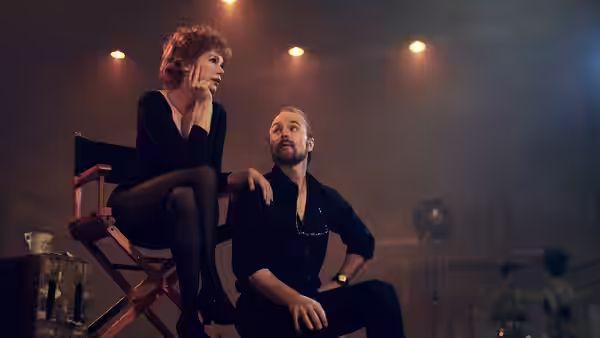
Rockwell has the harder and less rewarding job. He plays Fosse hunched and murmuring, cigarette in the corner of his mouth, shoulders up round his ears, and he is good at the charm and better at the cruelty. But the writers, among them Joel Fields, Tracey Scott Wilson, Charlotte Stoudt, Ike Holter and Debora Cahn, hand him the full kit of the troubled artist: the pills, the women, the insistence that being awful is the price of being good. We have met this man before and the series finds nothing new to say about him.

The numbers are the other reason to stay. Kail directs the opener and stages the Cabaret chairs with care, and the recreations that follow, from Damn Yankees to the first workshops for Chicago, are exact without being embalmed. Tim Ives shoots the rehearsal rooms flat and grey, all radiators and paper cups in Alex DiGerlando’s studios, and saves the amber for the stage, so you feel the gap between the work and the show. Alex Lacamoire’s arrangements of the standards are crisp, and Nathan Barr’s score keeps to low strings and steps aside when a real song arrives.

The structure is where it comes apart. The editors, Tim Streeto, Erica Freed Marker, Jonah Moran and Kate Sanford, cut between decades on a look, a cigarette or a chord, and the captions telling us how many years are left do not help as much as they should. We were lost more than once in the first three episodes, and then cross about being lost, because a show about two people who counted every beat ought to be able to count its own. It settles in the second half, when the timelines thin out and the series remembers whose name comes second in the title.

That is the deeper trouble. Having set out to give Verdon her due, the series spends most of its hours in Fosse’s dressing room. The supporting cast are sharp when they are let in: Norbert Leo Butz’s Paddy Chayefsky barrels through every scene like a man who has just eaten, Aya Cash’s Joan Simon watches the marriage with the patience of a friend who has said her piece once, and Paul Reiser’s Cy Feuer does the budget of Cabaret on his face. Bianca Marroquín’s Chita Rivera arrives late, and we wished she had come sooner.

Fosse told this story himself in All That Jazz in 1979, quicker and crueller, and the series borrows its hospital, its pills and its girls in the wings and never gets out from under it. Next to that film it looks handsome, slow and tidy.

Watch it for Williams and for the numbers, and keep a phone nearby for the names. If you already know who Cy Feuer was, this is a treat with a sag in the middle. If you do not, it is eight hours of well-dressed people arguing about a show you have not seen, and Williams is the only one who makes you want to see it.

Critical consensus AI synthesised

52
Positive
2
Mixed
5
Negative
4

Most critics come away lukewarm. The praise gathers almost entirely around the two leads: Michelle Williams is singled out again and again for her Verdon, and several reviews find the pairing with Sam Rockwell, and the dance sequences they share, the best reason to keep watching. The period detail and the exact recreations of Fosse’s choreography are widely admired, even by those who admire little else.

The reservations cluster in two places. Several critics find the story jumbled, hopping between timelines in a way that asks for a good deal of prior knowledge; The Times thinks it near impossible to follow without it. Others feel the series gives Fosse’s decline far more room than Verdon’s career, with Collider arguing hers is the more compelling story. The spread is wide: Den of Geek finds it a strong case even for newcomers to the choreography, while Vulture judges it made only for devoted students of showbiz history.

Empire
30 July 2019 · Christina Newland
70*

The series is a stylish exploration of the power dynamics in the Fosse-Verdon marriage and creative partnership, with strong performances especially from Michelle Williams. It could have given more credit to Verdon and focused less on Fosse's personal decline.

Read the full review →
The Guardian
2 August 2019
60*

The series dramatizes the toxic marriage and creative partnership between Bob Fosse and Gwen Verdon but is let down by its oddly structured, jumbled narrative across multiple timelines. The lead performances by Sam Rockwell and Michelle Williams, especially their chemistry and dance sequences, provide the main highlights.

Read the full review →
The Hollywood Reporter
13 March 2019 · Daniel Fienberg
50*

Rockwell and Williams bring star power to this look at the Fosse-Verdon partnership, offering surface pleasures from the glitz and performances. It feels restrictive and waits for deeper meaning or gravity beyond the known story.

Read the full review →
The Times
3 August 2019 · Camilla Long
40*

The glossy miniseries offers a confusing, convoluted account of the showbiz story that requires excessive background knowledge to follow and lacks sufficient dancing or clear narrative drive.

Read the full review →
Variety
13 March 2019 · Daniel D'Addario
40*

The show accurately depicts the creative process and choreography but lacks the spark and originality of Fosse's work, feeling like familiar TV tropes. It is worthy as a reclamation of Verdon's influence but doesn't find its own rhythm as television.

Read the full review →
Vulture
9 April 2019 · Matt Zoller Seitz
30*

The series is made for hardcore fans of showbiz history, delivering sumptuous period detail and exact recreations but feeling heavy-spirited and too immersive, like a glitzier, slower cousin of Mad Men.

Read the full review →

Straight answers AI written, from our review

Is Fosse/Verdon worth watching?
Fosse/Verdon is worth watching for Michelle Williams and for its careful recreations of the numbers, and we scored it 58. Her Gwen Verdon is exact, funny and furious, but the eight episodes spend most of their time in Bob Fosse's dressing room and hop between decades in ways that lose the viewer early on. It suits people who already know their Broadway history far better than newcomers.
How long is Fosse/Verdon, and what is it rated?
Fosse/Verdon is rated Från 15 år by the Statens medieråd in Sweden. It is a drama series.
Where can I watch Fosse/Verdon in Sweden?
Fosse/Verdon is streaming on Disney+ in Sweden. Availability is checked daily; the links above go straight to each service.
How violent or frightening is Fosse/Verdon, and is it suitable for children?
Fosse/Verdon has no UK certificate and carries TV-MA in the United States, so it is a series for adults rather than children. It is not violent or frightening; the adult content is a difficult man's pills, affairs and cruelty, and the emotional damage they do to the marriage at its centre. Teenagers interested in musical theatre could manage it, but the eight hours of arguing about old shows would test them.
How does Fosse/Verdon compare to All That Jazz?
Fosse/Verdon covers the same life as All That Jazz and comes off worse: Fosse's own film is faster, crueller and honest about the pills, and the series borrows its hospital, its wings and its women without matching it. The series gives Gwen Verdon a place the film never did, and Michelle Williams makes that worth having. Watch the film if you want one hard, vain, brilliant sitting; watch the series if you want her.
What should I watch after Fosse/Verdon?
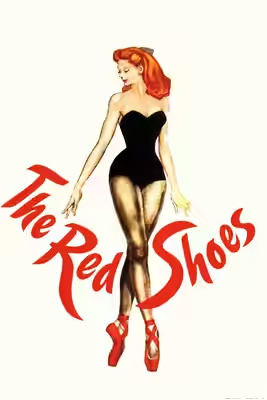
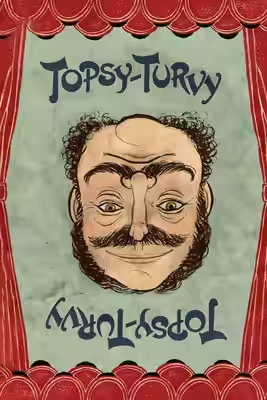
After Fosse/Verdon, try All That Jazz (1979, Fi1m 84): Fosse’s own version of the same life, faster, crueller and honest about the pills. Then The Red Shoes (1948, Fi1m 92): The finest film about what dancing costs, and it does not flinch; and Topsy-Turvy (1999, Fi1m 88): Mike Leigh on Gilbert and Sullivan: rehearsal rooms, sulks and the work itself.

Cast

If you liked this, try…

  1. All That Jazz (1979, Fi1m 84)Fosse’s own version of the same life, faster, crueller and honest about the pills.

  2. The Red Shoes (1948, Fi1m 92)The finest film about what dancing costs, and it does not flinch.

  3. Topsy-Turvy (1999, Fi1m 88)Mike Leigh on Gilbert and Sullivan: rehearsal rooms, sulks and the work itself.

  4. Feud: Bette and Joan (2017) · not reviewed yetTwo women, one industry that used them up, and much better wigs.

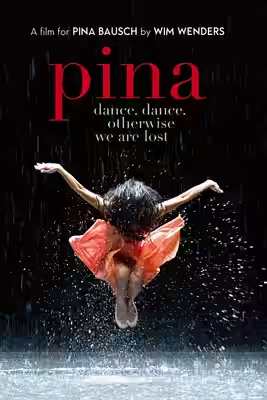
  5. Pina (2011, Fi1m 80)Wim Wenders films Pina Bausch’s dancers where they worked; no biography, all body.

Free account

Know what to watch tonight

Two lists that know where things are streaming, collections you can share, your own score beside ours, and Discover that remembers what you have seen.

  • Want to see, sorted by what is streaming now
  • Seen, with your score out of ten
  • No adverts, ever