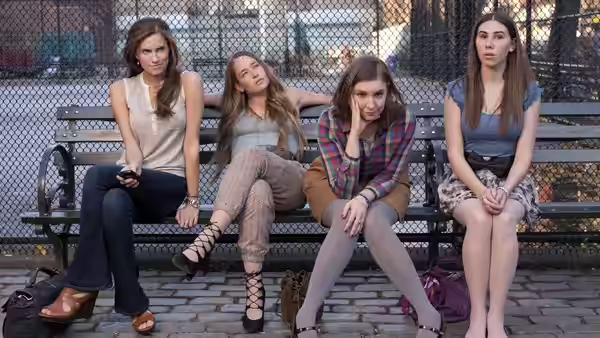
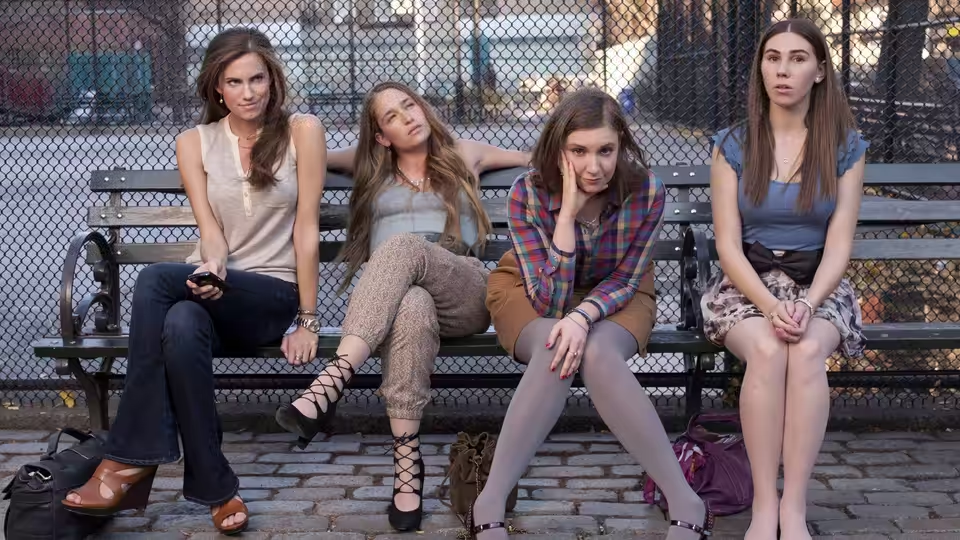
Marnie (Allison Williams), Shoshanna (Zosia Mamet), Hannah (Lena Dunham) and Jessa (Jemima Kirke) sit on a bench
Series review

Girls

2012 · Created by Lena Dunham · Series · 28m · FSK 16

In a sentenceFour twentysomethings in Brooklyn, none of whom you would lend money to, all of whom you would ring back

Brooklyn, 2012. Hannah Horvath (Lena Dunham), two years out of college and working an unpaid internship while she writes a book of essays, is taken to dinner by her parents Tad (Peter Scolari) and Loreen (Becky Ann Baker) and told the money stops now. She goes home to the flat she shares with Marnie Michaels (Allison Williams), who has a proper job and a devoted boyfriend, Charlie Dattolo (Christopher Abbott), whom she can no longer bear to be touched by. Hannah’s own arrangement is with Adam Sackler (Adam Driver), who builds things out of wood in his flat and rarely answers his phone. Jessa Johansson (Jemima Kirke) blows in from abroad and moves in with her cousin Shoshanna Shapiro (Zosia Mamet), who talks very fast and is still a virgin.

Fi1m review

Lena Dunham’s comedy about four women adrift in Brooklyn is sharp, unsparing and often uncomfortable to sit through, which is the point. Its world is small and the middle seasons wander, but the best episodes are as honest as television gets.

Hannah Horvath tells her parents, over the dinner at which they cut her off, that she thinks she may be the voice of her generation, or at least a voice of a generation. She is high when she says it. Lena Dunham, who created the series, writes and directs much of it and plays Hannah, spends six seasons and 62 episodes making sure we hear the joke and never quite lose sight of the ambition underneath. That is the whole method of Girls. It lets its four women be ridiculous and asks us to keep caring anyway.

It is very good, and we would put its best half-hours against any comedy of the past twenty years. It is also, for long stretches, hard to spend time with, and that is a description, not a complaint. The sex was what most critics remarked on at the time, and rightly, though not because there is a great deal of it. It is that Dunham and her directors, Jesse Peretz and Richard Shepard among them, shoot it the way the rest of the show is shot: in the same light, from the same middle distance, with nobody arranged to look good. We looked at the floor during the first scene between Hannah and Adam Sackler, and then realised we had never seen anything on television that was that accurate about what a bad arrangement between two people looks like from the inside.

Tim Ives photographs Brooklyn without a glow. The flats, dressed by production designer Judy Becker, have radiators, mismatched chairs and one good lamp, and they look rented rather than art-directed, which is harder than it sounds. Nat Sanders and Joi McMillon cut conversations so that the pause after a stupid remark runs a beat longer than is comfortable. Most comedies would cut to the reaction. This one stays on the person who said it.

Adam Driver is the discovery. Adam Sackler is written as the worst sort of boyfriend, unreachable and odd, and Driver plays him as a man who is simply concentrating on something else, so that when his attention does land on Hannah it is frightening in its completeness. Zosia Mamet takes Shoshanna, who could have been one joke about a girl who talks fast, and gives her a spine. Alex Karpovsky’s Ray Ploshansky, older than everyone and running a coffee shop he despises, is the show’s conscience and its most reliably funny man. Allison Williams has the hardest job: Marnie is vain and controlling, and Williams never once winks at us about it.

The scenes that got past our guard were the ones with the parents. Peter Scolari and Becky Ann Baker play Tad and Loreen Horvath as two decent people who have run out of ideas, and a late strand involving Tad, which we will not describe, moved us more than anything the four women do. That is a criticism of sorts. The show is more interested in the people around its heroines than it always admits.

The flaws are structural. The world is small: four white women with parents who can, if pressed, pay the rent, and the show’s occasional attempts to notice this are the least convincing things in it. The middle seasons wander. Marnie’s music career with Desi Harperin (Ebon Moss-Bachrach) is tiresome the first time and no better the third, and Jessa, whom Jemima Kirke plays with real charm, is sent on detours the writers plainly did not know how to end. Seasons of ten and twelve episodes, at 28 minutes each, should have no room for filler. Some of these do.

The best of Girls is in its standalone episodes, in which Hannah is shut in a room with one other person and the show becomes a small, exact two-hander. Several of these are directed by Richard Shepard, and they are where the writing, by Dunham with Jenni Konner and a staff that included Judd Apatow and Bruce Eric Kaplan, is at its plainest and most painful. Most critics rate the series about where we do, and we think the ones who found it merely coarse missed how carefully the coarseness is placed.

It is an 18 certificate and earns it in the first ten minutes. Watch a season at a time rather than the lot at once. These people are exhausting in the way real friends of that age are exhausting, and we liked them more with a week between visits.
Critical consensus AI synthesised

80
Positive
6
Mixed
0
Negative
0

The reviews are uniformly positive. Every critic lands on the same word: honest. The praise clusters on Dunham’s writing, which most critics find true to how twentysomethings in New York talk, fumble and fail at adulthood, rather than a glossy version of it. The sex scenes come up repeatedly, singled out for being awkward and unflattering in a way critics take as a virtue. Several reviews set the show against Sex and the City and find it the more real of the two.

The spread runs from warm to warmer, with The Hollywood Reporter the most enthusiastic by some distance. Such reservations as there are concern the characters rather than the craft: Variety finds them self-absorbed and self-indulgent, and IndieWire calls the pilot coarse, though both still recommend it. The Guardian notes the ongoing argument over how narrow the show’s world is and who it leaves out, without letting that dent its enjoyment. Nobody dissents.

The Hollywood Reporter
11 March 2012 · Tim Goodman
95*

The critic calls the series a brilliant gem and one of the most original, spot-on series in recent memory, praising Dunham's unique vision and the honest, nuanced portrayal of young women's lives and friendships.

Read the full review →
The Times
28 October 2012 · AA Gill
85*

The critic praises the show's bold, bright and real writing that captures life remembered rather than exaggerated, highlighting its graphic and fumblingly true depiction of youthful sex and distinction from Sex and the City.

Read the full review →
The Guardian
22 October 2012 · Lucy Mangan
80*

The critic finds the show hilarious and real in its portrayal of twentysomethings struggling with adulthood in New York. She notes its authentic feel compared to Sex and the City while acknowledging debates over its scope and representation.

Read the full review →
Variety
10 April 2012 · Brian Lowry
80*

The critic notes the characters are self-absorbed and self-indulgent but praises the series as fresh, honest and raw, calling it a voice worth hearing on HBO.

Read the full review →
IndieWire
16 April 2012 · Maggie Lange
70*

The critic finds the pilot coarse yet sensitive and promising overall. She singles out the realistic, awkward portrayal of young women's lives and relationships for praise.

Read the full review →
Vulture
15 April 2012 · Matt Zoller Seitz
70*

The critic calls the series a success for finding truth in its characters and setting. She singles out the precise, aesthetically modest depiction of privileged yet petty young women and their awkward, real sex scenes for praise.

Read the full review →

Straight answers AI written, from our review

Is Girls worth watching?
Girls is worth watching for anyone who can bear a comedy that refuses to make its people likeable, and we scored it 82. Lena Dunham's six seasons about four women adrift in Brooklyn are sharp and often uncomfortable, and the best standalone episodes are as honest as television gets. The middle seasons wander, so take it a season at a time.
How long is Girls, and what is it rated?
Girls has episodes of about 28m and is rated 16 by the FSK in Austria. It is a drama and comedy series.
Where can I watch Girls in Austria?
Girls is streaming on HBO Max and Amazon Prime Video in Austria, and it is also available to buy from Amazon Prime Video. Availability is checked daily; the links above go straight to each service.
How violent or frightening is Girls, and is it suitable for children?
Girls is an 18 certificate and earns it in the first ten minutes, chiefly through frank, unflattering sex rather than violence or fear. It is not for children, and many adults will find its bedroom scenes hard to sit through, since Dunham shoots them in plain light with nobody arranged to look good. Squeamish viewers should know that discomfort is the point.
How does Girls compare to Fleabag?
Girls is the longer, looser and more uncomfortable of the two; Fleabag is faster, funnier and tighter, and its second series is the better run of half-hours. Dunham's show sprawls across six seasons and four women, with real filler in the middle, where Waller-Bridge's two series waste almost nothing. Choose Girls if you want time with flawed people, Fleabag if you want precision.
What should I watch after Girls?
After Girls, try Fleabag (2016, Fi1m 90): A London woman looks straight at us while making the same mistakes, faster and funnier. Then Frances Ha (2012, Fi1m 82): Greta Gerwig in black and white, broke in Brooklyn, losing her best friend to a boyfriend; and Insecure (2016, Fi1m 81): Issa Rae’s Los Angeles comedy about a friendship that is harder work than any relationship.

Cast

If you liked this, try…

  1. Fleabag (2016, Fi1m 90)A London woman looks straight at us while making the same mistakes, faster and funnier.

  2. Frances Ha (2012, Fi1m 82)Greta Gerwig in black and white, broke in Brooklyn, losing her best friend to a boyfriend.

  3. Insecure (2016, Fi1m 81)Issa Rae’s Los Angeles comedy about a friendship that is harder work than any relationship.

  4. Please Like Me (2013) · not reviewed yetJosh Thomas’s Melbourne series, gentler than Girls and every bit as honest about bad flats.

  5. Tiny Furniture (2010) · not reviewed yetDunham’s first film, made in her mother’s loft, with the same wince and less money.

Free account

Know what to watch tonight

Two lists that know where things are streaming, collections you can share, your own score beside ours, and Discover that remembers what you have seen.

  • Want to see, sorted by what is streaming now
  • Seen, with your score out of ten
  • No adverts, ever