Edgar Reitz’s chronicle of one family in a Hunsrück village is television of rare patience, acted plainly and shot with a memory’s eye for colour. It asks a great deal of your time and repays most of it; the later episodes drift.
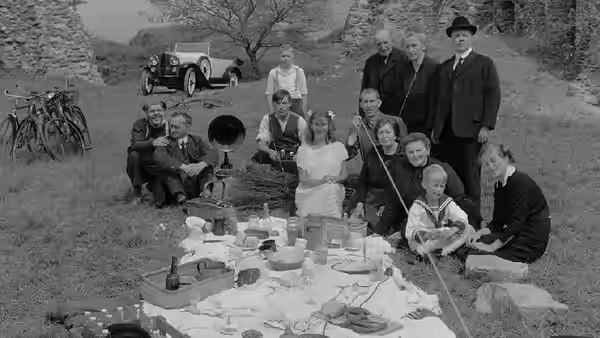
Edgar Reitz’s Heimat follows one family in one village in the Hunsrück hills from 1919 to 1982, across eleven episodes first shown on 16 September 1984, each about the length of a feature film. The tagline calls it a chronicle of Germany, and it behaves like one. Weddings, funerals, a new road, a wireless set, a war, another war. Reitz and his co-writer Peter Steinbach let the big events arrive in Schabbach the way they would have arrived anywhere: late, by post, and mostly as somebody else’s problem.
Our verdict is plain. This is one of the great long works of television, and we would tell a stranger to make time for it. The stranger should know that the time required is considerable, and that the last two or three episodes are not the equal of the first six.
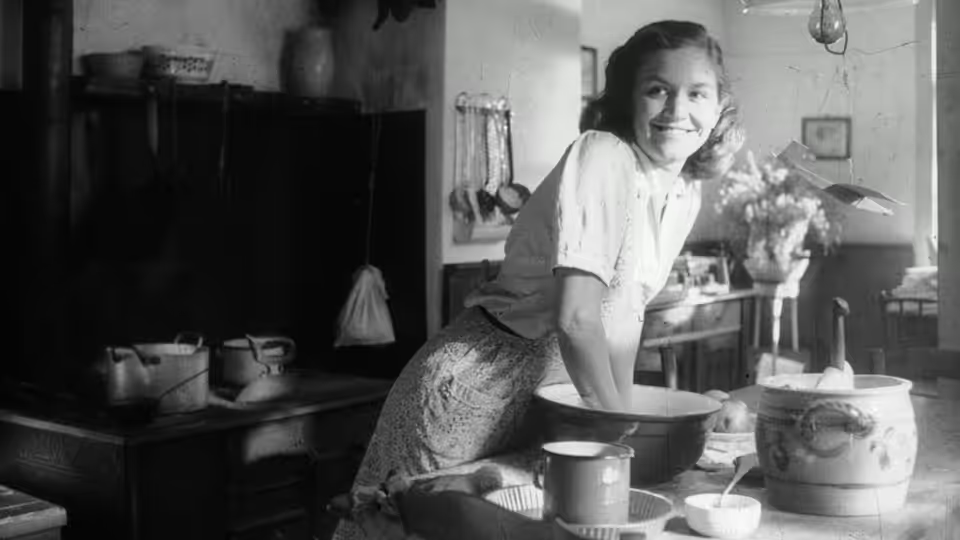
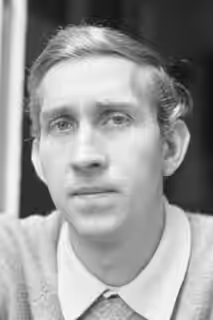
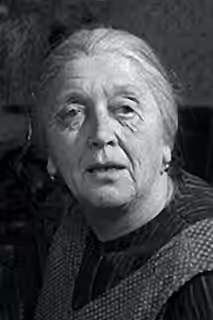
Marita Breuer plays Maria from a girl of nineteen to an old woman, and she is the reason the thing holds. Maria is left behind in the first episode when her husband Paul walks out of the village, and Breuer plays the years after not as grief but as a patience that narrows a little each decade. She looks up when a door opens, for years, and then stops. Gertrud Bredel’s Katharina, the mother who runs the smithy household, is the one person on screen who sees clearly, and Bredel gives her a plainness that never once asks to be admired. Rüdiger Weigang’s Eduard, the brother with the camera and no sense, drifts into things, and Weigang makes the drift funny until it is not. Karin Rasenack’s Lucie, the Berlin woman he marries, brings ambition into the village like a new appliance.
The Nazi years come in through Johannes Lobewein’s Alois Wiegand and Hans-Jürgen Schatz’s Wilfried, Maria’s own father and brother, and the village takes to the new order with the shrug it gives to everything else. We were horrified, and the horror came from how little changed on screen: the same kitchen, the same lanes, a flag, a uniform, a boy who used to be a nuisance now walking differently. Reitz does not show the camps and barely names them. Some will find that an evasion. We think it is deliberate: the village never looked, and Reitz keeps us at the kitchen table with the people who did not look.
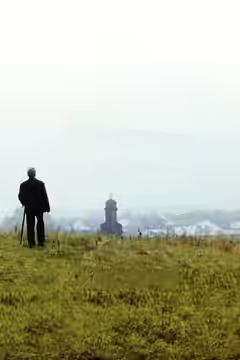
Gernot Roll shoots nearly all of it in black and white and then, without warning, lets a scene go into colour: a dress, a field, a sky. The switches do not follow a rule we could work out, and we do not think they are meant to; they land like the moments a memory keeps in colour when the rest has faded. Heidi Handorf’s editing lets a harvest or a village dance run for minutes, then jumps a decade in a single cut. Nikos Mamangakis’s music is spare and folk-like, strings and a recurring theme that returns until it sounds like something the village itself hums. Regina Bätz’s costumes are the clearest clock in the piece; you can date a scene by the width of a collar.
The narrator is Glasisch Karl, the village odd-job man with scabbed hands, played by Kurt Wagner, who opens each episode sorting through a pile of photographs and telling us who has died. It is a modest device and it works. He is the one person in Schabbach who notices everything and matters to nobody.
The faults are those of length. Once the series passes the war the family scatters, and the episodes set in the 1950s and 1960s spend a long time with characters who have not earned it. The colour switches, so sharp early on, become a habit. And the series is so attached to its village that the wider country stays a rumour; a viewer wanting to know what Germany did, rather than what Schabbach failed to notice, will have to look elsewhere.
Set aside a winter. Watch it in order, an episode a week, and let the gaps between viewings do what the gaps between decades do. By the end you will know these people’s kitchens better than your own, which is what the title means.