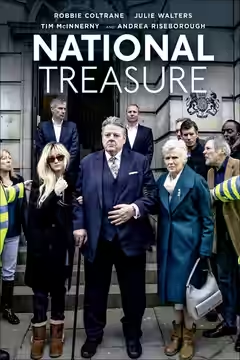
National Treasure is gripping, finely acted television, with Robbie Coltrane and Julie Walters making a family’s response to abuse allegations painfully credible. Its concentration on the accused leaves too little space for those making the allegations.
National Treasure is worth watching for the discomfort Robbie Coltrane and Julie Walters can create between people who know each other well. Jack Thorne’s four-part drama, directed by Marc Munden, considers what happens when a familiar public figure faces abuse allegations and his family must decide what to believe. The performances make that question difficult to dismiss. Our reservation is substantial: the series spends so much time with the accused man’s family that the people accusing him struggle to command the same attention.
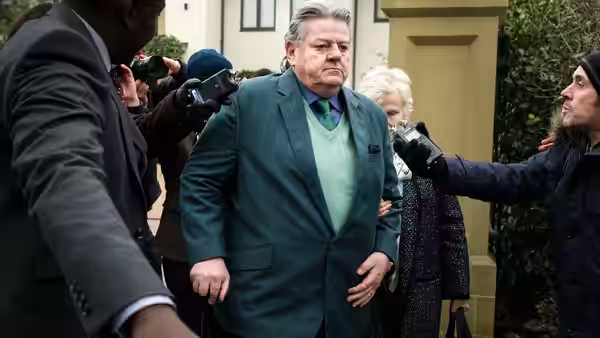
As Paul Finchley, Robbie Coltrane understands how readily an audience will grant a famous comedian the benefit of the doubt. His subdued performance gives us little encouragement to congratulate ourselves on seeing through him; we keep looking for something that will settle our feelings. We were uneasy about our own willingness to keep listening to Paul, because his manner remained reassuring even when the allegations demanded caution. The performance makes our desire to reach a comfortable opinion of him part of the difficulty.
Julie Walters gives the drama its strongest reason to stay close to this family. Marie Finchley’s uncertainty matters because belief affects every conversation within her marriage, and the performance makes reconsidering a familiar person look exhausting. Andrea Riseborough, as Danielle ‘Dee’ Finchley, gives the family scenes another source of tension, most sharply in the exchange between mother and daughter. We found that confrontation painful: their closeness to Paul makes the conversation harder, and neither woman’s distress can provide the other with reassurance.
Ole Birkeland’s cinematography and Beck Rainford’s production design sustain the quietly threatening atmosphere around the family, although the performances are what make it disturbing. The visual treatment is persuasive as a way of making us uncomfortable in Paul’s company; it is less useful if we start reading unease as evidence against him. Cristóbal Tapia de Veer’s music contributes to that pressure. Marc Munden gets the balance right most often when the actors’ restraint sets the tone.
Simon Smith and Luke Dunkley’s editing keeps the family drama closely tied to the suspense. There is room to register a reaction without losing interest in the next conversation, though the pace sometimes slackens. The comedy partnership is less satisfying: Jack Thorne gives it enough attention to raise expectations, but too little development to fulfil them. In a four-part series, we notice the time spent away from the more revealing family exchanges.
The larger problem is the attention paid to the people making the allegations. A drama about celebrity has good reason to examine the indulgence a familiar performer receives, but repeating that imbalance can leave the accusers peripheral once again. Their experiences deserve more room, especially given how carefully the series considers the family’s distress. For us, a crime drama earns its seriousness by attending to everyone affected, and the fine acting does not quite compensate for how narrowly the writing distributes its attention.
We recommend it to those who want a crime drama to make them question their sympathies. The performances reward close attention, and the reservations are worth discussing rather than reasons to dismiss the programme. It is not an easy evening. Leave time afterwards to talk about who deserved another scene.