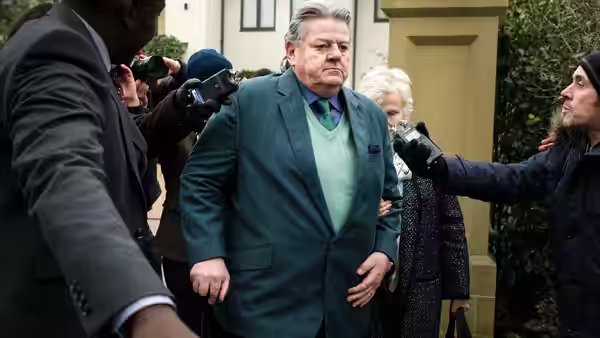
Paul Finchley (Robbie Coltrane) faces reporters with Marie (Julie Walters) and Dee Finchley (Andrea Riseborough) beside him
Series review

National Treasure

2016 · Created by Jack Thorne · Series · 48m

In a sentenceJulie Walters makes us nervous about what someone might say after a pause

Paul Finchley (Robbie Coltrane) is a comedian facing abuse allegations that threaten his public reputation. His wife, Marie Finchley (Julie Walters), must consider what she believes about her husband, while their daughter, Danielle ‘Dee’ Finchley (Andrea Riseborough), is drawn into the family’s response. The allegations bring public scrutiny into relationships already complicated by years of knowing one another. Paul has his reputation and his family’s trust at stake, but neither can resolve the accusations. His comedy partnership also comes under scrutiny as those closest to him face questions about the man they know.

Plays from YouTube when you press play; nothing loads from them until then.

Fi1m review

National Treasure is gripping, finely acted television, with Robbie Coltrane and Julie Walters making a family’s response to abuse allegations painfully credible. Its concentration on the accused leaves too little space for those making the allegations.

National Treasure is worth watching for the discomfort Robbie Coltrane and Julie Walters can create between people who know each other well. Jack Thorne’s four-part drama, directed by Marc Munden, considers what happens when a familiar public figure faces abuse allegations and his family must decide what to believe. The performances make that question difficult to dismiss. Our reservation is substantial: the series spends so much time with the accused man’s family that the people accusing him struggle to command the same attention.

As Paul Finchley, Robbie Coltrane understands how readily an audience will grant a famous comedian the benefit of the doubt. His subdued performance gives us little encouragement to congratulate ourselves on seeing through him; we keep looking for something that will settle our feelings. We were uneasy about our own willingness to keep listening to Paul, because his manner remained reassuring even when the allegations demanded caution. The performance makes our desire to reach a comfortable opinion of him part of the difficulty.

Julie Walters gives the drama its strongest reason to stay close to this family. Marie Finchley’s uncertainty matters because belief affects every conversation within her marriage, and the performance makes reconsidering a familiar person look exhausting. Andrea Riseborough, as Danielle ‘Dee’ Finchley, gives the family scenes another source of tension, most sharply in the exchange between mother and daughter. We found that confrontation painful: their closeness to Paul makes the conversation harder, and neither woman’s distress can provide the other with reassurance.

Ole Birkeland’s cinematography and Beck Rainford’s production design sustain the quietly threatening atmosphere around the family, although the performances are what make it disturbing. The visual treatment is persuasive as a way of making us uncomfortable in Paul’s company; it is less useful if we start reading unease as evidence against him. Cristóbal Tapia de Veer’s music contributes to that pressure. Marc Munden gets the balance right most often when the actors’ restraint sets the tone.

Simon Smith and Luke Dunkley’s editing keeps the family drama closely tied to the suspense. There is room to register a reaction without losing interest in the next conversation, though the pace sometimes slackens. The comedy partnership is less satisfying: Jack Thorne gives it enough attention to raise expectations, but too little development to fulfil them. In a four-part series, we notice the time spent away from the more revealing family exchanges.

The larger problem is the attention paid to the people making the allegations. A drama about celebrity has good reason to examine the indulgence a familiar performer receives, but repeating that imbalance can leave the accusers peripheral once again. Their experiences deserve more room, especially given how carefully the series considers the family’s distress. For us, a crime drama earns its seriousness by attending to everyone affected, and the fine acting does not quite compensate for how narrowly the writing distributes its attention.

We recommend it to those who want a crime drama to make them question their sympathies. The performances reward close attention, and the reservations are worth discussing rather than reasons to dismiss the programme. It is not an easy evening. Leave time afterwards to talk about who deserved another scene.


Critical consensus AI synthesised

73
Positive
6
Mixed
2
Negative
0

Most critics find National Treasure a compelling, uncomfortable drama, with praise concentrated on the performances and its treatment of celebrity, abuse allegations and their effects on a family. Robbie Coltrane’s complex, restrained performance draws repeated approval, while Julie Walters receives particular attention for Marie’s devastation and faltering certainty. The reviews generally value the series’ moral uncertainty and find its difficult subject matter handled with thought and care.

The reservations range from uneven storytelling to a more substantial objection about whose experience receives attention. Some critics find subplots underdeveloped or unwieldy, while assessments of pace differ: IndieWire notes sluggishness, whereas The Hollywood Reporter finds the drama brisk. The i Paper offers the clearest dissent, praising the leads but arguing that the victims have too little screen time or agency. The spread is largely favourable rather than sharply divided, though that criticism questions a central choice in the storytelling.

IndieWire
1 March 2017 · A- · Liz Shannon Miller
90

Miller calls the series important and vital viewing, despite some sluggish pacing and an unwieldy subplot. She praises Robbie Coltrane’s performance and Julie Walters’s portrayal of Marie’s devastation.

Read the full review →
Variety
27 February 2017 · Maureen Ryan
80*

Ryan finds the tightly focused drama suspenseful and impactful, despite a less developed subplot about Paul’s comedy partnership. She particularly praises the performances, especially Julie Walters’s portrayal of Marie as her certainty begins to crumble.

Read the full review →
The Guardian
20 September 2016 · Sam Wollaston
75*

Wollaston calls the drama thoughtful, bold and accomplished, while acknowledging that it is uncomfortable viewing. He particularly praises Robbie Coltrane’s complex, convincing performance and singles out Julie Walters and Andrea Riseborough as brilliant.

Read the full review →
The Hollywood Reporter
1 March 2017 · Tim Goodman
75*

Goodman finds the series compelling and brisk, with a familiar subject handled in a fresh, meaningful way. He especially praises the nuanced performances and the way the drama explores the effects of celebrity and abuse allegations on a family.

Read the full review →
Vulture
1 March 2017 · Jen Chaney
70*

Chaney finds the four-part series engrossing and thought-provoking, with its moral uncertainty lingering after the finale. She praises the subdued performances, especially Robbie Coltrane’s, and the quietly ominous atmosphere.

Read the full review →
Radio Times
15 March 2019 · Ben Dowell
64*

The available description presents the finale as delivering a decisive verdict on Paul Finchley. It offers no specific praise or complaint about the episode.

Read the full review →

Straight answers AI written, from our review

Is National Treasure worth watching?
National Treasure is worth watching for its finely acted, uncomfortable family drama, and we score it 78 out of 100. Robbie Coltrane and Julie Walters make uncertainty about a familiar person painfully credible, though we find the attention given to the accused man’s family leaves too little room for those making the allegations.
How long is National Treasure, and what is it rated?
National Treasure has episodes of about 48m. It is a drama and crime series.
Where can I watch National Treasure in Croatia?
National Treasure is not on any streaming or rental service in Croatia at the moment. It is available in 8 other countries; change your country at the top of the page to see where. Availability is checked daily.
How violent or frightening is National Treasure, and is it suitable for children?
National Treasure has a UK 15 certificate and is unsuitable for children, with abuse allegations and distressing family confrontations making it an uneasy watch. We find its quietly threatening atmosphere and the uncertainty within the marriage disturbing; older teenagers and adults comfortable with difficult subject matter are its audience.
How does National Treasure compare to The Hunt?
National Treasure is the better fit for viewers drawn to uncertainty within a family, while The Hunt offers a more directly frightening account of a falsely accused teacher’s distress. We recommend both for their performances, with reservations: National Treasure gives the accusers too little attention, while The Hunt keeps adding punishment after its damage is clear.
What should I watch after National Treasure?
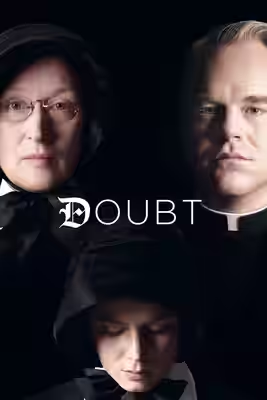
After National Treasure, try The Hunt (2012, Fi1m 82): The rush to judge becomes frighteningly intimate in another drama about an accusation. Then A Separation (2011, Fi1m 93): Family loyalties make establishing the truth painfully difficult, without excusing anyone; and Doubt (2008, Fi1m 71): Fine performances make uncertainty uncomfortable, particularly when authority expects to be believed.

Cast

If you liked this, try…

  1. The Hunt (2012, Fi1m 82)The rush to judge becomes frighteningly intimate in another drama about an accusation.

  2. Unbelievable (2019) · not reviewed yetA useful corrective, giving the people reporting abuse the attention they deserve.

  3. A Separation (2011, Fi1m 93)Family loyalties make establishing the truth painfully difficult, without excusing anyone.

  4. Doubt (2008, Fi1m 71)Fine performances make uncertainty uncomfortable, particularly when authority expects to be believed.

  5. The Lost Honour of Katharina Blum (1975) · not reviewed yetA woman’s treatment by police and press turns public suspicion into sustained pressure.

Free account

Know what to watch tonight

Two lists that know where things are streaming, collections you can share, your own score beside ours, and Discover that remembers what you have seen.

  • Want to see, sorted by what is streaming now
  • Seen, with your score out of ten
  • No adverts, ever