Sacha Baron Cohen puts the prosthetics back on and finds that American public life has caught up with him. One character, a gun-rights zealot called Erran Morad, draws out confessions worth the whole series; the others mostly stand around waiting for someone to be embarrassed.
Twelve years after Borat, Sacha Baron Cohen puts the prosthetics back on and goes looking for a country that has grown much harder to embarrass. Who Is America? runs to seven episodes, first shown on 15 July 2018, each a handful of segments in which an invented character sits down with a real person who has not been told who he is. The title asks its question in earnest. The answer the series gives is one excellent character and several who are mostly waiting for something to happen.
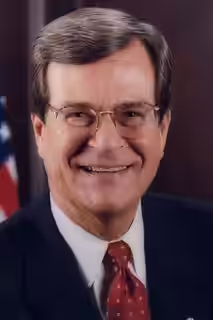
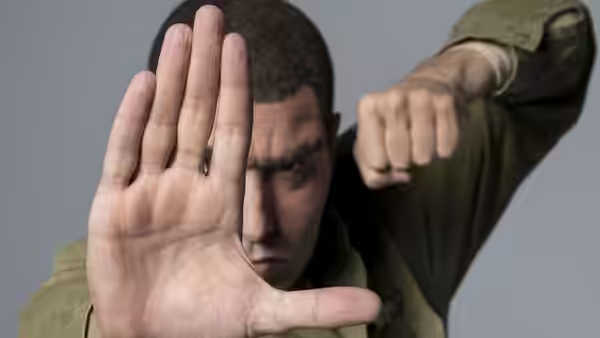
The excellent one is Erran Morad, a gun-rights evangelist with a square jaw, a flat voice and a settled conviction that every problem is solved by more guns in younger hands. In the first episode he pitches Kinderguardians, a gun-safety programme for preschoolers, and takes it to Washington. Men who have served in Congress read his lines off a card, lines about a pistol hidden inside a toy puppy and the developmental advantages of the under-fives, and they keep reading. Trent Lott, a former Senate majority leader, is among them. We laughed at the first line and had stopped by the third, because nobody on screen was joking.
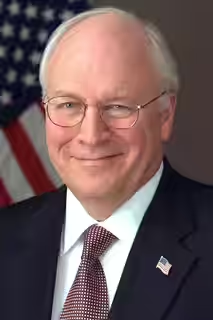
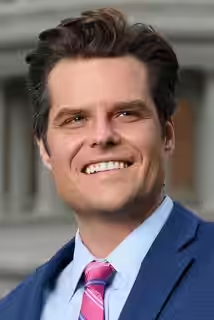
Morad works because his targets want to agree with him. Ali G and Borat got what they got by being foreign and foolish, so that the subject’s patience or prejudice came out in how they coped. Morad is a man these people want to impress, and he lets them do the talking. Matt Gaetz, a Florida congressman, listens to the whole pitch and declines to back anything on the spot, which is the one moment in the series where a politician behaves like a professional, and the show is honest enough to leave it in. Dick Cheney signs a waterboarding kit for him and looks pleased to have been asked. Later episodes send Morad after bigger game, and one segment, which we will not describe, shows that a sting can still do real damage.
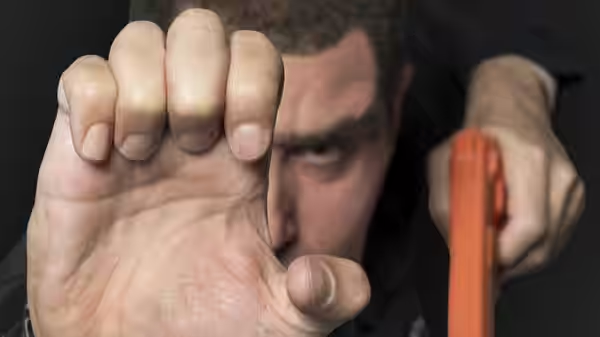
The rest of the wardrobe is thinner. A conspiracy vlogger lectures Bernie Sanders on percentages, and Sanders looks at him the way you look at a dripping tap. A liberal academic, the cartoon of a progressive that progressives already draw of themselves, sits through a dinner with conservative hosts that runs well past the point where anyone has anything left to reveal. An ex-convict turned artist gets one gallery owner to go further than we expected and then has nowhere to take her. These are sketch characters asked to carry documentary weight, and they cannot.
It is shot the only way it can be shot. Chris Darnell, Luke Geissbühler and Matthew W. Davis put the lens wherever it can be hidden, so faces sit half in shadow and the framing is a little off, which is honest and never handsome. Five editors are credited, among them Vera Drew and Eric Notarnicola, and the best segments hold a reaction a beat longer than the joke needs and trust the silence; the weaker ones run two minutes past the last laugh. Six directors share the credit, including Dan Mazer, who has worked with Baron Cohen since Da Ali G Show, and Nathan Fielder, whose own Nathan for You perfected the art of letting a real person talk himself into trouble. Where this feels like Fielder’s work, it is better.
The method depends on a gap between what people say when they think nobody important is listening and what they would say for the record. In 2006 that gap was wide. By 2018 the people Baron Cohen is after say the unsayable on camera every day, by choice, and a man in a wig can only confirm it. Most critics said as much, and on this we do not disagree with them.
Watch the first episode for Kinderguardians, which is the sharpest thing Baron Cohen has done since Borat, then decide. The rest is a gifted performer in a series of wigs, waiting for America to embarrass itself, and America had started without him.