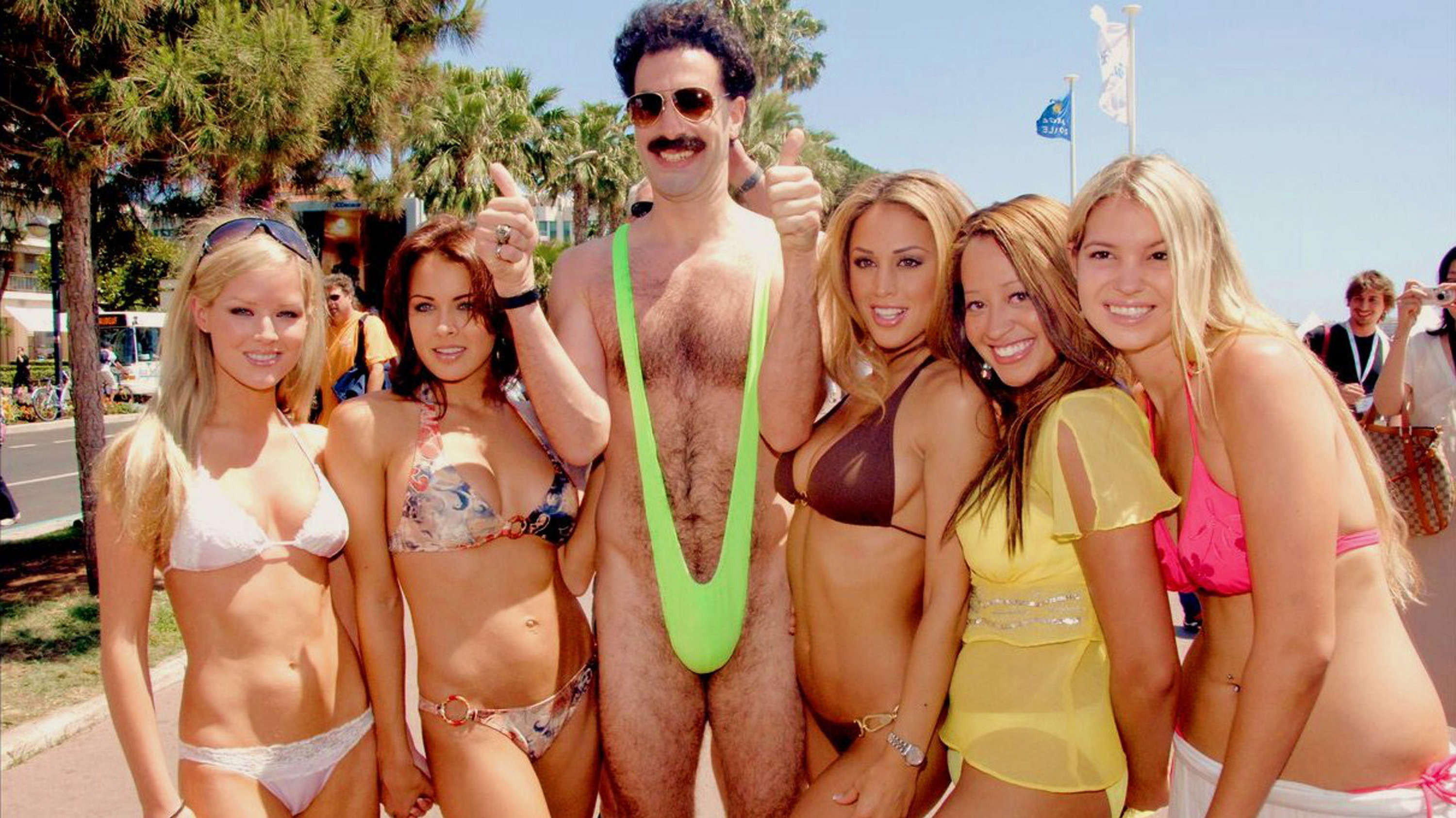
Larry Charles and Sacha Baron Cohen make a painfully funny prank film, with real people’s reactions supplying its sharpest moments. The obscenity works more reliably than the politics, and some of the embarrassment feels cheaply bought.
Borat is a ferociously funny comedy whose taste for humiliation sometimes outruns its judgement. Larry Charles lets Sacha Baron Cohen take an outrageous character into encounters with real Americans, then builds the film around their responses. We recommend it, provided that watching people struggle through an impossible social situation is a pleasure rather than an ordeal. The jokes depend on Borat saying things that most people would know to keep to themselves.
Cohen gives Borat a sweetness that makes people willing to hear him out. The character’s apparent innocence invites patience, and his bigotry then tests how far that patience will go. Cohen does not need to force every laugh; another person’s incredulity can do the work for him. His timing is particularly good at prolonging the uncomfortable business of waiting for somebody to decide how to respond.
The screenplay is credited to Peter Baynham, Anthony Hines, Cohen and Dan Mazer, and the comedy is more carefully organised than its reportorial form suggests. We laughed, then felt slightly ashamed of ourselves, at the ‘running of the Jew’. The grotesque antisemitic premise is presented with the same apparent innocence that Cohen brings to his encounters, so the laughter arrives before we have quite considered it. This is where the character’s combination of naivety and hatred produces something nastier and funnier than provocation alone.
The useful contribution of cinematographers Anthony Hardwick and Luke Geissbühler is keeping the reactions as important as the central performance. A face trying to make sense of Borat can hold our attention without any further assistance from him. Editors James Thomas, Peter Teschner and Craig Alpert keep the encounters moving without losing the hesitations that make them funny. Their handling of those exchanges gives Cohen space without making every participant’s bewilderment feel interminable. Erran Baron Cohen’s music provides useful accompaniment, though the exchanges are what we remember.
Our reservation concerns the people caught in the joke. Some reveal ugly prejudices, and the film gives us ample reason to laugh at their willingness to entertain Borat’s views. Others seem merely bewildered, and Charles is not always sufficiently interested in distinguishing embarrassment from a revealing response. Cohen’s ability to make almost anyone look foolish can become a problem when the film expects that foolishness to tell us something substantial about America: sometimes we have simply watched somebody being wrong-footed by a skilled comedian.
As a feature built from hoax reports, it faces the problem of making each fresh encounter justify starting the joke again. Cohen supplies enough variation in physical comedy and verbal provocation to keep that from becoming a chore. Charles also gives the scatological silliness room to work without requiring every laugh to serve a political purpose. At 84 minutes, the film is sensibly brief for an extended acquaintance with someone whose behaviour requires this much tolerance.
For all our reservations, the laughter is plentiful and often involuntary. We would choose it for an evening with people who can enjoy an appalling joke and still argue about whom it hurts. Anyone hoping for a tidy separation between satirical targets and innocent bystanders should choose something else.