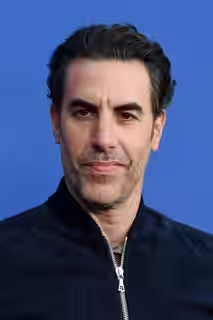
A man in olive clothing raises an open hand and clenches his other fist
Series review

Who Is America?

2018 · Created by Sacha Baron Cohen · Series

In a sentenceNobody notices the wig, and most of them would have said it anyway

Sacha Baron Cohen plays a stable of invented Americans and sends them, in prosthetics and under false names, to meet real ones across seven episodes. Nobody he sits down with has been told who he is. In the first episode a conspiracy vlogger lectures Bernie Sanders on percentages, a liberal academic sits through dinner with conservative hosts who take him at his word, and the series’ sharpest creation, Erran Morad, pitches Kinderguardians, a gun-safety programme for preschoolers, to current and former members of Congress, among them Trent Lott, and asks them to read its promotional script to camera. Most do. Matt Gaetz hears him out and will not. Later episodes bring Dick Cheney, Jill Stein, Howard Dean and Barney Frank to the table, each believing they are talking to somebody else.

Plays from YouTube when you press play; nothing loads from them until then.

Fi1m review

Sacha Baron Cohen puts the prosthetics back on and finds that American public life has caught up with him. One character, a gun-rights zealot called Erran Morad, draws out confessions worth the whole series; the others mostly stand around waiting for someone to be embarrassed.

Twelve years after Borat, Sacha Baron Cohen puts the prosthetics back on and goes looking for a country that has grown much harder to embarrass. Who Is America? runs to seven episodes, first shown on 15 July 2018, each a handful of segments in which an invented character sits down with a real person who has not been told who he is. The title asks its question in earnest. The answer the series gives is one excellent character and several who are mostly waiting for something to happen.

The excellent one is Erran Morad, a gun-rights evangelist with a square jaw, a flat voice and a settled conviction that every problem is solved by more guns in younger hands. In the first episode he pitches Kinderguardians, a gun-safety programme for preschoolers, and takes it to Washington. Men who have served in Congress read his lines off a card, lines about a pistol hidden inside a toy puppy and the developmental advantages of the under-fives, and they keep reading. Trent Lott, a former Senate majority leader, is among them. We laughed at the first line and had stopped by the third, because nobody on screen was joking.

Morad works because his targets want to agree with him. Ali G and Borat got what they got by being foreign and foolish, so that the subject’s patience or prejudice came out in how they coped. Morad is a man these people want to impress, and he lets them do the talking. Matt Gaetz, a Florida congressman, listens to the whole pitch and declines to back anything on the spot, which is the one moment in the series where a politician behaves like a professional, and the show is honest enough to leave it in. Dick Cheney signs a waterboarding kit for him and looks pleased to have been asked. Later episodes send Morad after bigger game, and one segment, which we will not describe, shows that a sting can still do real damage.

The rest of the wardrobe is thinner. A conspiracy vlogger lectures Bernie Sanders on percentages, and Sanders looks at him the way you look at a dripping tap. A liberal academic, the cartoon of a progressive that progressives already draw of themselves, sits through a dinner with conservative hosts that runs well past the point where anyone has anything left to reveal. An ex-convict turned artist gets one gallery owner to go further than we expected and then has nowhere to take her. These are sketch characters asked to carry documentary weight, and they cannot.

It is shot the only way it can be shot. Chris Darnell, Luke Geissbühler and Matthew W. Davis put the lens wherever it can be hidden, so faces sit half in shadow and the framing is a little off, which is honest and never handsome. Five editors are credited, among them Vera Drew and Eric Notarnicola, and the best segments hold a reaction a beat longer than the joke needs and trust the silence; the weaker ones run two minutes past the last laugh. Six directors share the credit, including Dan Mazer, who has worked with Baron Cohen since Da Ali G Show, and Nathan Fielder, whose own Nathan for You perfected the art of letting a real person talk himself into trouble. Where this feels like Fielder’s work, it is better.

The method depends on a gap between what people say when they think nobody important is listening and what they would say for the record. In 2006 that gap was wide. By 2018 the people Baron Cohen is after say the unsayable on camera every day, by choice, and a man in a wig can only confirm it. Most critics said as much, and on this we do not disagree with them.

Watch the first episode for Kinderguardians, which is the sharpest thing Baron Cohen has done since Borat, then decide. The rest is a gifted performer in a series of wigs, waiting for America to embarrass itself, and America had started without him.

Critical consensus AI synthesised

57
Positive
4
Mixed
2
Negative
3

The reviews split almost down the middle, and the critics’ score lands accordingly. Where most agree is on the high point: the gun-safety sketch, in which prominent figures are talked into endorsing the arming of small children, is picked out again and again as the sharpest and most revealing stretch. There is wide respect for Baron Cohen’s discipline in staying in character and for how readily his disguised interviews draw candid remarks from powerful people. IndieWire and The AV Club see something politically consequential in that.

The reservations cluster on the jokes. Several critics find the humour inconsistent, juvenile or simply not funny enough, with segments running long. The firmer dissent comes from The Hollywood Reporter, NME and The Guardian, who argue the deception rarely shocks because its targets already say these things openly, leaving the satire little to expose. The spread is wide, from warm to flatly disappointed.

IndieWire
15 July 2018 · B · Ben Travers
77

Travers finds the series ambitious and potentially consequential, but its jokes are inconsistent and it is often not very entertaining. He praises Cohen’s ability to stay in character and draw startlingly revealing behavior from prominent subjects.

Read the full review →
The AV Club
15 July 2018 · B · Randall Colburn
77

Colburn finds the premiere politically incisive, though it could be funnier and some segments drag. He singles out the Kinderguardians gun-safety satire for exposing how readily political figures embrace absurd claims that advance their agenda.

Read the full review →
The i Paper
16 July 2018 · Miranda Bryant
70*

The review finds the series timely and its satire more sophisticated than Baron Cohen’s earlier work. It praises the way his disguised characters expose the real people they encounter, while noting that some material becomes disturbing.

Read the full review →
Variety
15 July 2018 · Daniel D'Addario
70*

D’Addario finds the series a rich, timely comedy, though its contempt can sometimes irritate more than enlighten. He singles out the Kinder-Guardians segment as its creative high point, while criticizing some sketches as overlong and less engaging.

Read the full review →
Vulture
27 August 2018 · Jen Chaney
60*

Chaney finds the season flawed but mostly entertaining, with occasional flashes of near-genius. She singles out the Kinder-Guardians segment as the show’s most incisive and blistering achievement, while criticizing its repetitive and juvenile humor.

Read the full review →
The Guardian
22 July 2018 · Euan Ferguson
40*

The critic finds the satire uneven and less edgy than Baron Cohen’s earlier work. The preschool-gun segment is singled out as the sharpest, though the review argues that political extremism leaves little room for satire to land.

Read the full review →

Straight answers AI written, from our review

Is Who Is America? worth watching?
Who Is America? is worth watching for its first episode and not much beyond it, and we scored it 58. Sacha Baron Cohen's gun-rights evangelist Erran Morad gets former members of Congress to read a script endorsing firearms for preschoolers, and that segment alone justifies the hour. The other characters are sketch figures sitting through long dinners, waiting for an embarrassment that rarely arrives.
Where can I watch Who Is America? in Iceland?
Who Is America? is not on any streaming or rental service in Iceland at the moment. It is available in 9 other countries; change your country at the top of the page to see where. Availability is checked daily.
How violent or frightening is Who Is America?, and is it suitable for children?
Who Is America? contains no violence to speak of and is rated TV-MA in the United States, which places it with adult audiences, and it carries no UK certificate. The discomfort is in watching real public figures endorse guns for small children or sign a waterboarding kit without a flicker. It is not for children, who would also find little in it to follow.
How does Who Is America? compare to Brass Eye?
Who Is America? is the looser and more uneven of the two, and Brass Eye is the better programme. Chris Morris gets real public figures to condemn an invented drug with a discipline that holds every minute; Baron Cohen has one character, Erran Morad, who matches that, and several who pad out the running time. Choose this one if your interest is American politicians specifically.
What should I watch after Who Is America??
After Who Is America?, try Brass Eye (1997, Fi1m 86): Chris Morris gets real public figures to condemn an invented drug, with more discipline per minute. Then Nathan for You (2013, Fi1m 87): Fielder’s own series, where ordinary people talk themselves into absurdity without a single wig; and Borat (2006, Fi1m 81): The same method when the gap between private and public America was still wide.

Cast

If you liked this, try…

  1. Brass Eye (1997, Fi1m 86)Chris Morris gets real public figures to condemn an invented drug, with more discipline per minute.

  2. Nathan for You (2013, Fi1m 87)Fielder’s own series, where ordinary people talk themselves into absurdity without a single wig.

  3. The Yes Men (2003) · not reviewed yetTwo activists impersonate the World Trade Organisation and their hosts politely take notes.

  4. Borat (2006, Fi1m 81)The same method when the gap between private and public America was still wide.

  5. The Eric Andre Show (2012) · not reviewed yetAmbush comedy that makes the host the victim as often as the guest.

Free account

Know what to watch tonight

Two lists that know where things are streaming, collections you can share, your own score beside ours, and Discover that remembers what you have seen.

  • Want to see, sorted by what is streaming now
  • Seen, with your score out of ten
  • No adverts, ever