Ten films in thirty years, every one of them talking. A guide to where to start, where to linger, and which one to leave for a wet afternoon you don't mind losing.
Fi1m · 12 September 2026 · 4 min read
Quentin Tarantino has said, often enough that it is now a promise, that he will stop at ten. By his own count he is there: he treats Kill Bill as one film, which is generous to Vol. 2 and about right. Whether he keeps the promise is his business. Ours is the question people actually ask on a Friday night, which is not “is he a great director” but “which one?”
Here is our answer, from the one we would put on tonight to the one we admire from a safe distance.
1. Pulp Fiction (1994)
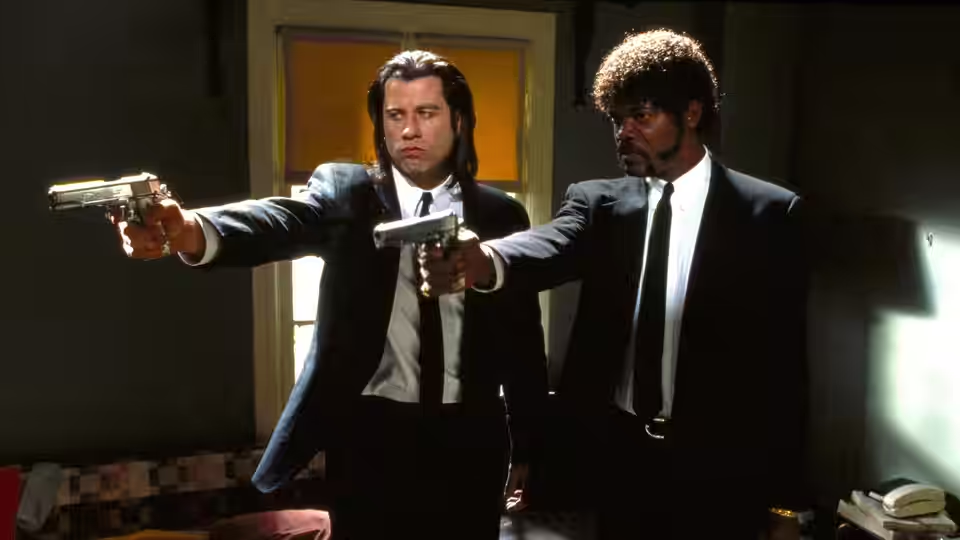
Pulp Fiction is still the one. Three stories, told out of order, about people who talk about hamburgers and foot massages while they wait to do something terrible. It was the film that persuaded a generation of young men that dialogue was the whole job, and most of them were wrong, but he wasn't. John Travolta was rescued by it; Samuel L. Jackson was made by it; Bruce Willis has never been better. It won the Palme d'Or, and it has dated less than anything else here because it was never trying to be contemporary in the first place.
2. Jackie Brown (1997)
The quiet one, and the one his admirers are most likely to have missed. Adapted from Elmore Leonard's Rum Punch, Jackie Brown is about a middle-aged air stewardess (Pam Grier) and a middle-aged bail bondsman (Robert Forster) who look at each other across a table and see a way out. It is patient, sad and very funny, and there is a sequence in a shopping mall that he has never bettered. It made less money than the others. That tells you something about audiences, not about the film.
3. Inglourious Basterds (2009)
The one in which he decided the Second World War could end however he liked. Inglourious Basterds has the best opening he has written, a farmhouse and a glass of milk, and the best villain, Christoph Waltz's Hans Landa, a man who enjoys his own cleverness so much that you very nearly enjoy it with him. It also has a long scene in a basement tavern that is, for our money, the most suspenseful thing he has made. The finale is the point at which you decide whether you can go along with him. We could.
4. Once Upon a Time in Hollywood (2019)
A fading television actor and his stunt double drive around Los Angeles in 1969, and for two hours almost nothing happens, gloriously. Once Upon a Time in Hollywood is his most relaxed picture and his most affectionate, and Brad Pitt, feeding a pit bull and fixing an aerial, has never seemed more at ease on screen. The Sharon Tate thread asks you to know what happened in real life and to have feelings about it. He does, and the last twenty minutes are his most tender even while they are being his most violent.
5. Reservoir Dogs (1992)
The debut, made for very little and mostly in one warehouse. Reservoir Dogs has the ear, the suits, the argument about tipping and the scene with the radio that people who have never seen it can describe. It is a young man's film and it knows it. Seen now it is a sketch of everything that followed, which is not the same as being lesser.
6. Django Unchained (2012)
Django Unchained is a Western about slavery that wants to be both a revenge fantasy and a serious film, and gets closer to managing it than it has any right to. Waltz again, as a bounty-hunting dentist; Leonardo DiCaprio as a plantation owner with terrible teeth; and Samuel L. Jackson, as the house slave Stephen, giving the most uncomfortable performance in any of these films. It runs long. The last half hour would have been better as the last quarter of an hour.
7. Kill Bill: Vol. 1 and Vol. 2 (2003, 2004)
His one film in two, and the halves are different animals. Vol. 1 is a martial arts picture, all yellow tracksuit and a sword fight in a Tokyo nightclub, and it is a great deal of fun for about ninety minutes. Vol. 2 is a Western, slower and stranger, with a coffin, a caravan and David Carradine talking about Superman. We prefer the second, which is the less popular opinion and the correct one. Uma Thurman holds both together.
8. The Hateful Eight (2015)
Eight people in a haberdashery in a blizzard, and one of them is lying. The Hateful Eight was shot in 70mm and mostly takes place in one room, which is either a joke or a point. Ennio Morricone's score, his first for a Western in decades, won him his only competitive Oscar. It is a nasty film, deliberately, and the nastiness eventually becomes the whole of it. We admire it, and we do not want to watch it again.
9. Death Proof (2007)
Half of a double bill called Grindhouse that Britain saw as a film on its own. Death Proof is Kurt Russell as a stuntman who kills women with his car, and then a second set of women, one of them the real stuntwoman Zoë Bell, who are not having it. The car chase at the end is done for real and it is tremendous. The forty minutes of conversation before it are the only time his dialogue has felt like padding.
Where to start
If you have somehow never seen one, Pulp Fiction. If you have seen that and want to know whether the fuss is justified, Jackie Brown, which is where he stops showing off. And if there is a tenth, we will be first in the queue, arguing about where it goes on this list before the credits have finished.
Features are written by AI in Fi1m’s voice, checked against our reviews before publication, and corrected in the open. How we use AI