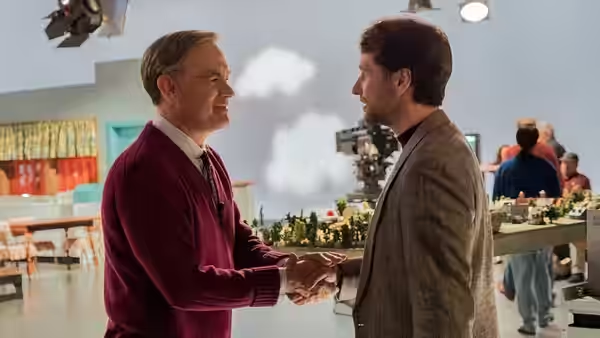
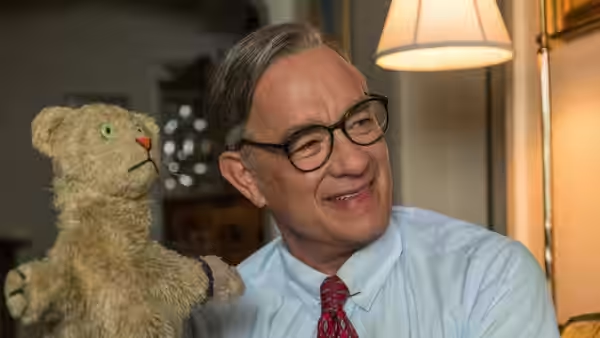
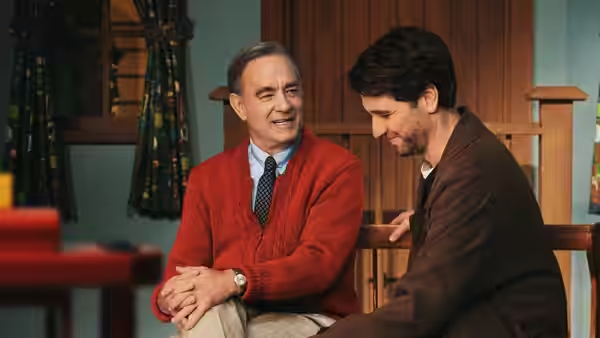
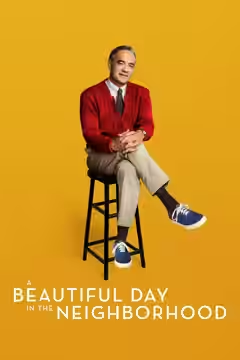
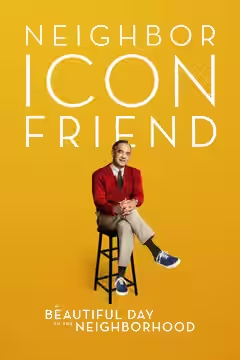
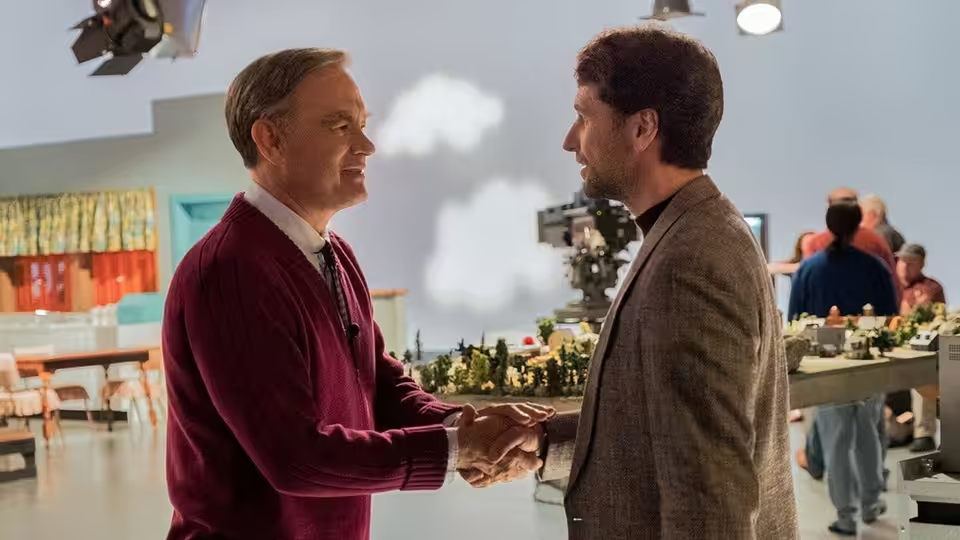
Fred Rogers (Tom Hanks) shakes hands with Lloyd Vogel (Matthew Rhys) on the studio set
Film review

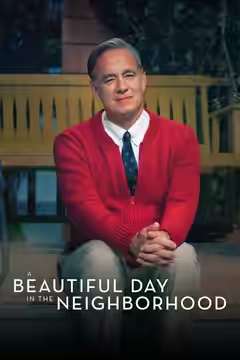
A Beautiful Day in the Neighborhood

2019 · Directed by Marielle Heller · 1h 49m

In a sentenceThe most patient man on television meets a magazine writer with a deadline and a black eye, and simply waits

New York, 1998. Lloyd Vogel (Matthew Rhys) writes for Esquire and has a reputation for taking his subjects apart, which is why nobody will agree to be profiled by him. His editor, Ellen (Christine Lahti), hands him the one assignment left: 400 words on the children’s television presenter Fred Rogers (Tom Hanks) for an issue about heroes. At home Lloyd has a new baby and a wife, Andrea (Susan Kelechi Watson), who asks him not to ruin her childhood. At his sister Lorraine’s wedding his estranged father Jerry (Chris Cooper) turns up drunk, and the two of them fight. Lloyd flies to Pittsburgh with a black eye and a tape recorder, and finds that Rogers, on the set of his programme, would rather ask the questions than answer them.

Plays from YouTube when you press play; nothing loads from them until then.

Fi1m review

Heller frames a magazine writer’s crisis as an episode of Mister Rogers’ Neighborhood, and the trick is warmer and stranger than it sounds. Tom Hanks is patient and exact; the story he is being patient with is the familiar one about a son and his father.

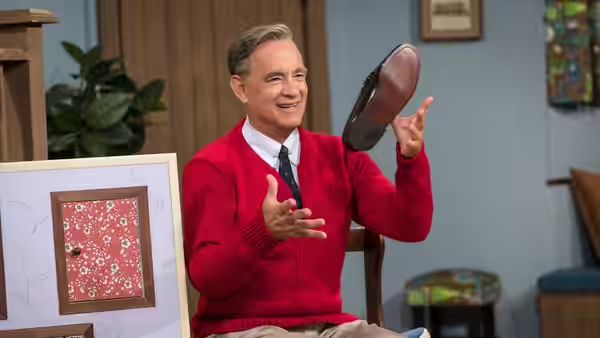
Marielle Heller’s film is not a biopic of Fred Rogers, and it says so in its first minute. It opens as an episode of Mister Rogers’ Neighborhood: the model street, the front door, the cardigan, Tom Hanks changing his shoes and telling us about a friend of his called Lloyd who has a hurt on his face. Lloyd is the subject. Rogers is the weather. That decision keeps the film from being the one you were dreading, and it also hands the film its main weakness, because Lloyd’s story is the ordinary one. We liked it, warmly and with reservations, for most of its 109 minutes.

Hanks does not do an impression. His voice is lower and slower than Rogers’s own, and he never tries to vanish inside the part. What he gets right is the pace. This Rogers listens as if there were no clock in the building, and pauses before answering as if the question had earned it. When Lloyd asks him something sharp at the studio, Rogers asks about Lloyd’s father instead, and Hanks makes the deflection look like attention. He also lets us see that goodness of this sort is work: there are admissions, later, about temper and about how he manages it, and Hanks plays them as facts rather than confessions.

Matthew Rhys has the harder job. Lloyd is a man who wrote a piece so unkind that no one will talk to him, and Rhys plays him without asking for our sympathy: shoulders up, jaw set, the bruise from his sister’s wedding worn like a badge. Chris Cooper’s Jerry is the drunk father who turns up with a new partner, Dorothy (Wendy Makkena), and wants to be forgiven before he has asked. Susan Kelechi Watson gives Andrea more weight than the script does; the marriage feels lived in, and her fondness for Rogers is the film’s first joke and its steadiest argument.

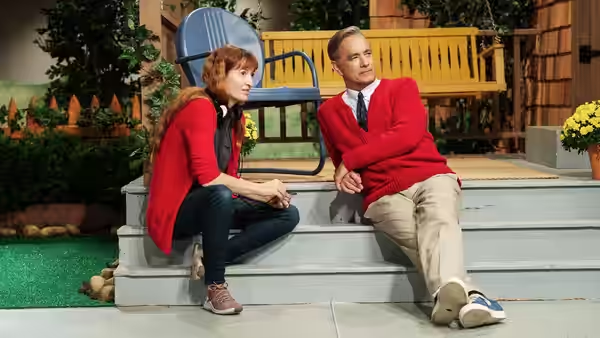
The craft is where Heller’s playfulness shows. Jade Healy’s team built the film’s cities as models, so that when Lloyd flies to Pittsburgh a toy aeroplane crosses a painted sky and lands beside a miniature of the studio, and the real world arrives with the same wooden houses the programme used. Jody Lee Lipes shoots the Neighborhood scenes soft and flat, so they look like the old show, and shoots the rest in cooler, plainer light, so you always know which world you are in. Nate Heller’s score is mostly piano, and quiet, and it knows when to stop. Arjun Bhasin’s costumes do a good deal of the characterisation: Rogers in his cardigans and Lloyd in jackets that look slept in.

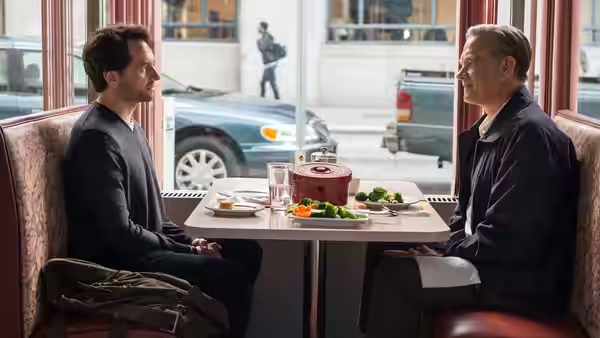
The scene everyone talks about is in a diner. Rogers asks Lloyd to take one minute to think about the people who loved him into being, and the film then holds that minute. Anne McCabe does not cut away to fill it. Hanks looks into the lens; the other diners fall silent; there is no music. We sat there and did as we were told, and we were caught out. It was not sentiment that did it, because there was none on offer; it was being asked, directly, and finding we had an answer. That minute is what separates this film from the tidy thing it might have been.

The rest is tidier. Once Lloyd’s family troubles come to a head, the script by Micah Fitzerman-Blue and Noah Harpster moves through them in the order you would expect, and the last half hour is slower and softer than the first. A dream sequence in which Lloyd shrinks to the size of one of the puppets and finds himself on the set has nerve, and we admired the nerve, but it tells us nothing we had not already gathered. Enrico Colantoni’s Bill Isler and Carmen Cusack’s Margy Whitmer, running the studio around Rogers, are sketched in a few lines and deserved more.

Heller’s The Diary of a Teenage Girl and Can You Ever Forgive Me? were about people who were hard to like, and she did not soften them. This film has a hard man too, but it wants him mended, and it mends him. That is the difference between a good film and the ones she made before it, and it is not a small difference.

It is a PG. Watch it at home, where you can do the minute without anyone seeing you.
Critical consensus AI synthesised

76
Positive
23
Mixed
7
Negative
0

Most critics are won over. The reviews find the film warm and moving, and several are surprised that it is more rigorous and less sugary than a film about Fred Rogers might be expected to be. Praise gathers around Tom Hanks, whose gentle, closely observed Rogers is singled out by almost everyone, including critics who like little else. Marielle Heller’s direction is the other constant: the framing of the story as an episode of the television programme, and a diner scene in which Rogers asks for a minute of silence, which several critics say stops the cinema dead.

The reservations are about focus and sweetness. Some feel the film is really about the journalist, Lloyd, and that Rogers himself goes unexplored; Vulture and The Skinny both say so. Others find the final act maudlin or the pace slow. The spread is narrow and nobody is hostile. The coolest notices, from The Hollywood Reporter and Den of Geek, find it predictable and tedious respectively, though both still admire Hanks.

Los Angeles Times
21 November 2019 · Justin Chang
90*

Chang finds the film tender, genuinely moving, and never manipulative. He especially praises Marielle Heller’s playful visual style and a moment of silence that brings the theater to a reflective standstill.

Read the full review →
Slant Magazine
20 November 2019 · ★★★½/4 · Keith Uhlich
88

Uhlich finds the film a knotty, hard-earned parable whose tenderness ultimately triumphs without ignoring its potential for cruelty. He praises Marielle Heller’s subtle interrogation of the story’s sentimental trappings.

Read the full review →
Empire
27 January 2020 · Ian Freer
85*

Freer calls the film a nuanced, formally playful delight and praises its perfectly judged tone. He singles out Tom Hanks’s performance and the moving scene in which Rogers invites Vogel to share a minute of silence.

Read the full review →
Sight and Sound
28 January 2020 · Andrew Simpson
85*

Simpson finds the film impressively humane and emotionally affecting, with its formal inventiveness supporting its exploration of grief and connection. He especially praises Marielle Heller’s direction and Tom Hanks’s nuanced portrayal of Fred Rogers.

Read the full review →
Variety
7 September 2019 · Critics Pick · Owen Gleiberman
85*

Gleiberman finds the film enchanting and soft-hearted, with Tom Hanks giving a transporting performance as Mister Rogers. He especially praises Hanks’s ability to capture Rogers’s gentle manner and make his sincere presence feel convincing.

Read the full review →
IndieWire
8 September 2019 · B+ · Eric Kohn
83

Kohn finds the film sweet and thoughtful, with more depth than its familiar sentimentality suggests. He especially praises Heller’s fourth-wall-breaking use of Rogers’s Emmy speech to turn a potentially cheesy moment into a magical one.

Read the full review →

Straight answers AI written, from our review

Is A Beautiful Day in the Neighborhood worth watching?
A Beautiful Day in the Neighborhood is worth watching, and we scored it 77. Tom Hanks plays Fred Rogers with patience rather than impression, and the film's model cities and one held minute in a diner give it more nerve than the tidy story about Lloyd Vogel and his father deserves. The last half hour is slower and softer than the first.
How long is A Beautiful Day in the Neighborhood, and what is it rated?
A Beautiful Day in the Neighborhood runs 1h 49m. It is a history and family film.
Where can I watch A Beautiful Day in the Neighborhood in Serbia?
A Beautiful Day in the Neighborhood is streaming on HBO Max in Serbia, and it is also available to rent from Amazon Prime Video from din 2.99. Availability is checked daily; the links above go straight to each service.
How does A Beautiful Day in the Neighborhood compare to Can You Ever Forgive Me??
A Beautiful Day in the Neighborhood is the warmer of Marielle Heller's two films and Can You Ever Forgive Me? is the sharper. The earlier film keeps its difficult lead difficult and is the better for it; this one takes a hard man and mends him. Choose the forgery story if you prefer your comedy melancholy, and this if you want to be asked, directly, to think about who loved you.
What should I watch after A Beautiful Day in the Neighborhood?
After A Beautiful Day in the Neighborhood, try Can You Ever Forgive Me? (2018, Fi1m 84): Heller’s previous film, with a lead she declines to soften and a sharper edge throughout. Then Won't You Be My Neighbor? (2018, Fi1m 80): The documentary, for anyone who wants the man rather than the parable; and The Straight Story (1999, Fi1m 88): An old man on a lawnmower goes to make peace with his brother; Lynch at his gentlest.

Cast

If you liked this, try…

  1. Can You Ever Forgive Me? (2018, Fi1m 84)Heller’s previous film, with a lead she declines to soften and a sharper edge throughout.

  2. Won't You Be My Neighbor? (2018, Fi1m 80)The documentary, for anyone who wants the man rather than the parable.

  3. The Straight Story (1999, Fi1m 88)An old man on a lawnmower goes to make peace with his brother; Lynch at his gentlest.

  4. Paddington 2 (2017, Fi1m 91)Kindness as a working method, with better jokes and a bear.

  5. Ikiru (1952, Fi1m 92)Kurosawa on a man deciding, late, what a decent life looks like.