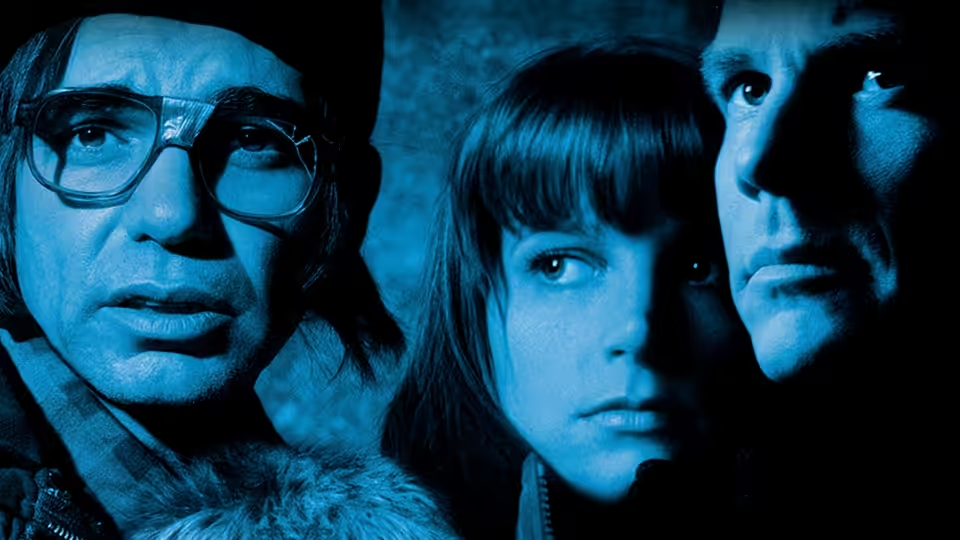
Sam Raimi makes a familiar crime story hurt through patience and sharply judged performances from Bill Paxton and Billy Bob Thornton. The plotting is sometimes predictable, but the characters matter enough to make its warning about greed painful.
Sam Raimi’s A Simple Plan is a patient, frightening crime drama that we recommend despite some predictable plotting. A fortune turns up in a crashed plane, and the promise of a better life begins to wear away ordinary scruples. Raimi takes that familiar starting point seriously enough to make it troubling again. He lets us understand why the money is tempting before asking how much we would excuse in the people who find it.
Scott B. Smith adapts his own novel with a firm grasp of how a sensible explanation can make a bad decision sound manageable. The plotting stays close to the people involved, so the thriller keeps its human scale even as their judgement worsens. There is no great mystery about the danger of greed, which limits the surprise. What holds our attention is the gradual change in what these people are prepared to accept, and how readily each step can be explained away.
Bill Paxton gives Hank Mitchell the reassuring presence the story needs. We want to believe in his competence, and Paxton is careful not to make that confidence look foolish at the outset. His performance makes it possible to follow the reasoning while becoming increasingly alarmed by the conclusions. Raimi’s restraint matters here: a more demonstrative performance would let us dismiss Hank too comfortably, when the uncomfortable part is how plausible Paxton makes him.
Billy Bob Thornton’s Jacob Mitchell is the stronger reason to watch. His difficulty keeping up with the others is painful because Thornton gives him feelings that are easier to understand than the plans around him. We were more upset by Jacob’s vulnerability than we expected; Thornton makes the prospect of wealth seem a particularly dangerous thing to put within his reach. The performance gives the brothers’ predicament a sadness that the mechanics of a crime story alone could not supply.
Alar Kivilo’s cinematography makes the wintry setting feel inhospitable without turning it into a distraction. The photography suits Raimi’s unhurried approach, giving us little comfort when our attention moves from the people to their surroundings. Patrizia von Brandenstein’s production design is persuasive about the ordinary lives the money might change. The film needs us to believe that these people might be tempted, and the lack of anything showy helps.
Arthur Coburn and Eric L. Beason’s editing gives the reasoning room to develop without loosening the suspense. At 121 minutes, the film has time to make company with these people uncomfortable, though we occasionally recognise the next moral difficulty before the script has finished approaching it. Danny Elfman’s music helps sustain the unease, but can underline a threat that the acting has already made plain. These are small objections, though they matter in a film whose strongest passages trust us to notice what is going wrong.
Within the crime thriller’s familiar account of greed and distrust, Raimi’s attention to the brothers is what distinguishes the film. The quieter approach suits him: he allows the performances to carry the tension without continually drawing attention to the direction. There is pleasure in watching something so carefully made, even when spending time with its characters becomes distressing. Choose it for a quiet evening, provided nobody expects to feel better afterwards.