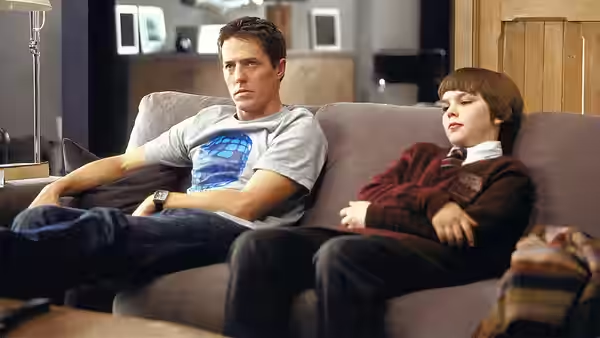
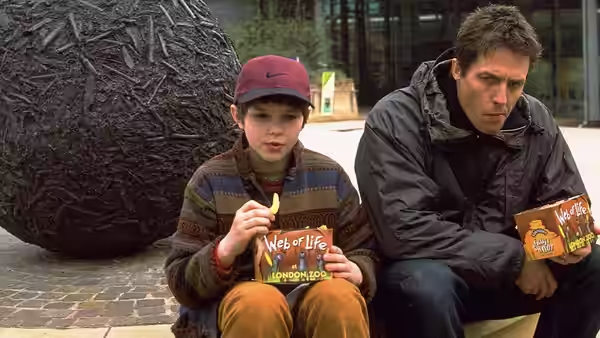
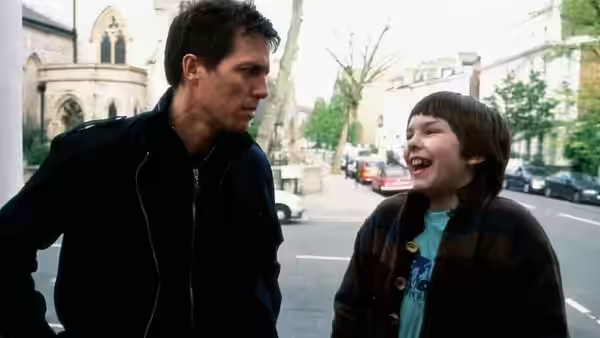
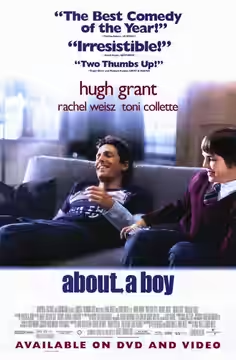
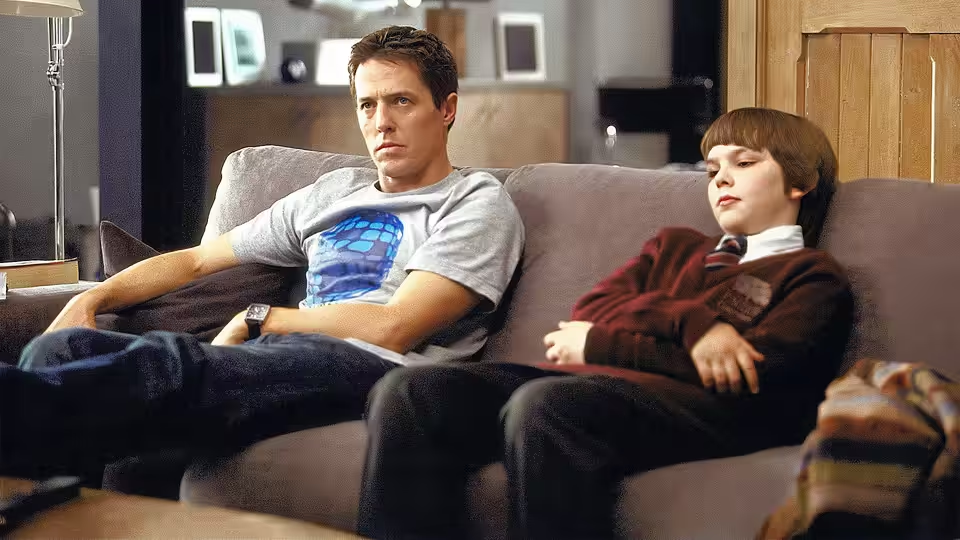
Will Freeman (Hugh Grant) and Marcus Brewer (Nicholas Hoult) sit side by side on a sofa
Film review

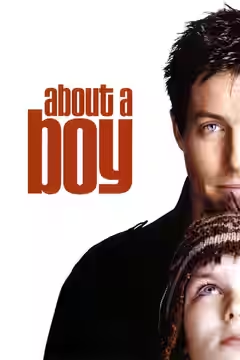
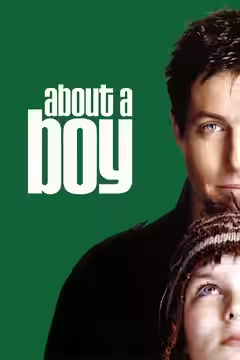
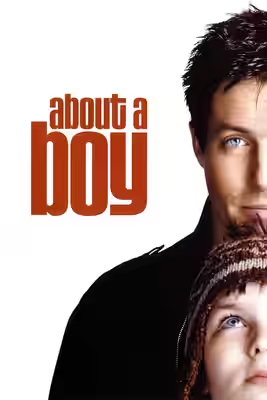
About a Boy

2002 · Directed by Chris Weitz, Paul Weitz · 1h 41m · CH 12

In a sentenceHugh Grant looks politely appalled at being asked to grow up

An unlikely friendship brings Will Freeman (Hugh Grant) together with Marcus Brewer (Nicholas Hoult), with neither quite equipped to deal with the other. Will is the adult and Marcus the boy, but growing up is a concern for both of them. Their relationship develops alongside the difficulties facing Fiona Brewer (Toni Collette), whose depression brings another set of needs into their lives. Will’s detachment becomes harder to maintain as he gets to know Marcus. The friendship asks how far Will is prepared to change and what the boy can expect from him.

Fi1m review

Hugh Grant and Nicholas Hoult make About a Boy a funny, touching comedy about an unlikely friendship. The women get less room, and the sentiment sometimes needs a firmer hand, but the central pairing earns our affection.

About a Boy is a good comedy about an unlikely friendship, with a performance from Hugh Grant that is worth rather more than the familiar lesson about growing up. Directors Paul Weitz and Chris Weitz trust the awkwardness between him and Nicholas Hoult, and the film is funniest when neither appears to be trying to please us. Adapting Nick Hornby’s novel with Peter Hedges, they keep the central relationship from becoming too respectable. Some of the surrounding characters could use the same attention.

Hugh Grant plays Will Freeman with a precise sense of how little to give away. His blankness is funny because there seems to be some calculation behind it: perhaps a sufficiently unhelpful response will bring this conversation to an end. We laughed at those pauses, and at the suggestion that answering properly would involve more work than Will considers reasonable. The performance keeps him interesting even when he has little of interest to contribute.

Nicholas Hoult’s Marcus Brewer gives Will someone he cannot simply out-charm. The pleasure of their scenes is the mismatch in comic rhythm: the adult appears to be managing an encounter while the boy declines to supply the response that would make it easy. The younger actor earns sympathy without asking us to find every awkward moment adorable. In a coming-of-age comedy, where a child can so easily become a lesson for an adult, that individuality matters.

The writing is less generous to the women. Toni Collette gives Fiona Brewer’s depression enough weight to stop it becoming an eccentricity, though the film sometimes seems too eager to make distress fit the comedy. Rachel Weisz brings assurance to Rachel, but the part has less room to develop than Will’s. The screenplay by Paul Weitz, Chris Weitz and Peter Hedges understands its central man more fully than the people around him, and that limits how far the feeling goes.

Remi Adefarasin’s cinematography keeps small shifts of expression legible without insisting that each should be important. Jim Clay’s production design has a comparable restraint: the surroundings feel inhabited without competing for attention. Neither contribution makes an ordinary conversation feel like a grand occasion. That suits the material, although the visual modesty also means there is little to distract us when an exchange is less sharply written.

Nick Moore’s editing is alert to the time a reaction needs; a quicker cut would often spoil Will’s apparent indifference. Badly Drawn Boy’s music adds an appealing softness, but it also helps make the sentiment feel more settled than the writing warrants. When the film presses hardest for an emotional response, the encouragement becomes noticeable. The friendship has already done enough to interest us without quite so much assistance.

Coming-of-age comedies often ask children to be relentlessly lovable, and this one benefits from letting Marcus be awkward. Its growing tidiness is a limitation, especially when the central actors have made the discomfort so enjoyable. At 101 minutes, it gives their exchanges room without allowing the pace to become leisurely. We recommend it for their company, with a little patience for the film’s more insistent efforts to warm us up.

Critical consensus AI synthesised

68
Positive
6
Mixed
7
Negative
0

The reviews lean towards approval rather than outright enthusiasm, with positive and mixed assessments but no negative verdicts. Hugh Grant is the clearest point of agreement: critics repeatedly praise his comic timing and controlled portrayal of Will, even when the film itself wins only qualified approval. Nicholas Hoult also earns praise for his performance and chemistry with Grant. The warmer accounts find the comedy funny, irreverent and refreshingly unsentimental, with an unlikely friendship that gives the coming-of-age story its appeal.

The main divide concerns how successfully the humour and emotion work together. Digital Spy finds the storytelling both hilarious and affecting, while Variety considers it pleasant but short on laughs and emotional involvement, finding the emotional climax manufactured. The Guardian admires Grant’s intelligence but misses his earlier comic energy and questions the film’s earnestness. The spread is appreciable rather than polarised, though several partial reviews offer too little accessible detail to establish their reasoning.

Radio Times
★★★★ · Lorien Haynes
80

The review is positive about this British adaptation. It singles out Hugh Grant’s excellent performance as Will.

Read the full review →
Total Film
26 April 2002 · ★★★★ · Total Film
80

The critic calls it a pleasingly skewed, very funny British comedy that delivers an enjoyable take on coming of age. They praise the chemistry between Hugh Grant and Nicholas Hoult, along with Hoult’s performance and the film’s irreverent humor.

Read the full review →
Empire
1 January 2010 · Colin Kennedy
70*

Kennedy finds the comedy-drama admirably unsentimental and consistently funny, with its positives outweighing its flaws. He singles out Hugh Grant’s finely calibrated comic performance, while noting that the supporting cast cannot match him gag for gag.

Read the full review →
The New York Times
17 May 2002 · A. O. Scott
70*

The review is broadly positive about the film’s comic take on an unlikely friendship. It singles out Hugh Grant’s performance as a highlight.

Read the full review →
Evening Standard
10 April 2012
65*

The review is broadly positive, though it finds the women less successful than the central character. It especially praises Hugh Grant’s comic timing and performance.

Read the full review →
Screen Daily
18 March 2002 · Sheila Johnston
64*

The page identifies this as a review, but the accessible text does not reveal the critic’s verdict. It also does not show what the critic singled out for praise or complaint.

Read the full review →

Straight answers AI written, from our review

Is About a Boy worth watching?
About a Boy is worth watching for Hugh Grant and Nicholas Hoult’s funny, touching partnership, and we score it 77 out of 100. We recommend it for their awkward exchanges and dry comic timing, with some patience for the underwritten women and the film’s occasional insistence on making us feel warm.
How long is About a Boy, and what is it rated?
About a Boy runs 1h 41m and is rated 12 by the CH in Switzerland. It is a drama and comedy film.
Where can I watch About a Boy in Switzerland?
About a Boy is not on any streaming or rental service in Switzerland at the moment. It is available in 24 other countries; change your country at the top of the page to see where. Availability is checked daily.
How violent or frightening is About a Boy, and is it suitable for children?
About a Boy has a UK 12 certificate, making it a more appropriate choice for teenagers than younger children. Fiona’s depression gives the comedy an adult concern that we would weigh when choosing it for a family evening; the certificate alone does not establish how much violence or frightening material it contains.
How does About a Boy compare to The Station Agent?
About a Boy offers a more sentimentally insistent take on reluctant friendship than The Station Agent, which we favour for the space it gives its actors. Both find dry humour in awkward company, but Grant and Hoult’s mismatched comic rhythms are the particular pleasure here, while Peter Dinklage’s watchful performance anchors the companion film.
Is About a Boy based on a true story or a book?
About a Boy is adapted from Nick Hornby’s novel, rather than presented as a true story, with a screenplay by Paul Weitz, Chris Weitz and Peter Hedges. We recommend it without requiring familiarity with the book: the awkward friendship between Will and Marcus supplies the comedy and feeling on its own.
What should I watch after About a Boy?
After About a Boy, try The Station Agent (2003, Fi1m 82): The awkward business of accepting friendship, handled with patience and dry humour. Then Hunt for the Wilderpeople (2016, Fi1m 82): A prickly adult and a difficult boy make unexpectedly good comic company; and Local Hero (1983, Fi1m 86): Another comedy that finds warmth without requiring its people to become saints.

Cast

Awards

Academy Awards, 2003

Nominated
Best Writing, Adapted Screenplay

If you liked this, try…

  1. The Station Agent (2003, Fi1m 82)The awkward business of accepting friendship, handled with patience and dry humour.

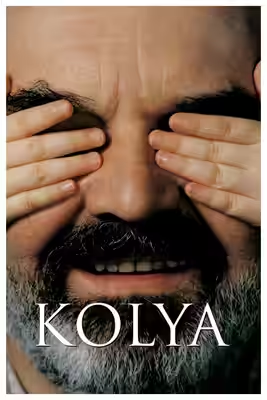
  2. Kolya (1996) · not reviewed yetAn adult’s comfortable selfishness meets a child who requires more than charm.

  3. Hunt for the Wilderpeople (2016, Fi1m 82)A prickly adult and a difficult boy make unexpectedly good comic company.

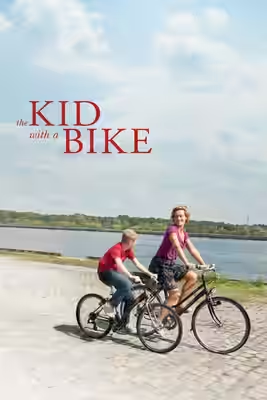
  4. The Kid with a Bike (2011) · not reviewed yetA tougher look at a child’s need for dependable adult affection.

  5. Local Hero (1983, Fi1m 86)Another comedy that finds warmth without requiring its people to become saints.

Free account

Know what to watch tonight

Two lists that know where things are streaming, collections you can share, your own score beside ours, and Discover that remembers what you have seen.

  • Want to see, sorted by what is streaming now
  • Seen, with your score out of ten
  • No adverts, ever