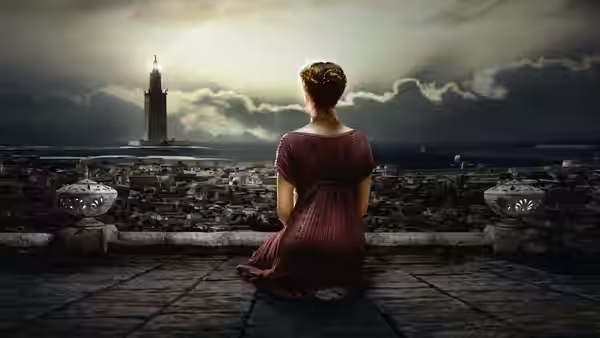
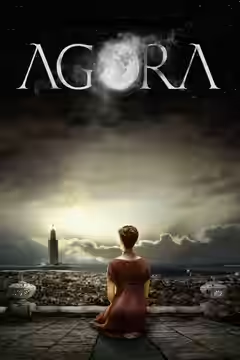
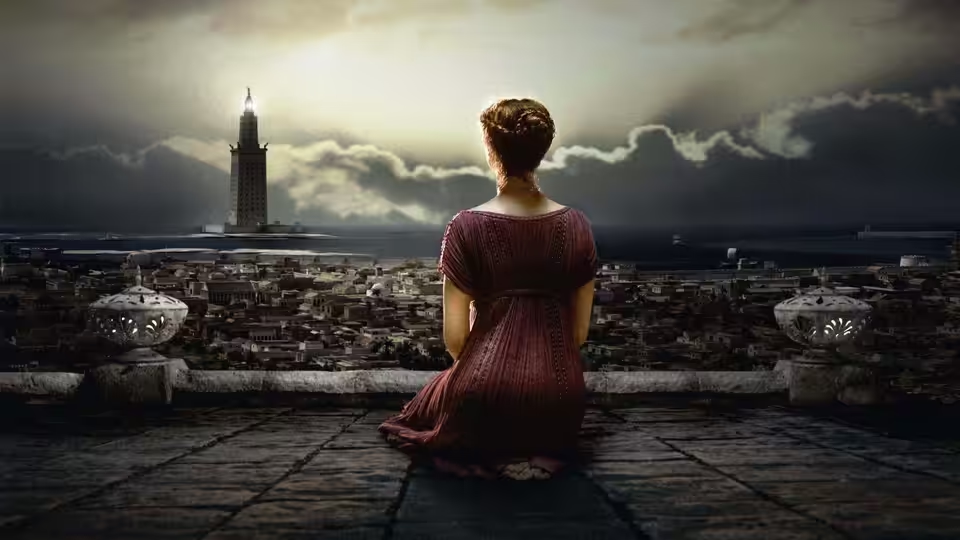
A woman in a red dress sits on a terrace overlooking the city and lighthouse
Film review

Agora

2009 · Directed by Alejandro Amenábar · 2h 07m · ICAA 12

In a sentenceThe camera keeps retreating to orbit, as if embarrassed by what the people are doing downstairs

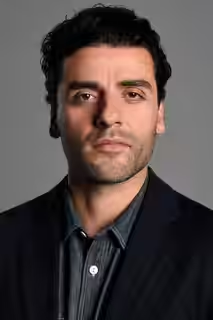
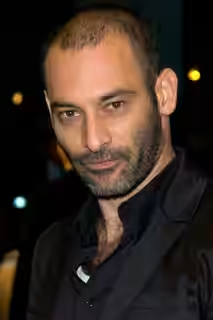
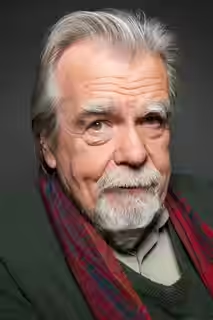
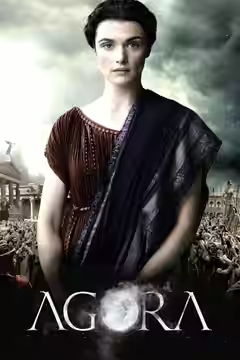
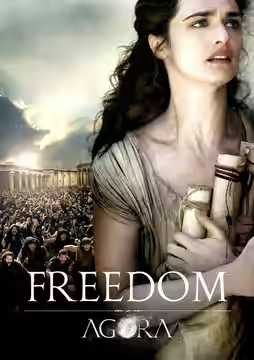
Alexandria, Egypt, 391 AD. Hypatia (Rachel Weisz), daughter of Theon (Michael Lonsdale), who runs the city’s Library, teaches philosophy and astronomy to the sons of the elite and wants to work out why the planets wander across the sky. Her student Orestes (Oscar Isaac) is in love with her and says so in front of the school. Her slave Davus (Max Minghella) is in love with her and says nothing. Outside, the city is splitting. Christians led by Bishop Theophilus (Manuel Cauchi) mock the old gods in the agora, and the monk Ammonius (Ashraf Barhom) feeds the poor and offers Davus a faith Hypatia’s household never will. When the pagans strike back, the scholars are besieged inside the Library, and the emperor is asked who owns it.

Fi1m review

Alejandro Amenábar’s drama of reason against faith in fourth-century Alexandria is lavishly built and seriously meant, and Rachel Weisz holds it together. It is also a film that keeps telling us what it thinks, when it could have shown us and trusted us.

Alejandro Amenábar, who made The Others (2001) and The Sea Inside (2004), goes to Alexandria in 391 AD for a film about a woman who wants to know how the heavens move while the city around her decides how everyone is going to pray. He wrote it with Mateo Gil, and they have made something rarer than it sounds: a historical film in which the most urgent thing anyone does is ask a question. It is handsome, it is serious, and it is far too fond of the sermon. It runs 127 minutes and carries a 12.

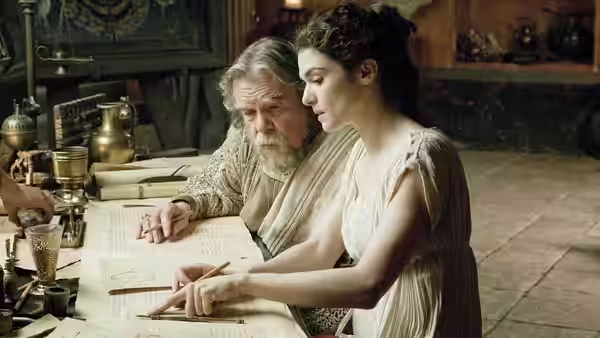
Rachel Weisz plays Hypatia as a teacher before anything else. She puts a problem to a room of young men and waits, unbothered, while they fail to answer it. When Orestes declares his love in front of the whole school she replies with a gift he did not want, and Weisz plays it as a fact about her body and her work rather than as cruelty. The film is best in these lessons, in the lamplit hall with the models of the spheres turning, because there we can see what she is protecting and why she would rather protect it than be loved.

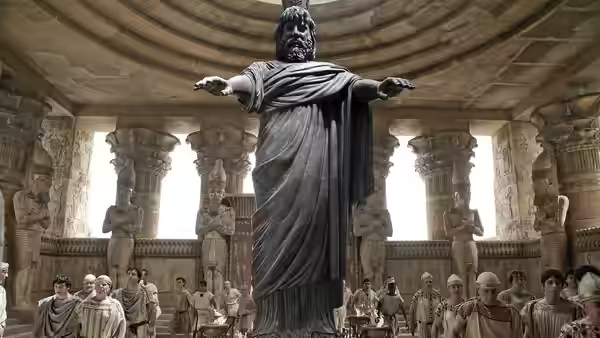
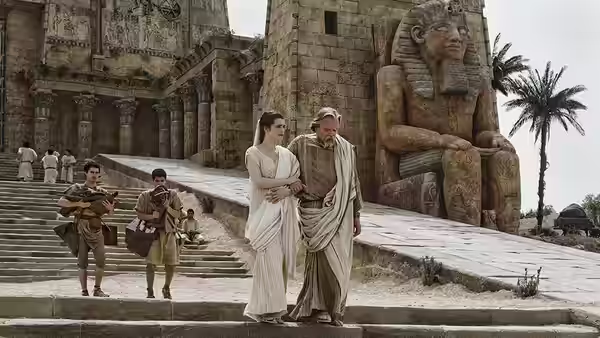
Guy Hendrix Dyas builds the Serapeum and the agora out of hot plaster, dust and shadow, and the place feels lived in rather than dressed. Xavi Giménez shoots the streets in bleached white daylight and the Library in a dimness the lamps barely reach, so knowledge is always the darker room. Gabriella Pescucci puts the philosophers in pale linen and the Christian monks in black, which means we can read a crowd from across the square before anyone speaks. Dario Marianelli gives it choir and strings that swell at the vistas, and Nacho Ruiz Capillas cuts the riots fast and the lessons slow, which is the right way round.

The trouble is the device Amenábar leans on hardest. Again and again the camera lifts from the crowd, past the rooftops, up through the clouds until the earth is a marble and the mob is a scatter of insects. The first time it is a fine idea, and it is what the film is about: the planets do not care. By the third time we felt we were being taken by the ear to the window and told to look. The supporting cast get the same treatment. Ashraf Barhom’s Ammonius glowers and recruits; Richard Durden’s Olympius blusters; Sami Samir’s Cyril arrives in the second half to be the problem. They are positions with beards.

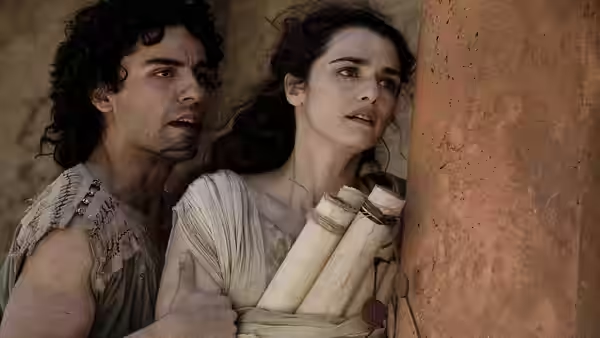
That leaves the two men who love her. Oscar Isaac’s Orestes, who grows from a show-off pupil into a politician trying to keep a city from tearing itself in half, is the most interesting person in the film and gets the least time. Max Minghella’s Davus is asked to stand in doorways looking at Weisz and then to go and join the monks, and there is not much a face can do with that. Michael Lonsdale gives Theon a tired grace. The accents wander from Paris to the Home Counties by way of Haifa, and nobody has decided whether that matters.

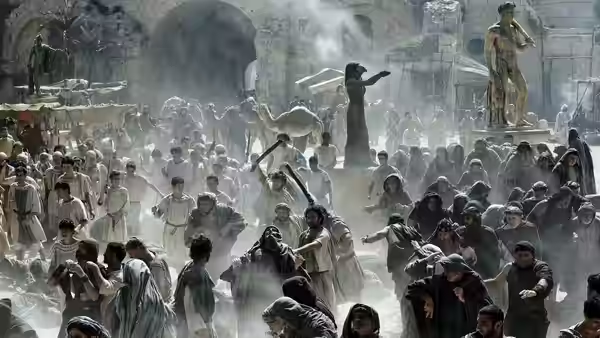
Here is what got to us. When the mob finally breaks into the Library, Ruiz Capillas cuts it to the rhythm of the men doing the damage rather than the scholars watching, so the scrolls come off the shelves and hit the floor in a brisk, ordinary way, like furniture being cleared. We were angrier than we expected to be, and it was the ordinariness that did it. Then the camera went up to orbit, and the anger cooled into being told about it.

The second half jumps forward some years and takes a turn we will not describe, though anyone who knows the name Hypatia knows roughly where it goes. Against the usual sword-and-sandal fare this is a clear step up, because it is about something and the something is worth arguing over. Against Amenábar’s own work it is a step down. The Others trusted silence and a look; this one keeps clearing its throat.

See it for Weisz, for the buildings and for the lessons, and be patient with the sermons. It is a film in which the most exciting thing anyone does is draw a circle on the ground, and we mean that as a recommendation.

Critical consensus AI synthesised

64
Positive
6
Mixed
6
Negative
1

Most critics lean cautiously positive. The reviews agree that this is an unusual historical epic, more interested in ideas than in battles, and nearly all of them read it as a parable about religious fundamentalism with a plain modern application. Rachel Weisz’s Hypatia is praised in almost every notice, including the harsher ones, and the production design and recreation of fourth-century Alexandria draw consistent admiration.

The reservations cluster on the drama rather than the argument. Several critics find the style heavy, the supporting characters thin and the emotional temperature low, with the science sometimes crowding out the people. The spread is wide: The New York Times and The Guardian recommend it firmly, while Slant Magazine finds it pointless and dramatically slack, The AV Club calls it a shallow assault on Christianity that turns people into symbols, and The Telegraph judges it an ambitious mess. Only one review is outright negative, but half the reviews are mixed.

The New York Times
27 May 2010 · A.O. Scott
84*

The critic finds the film a rousing, intellectually provocative drama that avoids easy genre categories and bristles with ideas and topical provocations. He highlights the central story of Hypatia pursuing cosmic mysteries amid personal and historical conflicts in ancient Alexandria.

Read the full review →
Empire
19 April 2010 · Phil de Semlyen
80*

The film offers a bold, thought-provoking return for director Amenábar and a timely assault on religious intolerance. It is always intelligent and a welcome comeback from the director of The Others.

Read the full review →
The Guardian
22 April 2010 · Peter Bradshaw
80*

The critic finds it an ambitious and cerebral historical drama that stands out from typical sword-and-sandal epics by focusing on ideas and real drama rather than spectacle. Rachel Weisz's performance as Hypatia is singled out as outstanding.

Read the full review →
The Hollywood Reporter
17 May 2009 · festival review
70*

The critic finds the film hampered by a heavy-handed opening and conventional epic tropes but values its timely parable on religious intolerance and fundamentalism, highlighting Rachel Weisz's strong performance as the intellectually passionate Hypatia.

Read the full review →
The Times
25 April 2010 · Cosmo Landesman
70*

The critic praises it as a thoughtful, adult film that reflects on religious extremism through its historical setting and natural dialogue, commending the avoidance of heavy spectacle. Weisz's performance is highlighted as strong, though the film lacks some intimacy with its central character.

Read the full review →
Variety
18 May 2009 · festival review · Todd McCarthy
67*

The review describes a visually imposing epic that ambitiously dramatizes a pivotal historical shift through Hypatia's story, with spectacular production values and clear parallels to modern religious fundamentalism. It notes the film's intellectual seriousness and impressive physical production but criticizes a certain heaviness of style and lack of emotional pulse.

Read the full review →

Straight answers AI written, from our review

Is Agora worth watching?
Agora is worth watching if you want a historical drama that is about ideas rather than swords, and we scored it 66. Rachel Weisz is the reason to stay, along with the lamplit lessons and Guy Hendrix Dyas's plaster-and-dust Alexandria. Be patient with it: Amenábar keeps telling us what to think when he could have trusted us.
How long is Agora, and what is it rated?
Agora runs 2h 07m and is rated 12 by the ICAA in Spain. It is an adventure and drama film.
Where can I watch Agora in Spain?
Agora is streaming on Netflix in Spain, and it is also available to rent from Amazon Prime Video from €2.99. Availability is checked daily; the links above go straight to each service.
How violent or frightening is Agora, and is it suitable for children?
Agora carries a UK 12, and its violence is riots, sieges and a mob sacking a library rather than anything gory or lingering. The scholars are besieged and the streets turn ugly, but Amenábar cuts it briskly and pulls the camera away to orbit rather than dwelling. It is fine for teenagers; younger children will find the philosophy slow and the crowds frightening.
How does Agora compare to The Others?
Agora is Alejandro Amenábar's louder film and The Others is his better one. The ghost story trusts a dark house, a look and the time spent waiting; the Alexandria drama keeps clearing its throat and explaining itself. Go to Agora for Weisz and the buildings, and to The Others if you want to see what this director can do with silence.
What should I watch after Agora?
After Agora, try The Others (2001, Fi1m 80): Amenábar with the volume down; a haunted house that trusts a look over a speech. Then Of Gods and Men (2010, Fi1m 84): French monks in Algeria decide whether to stay; quiet, plain and shattering.

Cast

Awards

European Film Award – People's Choice Award for Best European Film, 2010

Nominated
European Film Award – People's Choice Award for Best European Film

Goya Award for Best Art Direction, 2010

Won
Goya Award for Best Art Direction

Goya Award for Best Cinematography, 2010

Won
Goya Award for Best Cinematography

Goya Award for Best Costume Design, 2010

Won
Goya Award for Best Costume Design

Goya Award for Best Original Screenplay, 2010

Won
Goya Award for Best Original Screenplay

Goya Award for Best Production Supervision, 2010

Won
Goya Award for Best Production Supervision

Goya Award for Best Special Effects, 2010

Won
Goya Award for Best Special Effects

If you liked this, try…

  1. The Name of the Rose (1986) · not on Fi1m yetMonks, murders and a library that some people would rather nobody read.

  2. The Others (2001, Fi1m 80)Amenábar with the volume down; a haunted house that trusts a look over a speech.

  3. Silence (2016) · not on Fi1m yetScorsese on faith under persecution, and honest about how little comfort it offers.

  4. Fellini Satyricon (1969) · not on Fi1m yetThe ancient world as a fever dream, with none of the tidy lessons.

  5. Of Gods and Men (2010, Fi1m 84)French monks in Algeria decide whether to stay; quiet, plain and shattering.

Agora (2009) review: a handsome history film that lectures (Spain) | Fi1m