Alejandro Amenábar’s drama of reason against faith in fourth-century Alexandria is lavishly built and seriously meant, and Rachel Weisz holds it together. It is also a film that keeps telling us what it thinks, when it could have shown us and trusted us.
Alejandro Amenábar, who made The Others (2001) and The Sea Inside (2004), goes to Alexandria in 391 AD for a film about a woman who wants to know how the heavens move while the city around her decides how everyone is going to pray. He wrote it with Mateo Gil, and they have made something rarer than it sounds: a historical film in which the most urgent thing anyone does is ask a question. It is handsome, it is serious, and it is far too fond of the sermon. It runs 127 minutes and carries a 12.
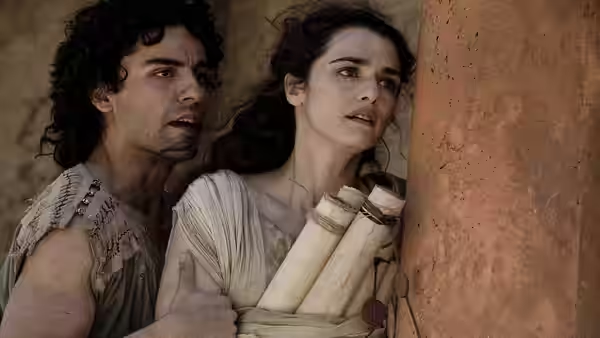
Rachel Weisz plays Hypatia as a teacher before anything else. She puts a problem to a room of young men and waits, unbothered, while they fail to answer it. When Orestes declares his love in front of the whole school she replies with a gift he did not want, and Weisz plays it as a fact about her body and her work rather than as cruelty. The film is best in these lessons, in the lamplit hall with the models of the spheres turning, because there we can see what she is protecting and why she would rather protect it than be loved.
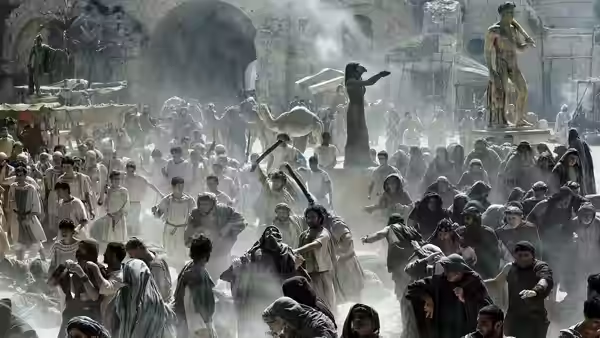
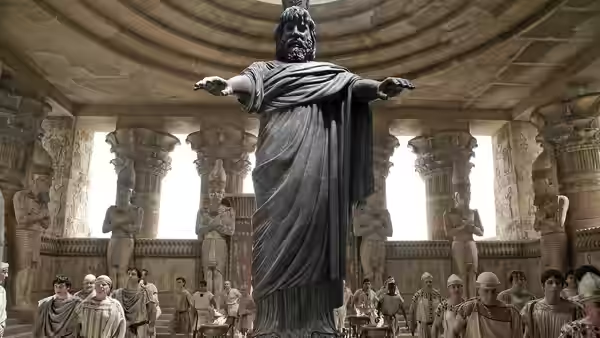
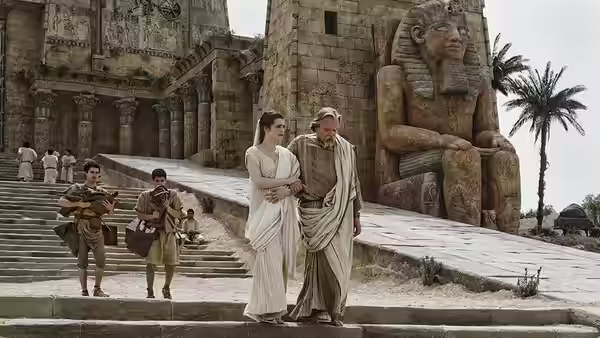
Guy Hendrix Dyas builds the Serapeum and the agora out of hot plaster, dust and shadow, and the place feels lived in rather than dressed. Xavi Giménez shoots the streets in bleached white daylight and the Library in a dimness the lamps barely reach, so knowledge is always the darker room. Gabriella Pescucci puts the philosophers in pale linen and the Christian monks in black, which means we can read a crowd from across the square before anyone speaks. Dario Marianelli gives it choir and strings that swell at the vistas, and Nacho Ruiz Capillas cuts the riots fast and the lessons slow, which is the right way round.
The trouble is the device Amenábar leans on hardest. Again and again the camera lifts from the crowd, past the rooftops, up through the clouds until the earth is a marble and the mob is a scatter of insects. The first time it is a fine idea, and it is what the film is about: the planets do not care. By the third time we felt we were being taken by the ear to the window and told to look. The supporting cast get the same treatment. Ashraf Barhom’s Ammonius glowers and recruits; Richard Durden’s Olympius blusters; Sami Samir’s Cyril arrives in the second half to be the problem. They are positions with beards.
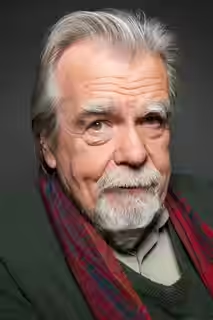
That leaves the two men who love her. Oscar Isaac’s Orestes, who grows from a show-off pupil into a politician trying to keep a city from tearing itself in half, is the most interesting person in the film and gets the least time. Max Minghella’s Davus is asked to stand in doorways looking at Weisz and then to go and join the monks, and there is not much a face can do with that. Michael Lonsdale gives Theon a tired grace. The accents wander from Paris to the Home Counties by way of Haifa, and nobody has decided whether that matters.
Here is what got to us. When the mob finally breaks into the Library, Ruiz Capillas cuts it to the rhythm of the men doing the damage rather than the scholars watching, so the scrolls come off the shelves and hit the floor in a brisk, ordinary way, like furniture being cleared. We were angrier than we expected to be, and it was the ordinariness that did it. Then the camera went up to orbit, and the anger cooled into being told about it.
The second half jumps forward some years and takes a turn we will not describe, though anyone who knows the name Hypatia knows roughly where it goes. Against the usual sword-and-sandal fare this is a clear step up, because it is about something and the something is worth arguing over. Against Amenábar’s own work it is a step down. The Others trusted silence and a look; this one keeps clearing its throat.
See it for Weisz, for the buildings and for the lessons, and be patient with the sermons. It is a film in which the most exciting thing anyone does is draw a circle on the ground, and we mean that as a recommendation.