Film review

Butch Cassidy and the Sundance Kid

1969 · Directed by George Roy Hill · 1h 51m · MPA PG

In a sentenceTwo outlaws who will not stop talking, chased across a state by men who never say a word

WesternCrimeDrama

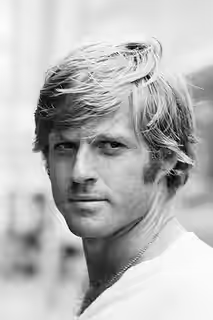
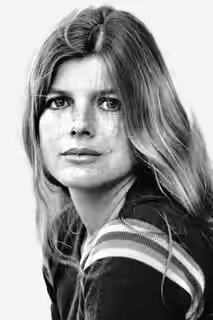
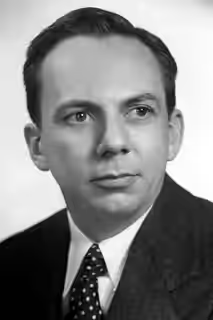
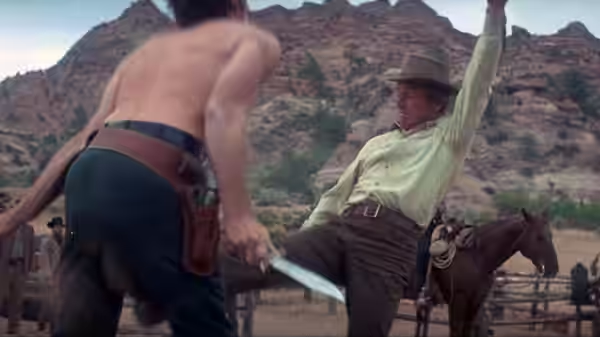
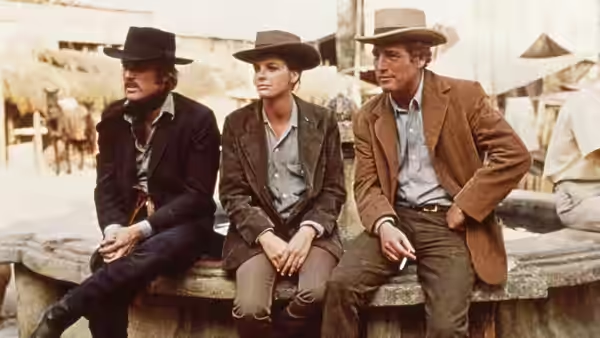
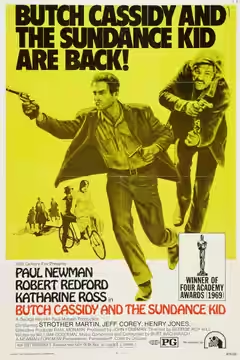
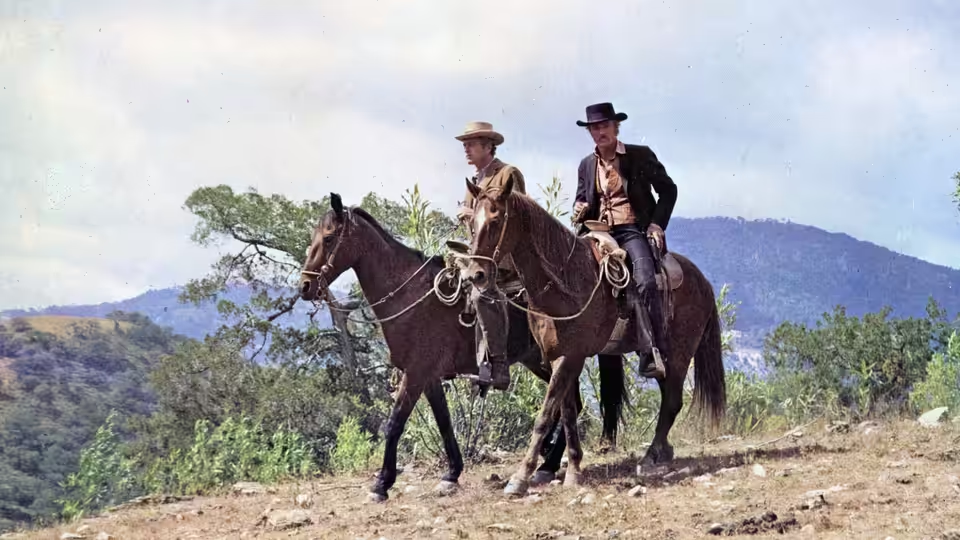
Wyoming, at the end of the 1890s. Butch Cassidy (Paul Newman) leads the Hole-in-the-Wall gang by talking faster than anyone else in it, and the Sundance Kid (Robert Redford) backs him up by shooting faster. Butch’s leadership is challenged by the enormous Harvey Logan (Ted Cassidy), who wants a knife fight and gets a lesson about rules instead. The gang robs the Union Pacific Flyer twice, opposed both times by a stubborn clerk called Woodcock (George Furth) who will not open the mail car door. Between jobs the pair rest at the house of schoolteacher Etta Place (Katharine Ross), Sundance’s lover, while Butch talks about Bolivia. After the second robbery the railroad sends a posse that does not stop for nightfall, and the two men begin to realise it is not going home.

Plays from YouTube when you press play; nothing loads from them until then.

Fi1m review

George Roy Hill’s outlaw comedy is as easy to like as its reputation says, and Newman and Redford make it look like no work at all. It is padded in places and knows exactly how charming it is, but the chase and the ending land regardless.

The film opens in sepia, with a card that reads ‘Not that it matters, but most of it is true’, and that sentence tells you the tone. William Goldman’s script takes two real outlaws at the tail end of the 1890s, when the railroads had money for detectives and the West was running out of places to hide, and plays their decline as a comedy. George Roy Hill gets it done in 111 minutes. It is a good film with a few habits we could do without, and its last ten minutes are as fine as anything the genre has managed.

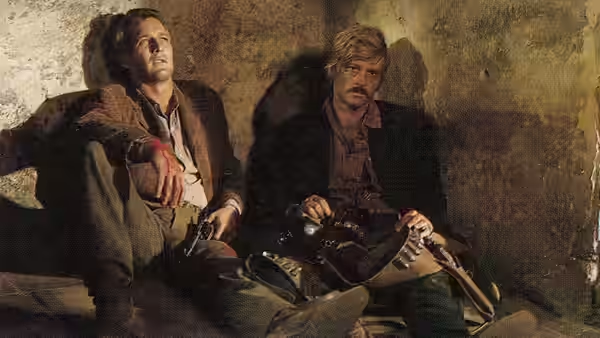
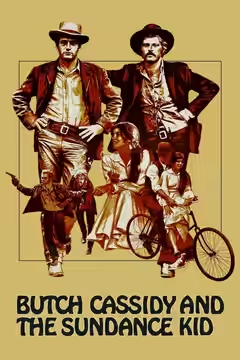
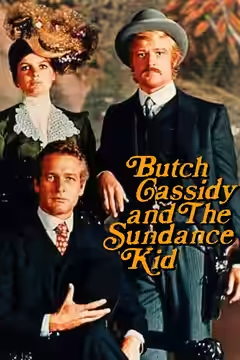
Paul Newman plays Butch as the talker: he plans the jobs, he has never shot anyone, and he cannot pass a stranger without trying to charm him. Robert Redford’s Sundance says perhaps a third as much and does it from under a black hat. Goldman writes them as a married couple who stopped listening years ago and never stopped enjoying it. The knife fight with Ted Cassidy’s Harvey Logan, settled by a question about rules, is the best joke in the film because it is also the most honest thing Butch does. Katharine Ross, as Etta, has the hardest part and the least to work with. Her introduction, in which Sundance appears to be an intruder ordering her to undress before it turns out to be a game between lovers, played uneasily in 1969 and plays worse now.

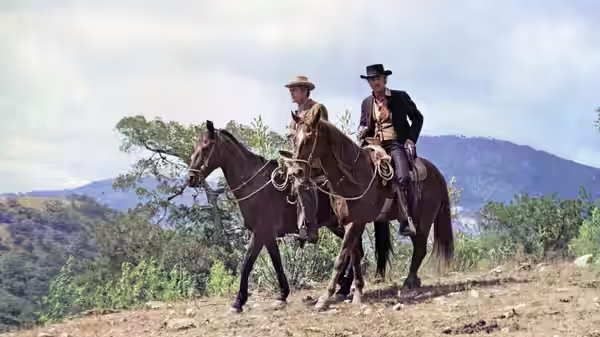
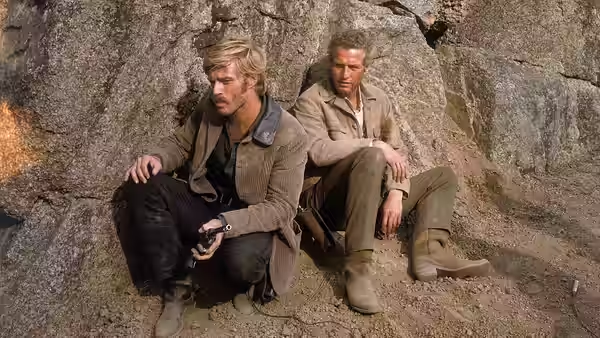
Conrad Hall photographs all of it through dust and low sun. The gang rides out of haze and the posse rides in it, so that for most of the chase the men hunting Butch and Sundance are a smudge on a ridge and a hat. Hall lets the light flare into the lens and the skies wash out to white. Edith Head puts Redford in a black hat and a corduroy jacket he wears until it is part of him, gives Newman a bowler that sits slightly wrong, and dresses Ross in high collars that make her look like the only adult in the picture.

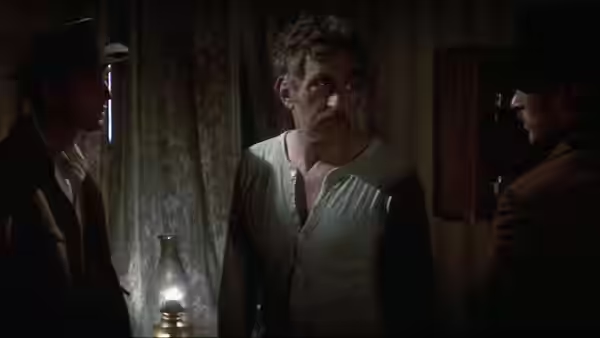
The chase is where the film stopped being merely pleasant for us. We had laughed through both train robberies, at George Furth’s Woodcock refusing to open the mail car and at the dynamite that follows, and then the posse came, and kept coming through the night, and we found ourselves as unsettled as the outlaws were. It was the silence that did it. Hill never gives the pursuers a face or a line; they are a lantern moving across a dark hillside and, by day, a rider in a white hat who does not hurry. Butch asks who those guys are, more than once, and by the second time it is not a joke.

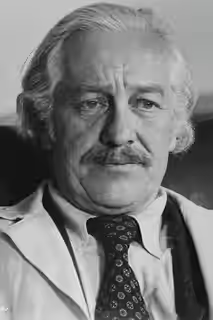
The padding is real. Burt Bacharach’s ‘Raindrops Keep Fallin’ on My Head’ arrives over a bicycle ride round a farmyard, and for three minutes the Western turns into a Sunday-afternoon light entertainment programme. It is pleasant and it stops the film dead. Later, editors Richard C. Meyer and John C. Howard cover a long journey with a montage of sepia stills. Goldman cannot leave a scene without a curtain line, and Strother Martin’s Percy Garris gets one good tirade and then repeats it. The film’s fondness for its own charm is what kept us, at intervals, from loving it.

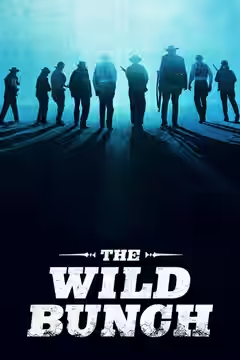
Set beside the other outlaw Western of 1969, Sam Peckinpah’s The Wild Bunch, this is the sunnier account of the same fact: the century was ending and the men who lived by robbing it had no idea what to do next. Peckinpah answered with a massacre. Hill and Goldman answer with jokes, and keep them going so long that when the film finally stops making them the quiet is worse.

We will not describe the ending. We will say that we knew it going in, as most people do, and that it still caught us, because of a choice Hall and the editors make in the last seconds that is the opposite of the crowd-pleasing one. Watch it with someone who has never seen it, and do not tell them.
Critical consensus AI synthesised

76
Positive
11
Mixed
1
Negative
2

Most critics like it, and the ones writing decades after release like it best. The praise clusters on the Newman and Redford double act: the relaxed, straight-faced interplay between them is mentioned in nearly every review, and several call the film a buddy picture in western clothes rather than a western proper. William Goldman’s script is the next most praised element, described as witty, playful and quotable, with Conrad Hall’s photography and Burt Bacharach’s score picked out by more than one writer.

The spread is wide, and it runs along a line in time. The reviews from autumn 1969 are the coolest: The New York Times finds the genre-mixing slick but empty, Roger Ebert calls it slow and over-cute, and The New Yorker thinks the facetious tone rings false. Later writers concede some tweeness, a dated soundtrack and borrowings from The Wild Bunch, but treat those as small faults in something they find thoroughly likeable.

Radio Times
★★★★★ · David Parkinson
100

Director George Roy Hill's freewheeling, Oscar-winning comic western was one of the biggest box-office hits in the genre's history. It features the unforgettable pairing of Paul Newman and Robert Redford, whose exhilarating performances turn the ruthless real-life desperados into lovable rogues and ultimately tragic heroes.

Read the full review →
Empire
1 January 2013 · Bob McCabe
90*

The critic praises the note-perfect performances by Newman and Redford, William Goldman's playful and insightful screenplay, and the film's memorable moments like the waterfall leap and elegiac ending. They conclude it may be the most likeable film ever made, despite some twee elements and its role in popularising the buddy movie.

Read the full review →
Sight and Sound
· David Wilson
90*

The film is immensely enjoyable to watch, glowingly photographed, wittily scripted, and features superbly confident performances from Paul Newman and Robert Redford. It plays as a buddy movie more than a traditional western, with a playful tone and relaxed double act from the leads.

Read the full review →
The AV Club
14 June 2006 · A- · Nathan Rabin
90

The review positions the film as the gold standard for modern buddy comedies, lauding its witty, irreverent dialogue and the charismatic performances of Newman and Redford that blend tragedy with fun and timeless star power.

Read the full review →
The Guardian
23 September 2019
90*

The critic finds the film a rollicking, spectacularly effective entertainment that still works well today. They single out the magical Newman-Redford chemistry, Goldman’s lively script, Bacharach’s score and Conrad Hall’s photography for particular praise.

Read the full review →
The Hollywood Reporter
26 October 2014 · John Mahoney
90*

The critic calls it a great and exceptionally popular film, praising William Goldman's screenplay, the perfectly cast stars Paul Newman and Robert Redford, George Roy Hill's direction, and innovative techniques like the score, cinematography, and editing that sustain its legendary aura.

Read the full review →

Cast

Awards

Academy Awards, 1970

Nominated
Best Director
Nominated
Best Picture
Nominated
Best Sound
Won
Best Cinematography
Won
Best Original Score, no Musical
Won
Best Writing, Original Screenplay

If you liked this, try…