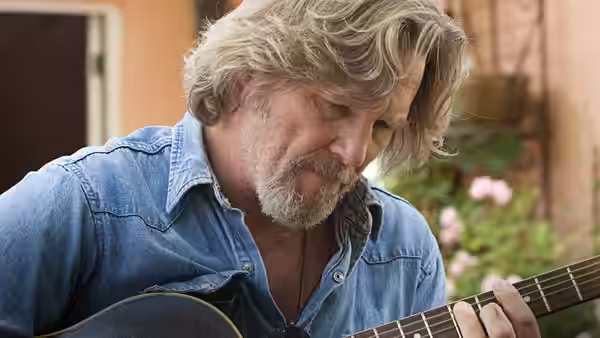
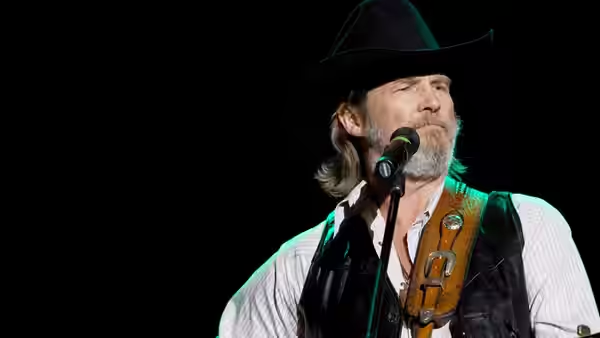
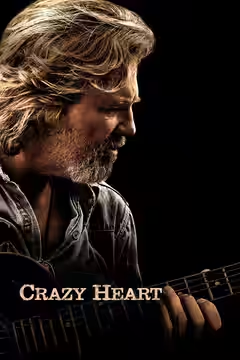
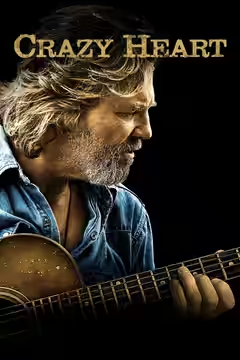
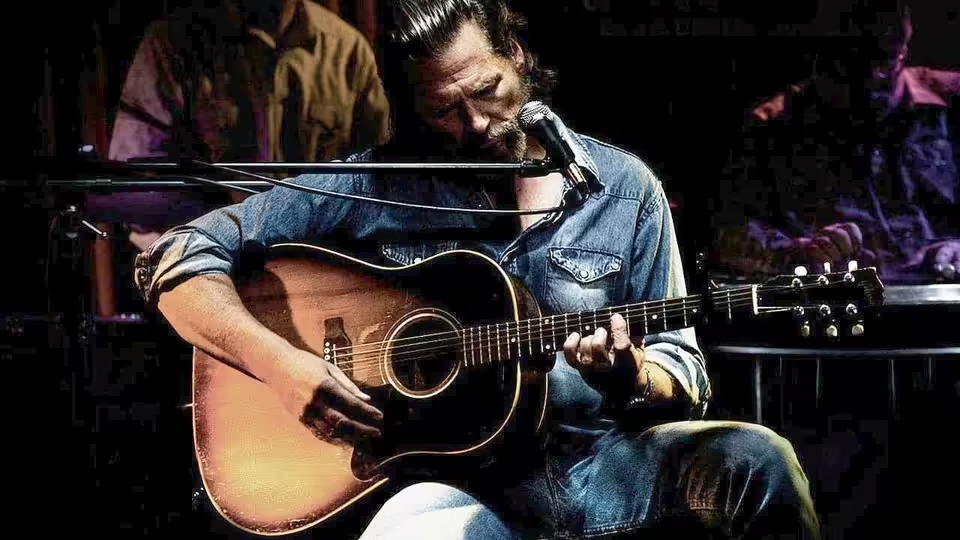
Bad Blake (Jeff Bridges) sings into a microphone while playing acoustic guitar onstage
Film review

Crazy Heart

2009 · Directed by Scott Cooper · 1h 52m · MPA R

In a sentenceJeff Bridges sweats through a shirt, sings like he means it, and the plot waits politely for him to sober up

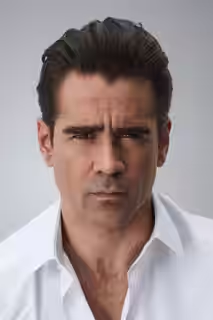
Bad Blake (Jeff Bridges) is fifty-seven, a country singer who once wrote hits and now plays bowling alleys and bars across the American Southwest, driving himself between them in an old Suburban with a bottle of whisky on the seat. In Pueblo, Colorado, he plays a bowling alley to a half-empty room; in Santa Fe, New Mexico, a local journalist, Jean Craddock (Maggie Gyllenhaal), a single mother with a small son, comes to interview him and does not leave when she should. His manager, Jack Greene (Paul Herman), wants him to open for Tommy Sweet (Colin Farrell), the former protégé who now fills arenas and whom Bad has not forgiven for the success. Bad wants a drink, then another, then a new song, in roughly that order.

Plays from YouTube when you press play; nothing loads from them until then.

Fi1m review

A washed-up country singer, a bottle, a woman and one more chance at a song: there is nothing here you have not seen before. Jeff Bridges plays it so truthfully, and the songs are so good, that the familiarity hardly matters until the last twenty minutes.

Scott Cooper’s first film as director, adapted by him from Thomas Cobb’s novel, follows Bad Blake (Jeff Bridges), fifty-seven, a country singer who once filled halls and now plays bowling alleys in the Southwest, driving himself between gigs with a bottle on the passenger seat. Everyone knows the shape of this: the drink, the woman, the reckoning. Cooper knows we know, and does not try to hide it. What he offers instead is Bridges, and for most of 112 minutes that is enough.

Bridges plays Bad as a man who has let himself go and is still, out of habit, a professional. He unbuckles his belt before he sits down and pours a drink before he takes off his hat, and when he gets on stage the belly and the sweat stop mattering because the voice is real and his timing is better than the band’s. He sings the songs himself, low and cracked and a little behind the beat, which is where a country singer should be. What we admired most is how little he asks for. There is no scene in which he tells us how far he has fallen; Bridges lets one look at a half-empty room do it.

Barry Markowitz shoots the Southwest in flat, hard afternoon light and the bars in whatever amber they already had, so Bad’s world looks like a place that has run out of things to hide. Waldemar Kalinowski gives every motel the same bedspread and the same lamp, and Doug Hall keeps Bad in one brown jacket and one pair of jeans across four states, so that a shave and a clean shirt register as an event. The songs, from T Bone Burnett and Stephen Bruton, with The Weary Kind written by Burnett and Ryan Bingham (who turns up as Tony, one of the pickup musicians), are good enough that we would have bought the record, which is not something we can say of most films about musicians. John Axelrad and Jeffrey Ford let them play almost whole, and the film is better for it.

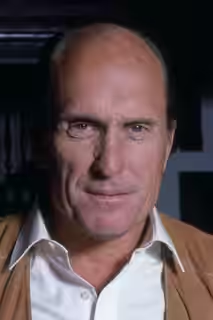
Maggie Gyllenhaal plays Jean Craddock, a Santa Fe journalist and single mother who comes to interview Bad and stays. The script asks her to fall for a man twice her age who drinks before breakfast, and Gyllenhaal nearly makes it work by playing Jean as someone who knows exactly what she is doing and does it anyway. Robert Duvall, as Wayne, Bad’s bartender friend in Houston, is on screen for perhaps ten minutes, spends most of them fishing, and reminds anyone who remembers Tender Mercies (1983) that he once played this part himself. Colin Farrell is the surprise. As Tommy Sweet, the former protégé who now plays arenas, he is warm, slightly guilty and a decent singer, and the film’s best idea is that Tommy is not the villain.

The scene that got to us is in Phoenix, where Bad opens for Tommy’s crowd. Halfway through a song he walks off, is sick behind a bin, wipes his mouth and walks back to finish it. Bridges plays it without a flicker of self-pity and Cooper does not cut away; the band keeps time and so does he. We were moved more than we expected to be, because the film is not asking us to forgive him, only to notice that somewhere under all of it he is still good at this.

The trouble is the last half hour. The second half takes a turn we will not describe, and after it the script, which had been content to watch, starts to arrange. Scenes that should take a week take a line. People forgive one another on schedule. The loose first hour, which felt like life, gives way to a story that knows where it is going and goes there without delay. We felt the gears turning, and we minded.

Tender Mercies did this with less and trusted its silences. The Wrestler (2008) took the same shape a year earlier and was crueller about it. Crazy Heart is kinder than either, and the kindness is both its virtue and its weakness: Cooper likes Bad too much to make him pay a full price. Still, the warmth is honestly come by, and the film never pretends he is anything other than a drunk.

See it for Bridges, for Farrell, and for the songs, and watch it at home, where the small rooms and the small gestures suit the screen. Do not expect to be surprised. It runs 112 minutes and reached British cinemas on 5 March 2010.

Critical consensus AI synthesised

68
Positive
11
Mixed
7
Negative
2

Most critics like Crazy Heart, and nearly all of them like it for the same reason. Jeff Bridges’ performance as the washed-up country singer is praised in almost every review: understated, lived-in and convincing both at the microphone and away from it. His singing voice draws repeated comment, as do the original songs, and several reviews single out his easy rapport with Maggie Gyllenhaal. The story itself is called familiar by friend and foe alike; the positive reviews simply think Bridges makes that not matter.

The reservations cluster on the script. Several critics find the redemption arc sentimental and tidy, and Slant argues the romance pushes a loose character study into a contrived, monotonous shape. The Hollywood Reporter goes furthest, calling the material tired and the film ordinary despite being watchable, and Little White Lies finds the relationships underdeveloped. The spread is wide, from warm recommendation to outright dismissal, but even the harshest reviews exempt Bridges from blame.

Los Angeles Times
16 December 2009 · Kenneth Turan
85*

Turan finds the familiar story elevated by a powerful, memorable performance and welcome integrity. He singles out Bridges’ seamless transformation and the excellent original country songs for praise.

Read the full review →
The AV Club
17 December 2009 · B+ · Nathan Rabin
83

The review finds the film overly sentimental and tidy but ultimately easy to root for. It praises Jeff Bridges’ humane, deeply empathetic performance and weathered singing voice.

Read the full review →
Empire
27 January 2010 · ★★★★ · Nev Pierce
80

The review calls the film deceptively affecting, with a familiar story elevated by strong performances. It singles out Jeff Bridges’ fully inhabited performance and the soulful songs as its greatest strengths.

Read the full review →
Radio Times
★★★★ · Stella Papamichael
80

Papamichael finds the drama intimate and compelling, with Bridges giving a modest, nuanced performance. She also praises the warmth of his connection with Gyllenhaal’s journalist and her young son.

Read the full review →
Total Film
26 January 2010 · ★★★★ · Neil Smith
80

Smith finds the film a familiar redemption drama, but says Bridges makes it worth watching. He praises Bridges’s gruff, authentic performance onstage and off.

Read the full review →
Variety
30 November 2009 · Todd McCarthy
75*

McCarthy finds the familiar redemption story engaging, largely because Jeff Bridges makes its central character feel beautifully true. He praises Bridges’ performance above all, while noting that the direction is amiable but could use more snap.

Read the full review →

Straight answers AI written, from our review

How long is Crazy Heart, and what is it rated?
Crazy Heart runs 1h 52m and is rated R by the MPA in the US. It is a drama and music film.
Where can I watch Crazy Heart in the US?
Crazy Heart is available to rent from Apple TV from $3.99. Availability is checked daily; the links above go straight to each service.
What should I watch after Crazy Heart?
After Crazy Heart, try Tender Mercies (1983, Fi1m 86): Duvall as the drunk country singer; quieter, shorter, and it trusts its silences. Then The Wrestler (2008, Fi1m 85): The same shape, a ring instead of a stage, and a much harder reckoning; and Nashville (1975, Fi1m 89): Altman’s crowded, caustic portrait of the industry Bad Blake fell out of.

Cast

Awards

Academy Awards, 2010

Nominated
Best Supporting Actress
Won
Best Actor

BAFTA Film Awards, 2010

Nominated
Best Actor in a Leading Role
Nominated
Best Original Music

Independent Spirit Awards, 2010

Nominated
Best First Screenplay
Won
Best First Feature
Won
Best Male Lead

SAG Awards, 2010

Won
Outstanding Performance by a Male Actor in a Leading Role

Writers Guild of America Award for Best Adapted Screenplay, 2010

Nominated
Writers Guild of America Award for Best Adapted Screenplay

Critics' Choice Awards, 2009

Won
Best Actor

Golden Globes, 2009

Won
Best Actor – Motion Picture Drama

Los Angeles Film Critics Association Award for Best Actor, 2009

Won
Los Angeles Film Critics Association Award for Best Actor

National Society of Film Critics Award for Best Actor, 2009

Nominated
National Society of Film Critics Award for Best Actor

Satellite Award for Best Actor – Motion Picture, 2009

Nominated
Satellite Award for Best Actor – Motion Picture

If you liked this, try…

  1. Tender Mercies (1983, Fi1m 86)Duvall as the drunk country singer; quieter, shorter, and it trusts its silences.

  2. Payday (1973) · not on Fi1m yetRip Torn’s country star on the road, with none of Cooper’s kindness and better for it.

  3. The Wrestler (2008, Fi1m 85)The same shape, a ring instead of a stage, and a much harder reckoning.

  4. Wild Rose (2018) · not on Fi1m yetA Glasgow single mother wants Nashville; the songs are live and the hope is earned.

  5. Nashville (1975, Fi1m 89)Altman’s crowded, caustic portrait of the industry Bad Blake fell out of.