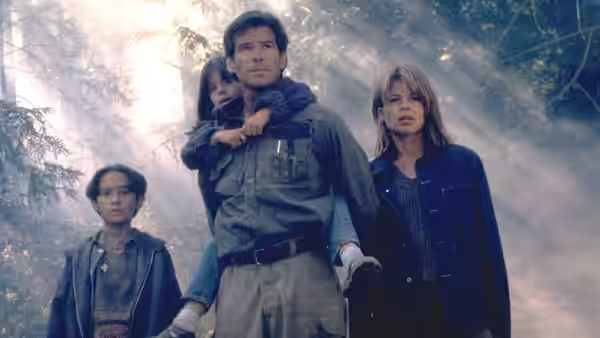
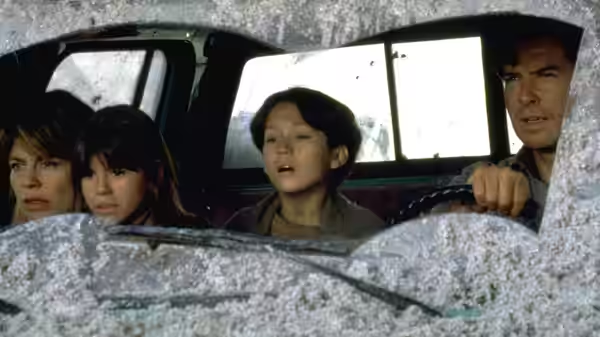
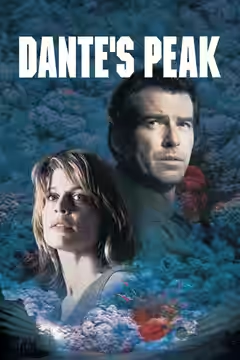
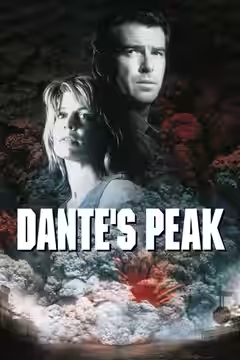
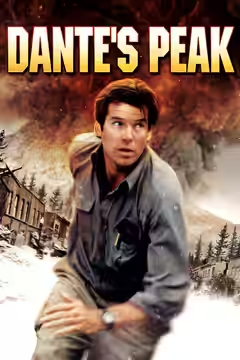
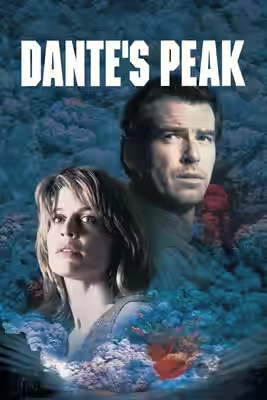
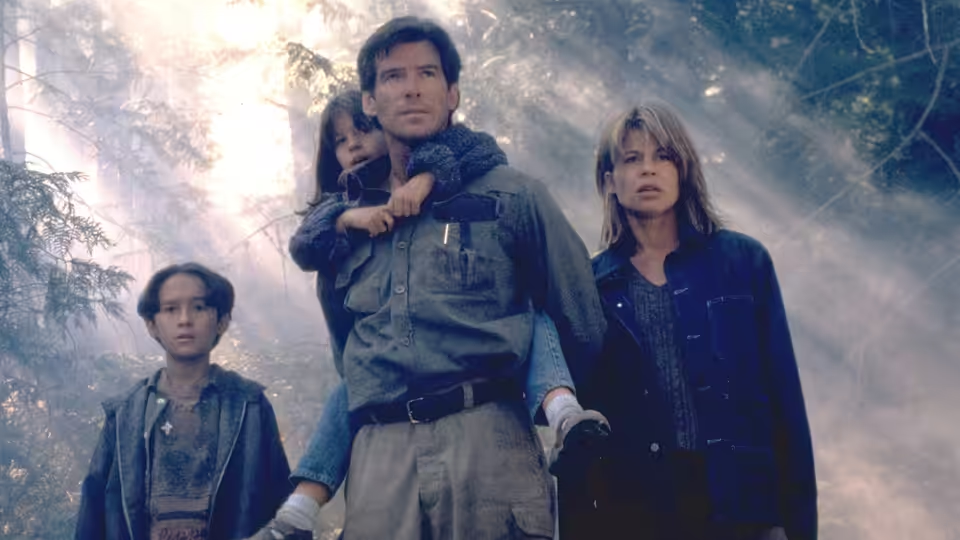
Harry Dalton (Pierce Brosnan), Rachel Wando (Linda Hamilton), and the children move through smoky woods
Film review

Dante's Peak

1997 · Directed by Roger Donaldson · 1h 48m

In a sentenceA town called Dante’s Peak, a mountain called Dante’s Peak, and nobody who thought to ask why

Harry Dalton (Pierce Brosnan), a volcanologist with the United States Geological Survey, loses his partner to an eruption in Colombia and, some years later, is sent to check on a dormant mountain above Dante’s Peak, a small town in the Cascades of Washington State that has just been named the second most desirable place to live in America. Mayor Rachel Wando (Linda Hamilton) runs the coffee shop, raises two children, Graham (Jeremy Foley) and Lauren (Jamie Renée Smith), and is about to welcome an investor, Les Worrell (Brian Reddy), with money for the town. Harry finds dead trees, an acidic lake and two bathers boiled in a hot spring. His boss Paul Dreyfus (Charles Hallahan) arrives with a team and tells him not to frighten anyone. Then the tap water turns brown.

Fi1m review

Roger Donaldson keeps the mountain quiet for an hour of meetings and brown tap water, then lets it go, and the last forty minutes do what the poster promised. Fine for a wet afternoon; slow for anything else.

Dante’s Peak is a disaster film built to the old plan: a town, a warning nobody wants to hear, and then the roof comes off. Roger Donaldson directs from a script by Leslie Bohem, it runs 108 minutes, and it spends the first hour of them making sure we know the mountain is going to go. It is a decent Saturday-afternoon picture with a long wait at the front, and we would not pretend it is more.

The opening is the best piece of writing in it. Harry Dalton (Pierce Brosnan) is in Colombia when a volcano erupts, and he loses the woman he loves to a lump of rock through a windscreen. Donaldson stages it fast and dirty, ash on the lens and a truck that will not start, and the film is never again as frightened as it is in those five minutes. Then Harry goes to Dante’s Peak, Washington, and the film sits down.

What follows is a procedural. Harry drives up the mountain and finds dead trees. He tests a lake and it eats his instrument. Two swimmers have been boiled in a hot spring, and we winced, properly, at the sight of the bodies; Bohem and Donaldson are wise enough to show them for a second and cut away. Paul Dreyfus (Charles Hallahan) flies in with a team, Greg (Grant Heslov), Terry (Kirk Trutner), Stan (Tzi Ma) and Nancy (Arabella Field), and tells Harry he has seen false alarms empty towns before. Hallahan plays him as a reasonable man rather than a villain, which is the film’s one bit of generosity to its own plot. Les Worrell (Brian Reddy) has a cheque for the town and does not want to hear about sulphur. By the forty-minute mark we were restless, and we were still restless at sixty.

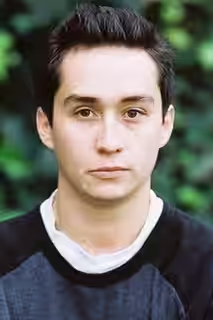
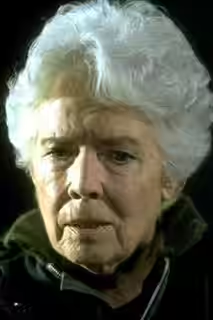
Brosnan, fresh from GoldenEye, plays the whole thing in a fleece, reading dials and frowning, and it suits him better than it sounds; he is good at competence and the part asks for nothing else. Linda Hamilton gets a coffee shop, two children, a mother-in-law and a job title, and no scene in which she does anything but worry. The children, Jamie Renée Smith and Jeremy Foley, are fine and are written as errands. Elizabeth Hoffman’s Ruth lives up the mountain and refuses to come down, and anyone who has seen a disaster film knows what that is for. Isis Mussenden dresses the town in plaid and the scientists in survey jackets, and nobody looks as if they have ever been somewhere other than a hardware shop, which is right.

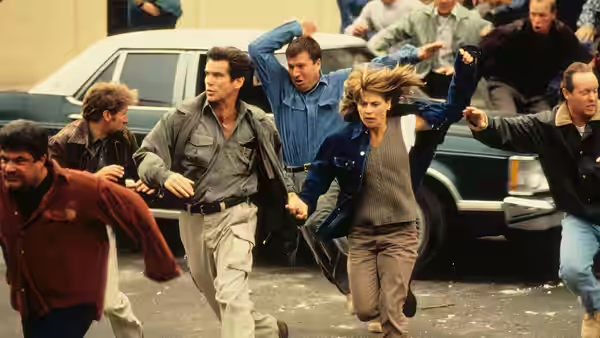
Then the mountain goes, and the film wakes up. Donaldson and his effects crew favour ash, water and falling masonry over the obviously drawn, and the result has lasted far better than most of its decade. Andrzej Bartkowiak shoots the ash-fall in flat grey light so that J. Dennis Washington’s Main Street, built to be wrecked, looks like a photograph of itself before the first window breaks. The sequence the film is remembered for, a pyroclastic cloud coming down through the pines at the speed of a train, is the one that got us: we sat forward and stopped noticing the dialogue, because there was none. Tina Hirsch, Howard E. Smith and Conrad Buff IV cut the escape as a run of short, clear shots, and for twenty minutes you can always tell where everyone is and what will kill them.

The weaknesses are the ones the genre always has, and the film does nothing to disguise them. Nobody in Dante’s Peak panics convincingly; the evacuation is a traffic jam with extras in it. John Frizzell and James Newton Howard are both credited with the music, and the score does the shouting the cast have been told not to.

Donaldson’s No Way Out, from 1987, had a story with a spring in it. This one has a timetable. Set against The Towering Inferno, which gave its people decisions to make while the building burned, Dante’s Peak gives its people a mountain and asks them to look up at it. Most critics have landed where we have, mildly entertained and mildly bored, and we see no reason to argue.

The 12 certificate earns its moments, the hot spring especially, so think twice about younger children. Otherwise this is a film for a wet afternoon at home, where the first hour is well suited to making tea and the second to not answering the door.

Critical consensus AI synthesised

50
Positive
0
Mixed
6
Negative
3

Most critics land in the middle. The reviews agree that the eruption is the point and that the effects deliver it: collapsing buildings, roads running with molten rock, a whole town coming apart on a convincing scale. More than one notice also credits the sound design with much of the impact. Nobody is enthusiastic, though; the warmest verdicts call it a serviceable Saturday-night disaster film that does what the genre asks and not much else.

The complaints cluster around the people. Bland characters, flat dialogue and a formulaic storyline recur in almost every review, along with a long wait before the mountain finally goes. The spread is wider than the average suggests. The New York Times and Variety find the human story weak enough to sink the whole thing, and The AV Club, writing some years later, calls even the effects dull. Eye for Film, also looking back, is kinder, crediting the cinematography and some unusual volcanic set-ups with making the danger feel real.

RogerEbert.com
64*

The review text was unavailable, so its verdict cannot be established. No specific praise or complaint could be verified from the accessible page.

Read the full review →
Empire
1 January 2000 · Caroline Westbrook
60*

The critic finds the film an entertaining but formulaic disaster movie that works well enough for a Saturday night. The spectacular volcanic effects are praised, while weak dialogue and a lack of panic are singled out as drawbacks.

Read the full review →
Radio Times
★★★ · Jason Caro
60

Caro finds the disaster film entertaining in its set pieces but lacking in characterisation and dialogue. He singles out the collapsing buildings and molten roads as exciting effects-driven moments.

Read the full review →
Total Film
28 March 1997 · ★★★ · Total Film
60

The review finds the film entertaining but formulaic, with a slow build-up before an exciting finale. It praises the top-notch effects and immersive THX sound, while faulting the clichés and dialogue.

Read the full review →
Time Out
· NF
55*

The review finds the film effective as spectacle but let down by its colorless characters. It singles out the computer-generated spectacle as a strength, while the characters are overshadowed.

Read the full review →
The New York Times
7 February 1997 · Janet Maslin
35*

Maslin finds the disaster film noisy and formulaic, with only a faint hint of genre parody to enliven it. She praises the suitably catastrophic effects but says they lack cleverness and the long wait for danger weakens the excitement.

Read the full review →

Straight answers AI written, from our review

Is Dante's Peak worth watching?
Dante's Peak is worth watching only if you want a disaster film for a wet afternoon and can sit through an hour of meetings before the mountain goes, and we scored it 56. The last forty minutes deliver what the poster promised, with a pyroclastic cloud coming down through the pines that made us sit forward. The first hour is well suited to making tea.
How long is Dante's Peak, and what is it rated?
Dante's Peak runs 1h 48m. It is an action and adventure film.
Where can I watch Dante's Peak in Türkiye?
Dante's Peak is available to rent from Amazon Prime Video from ₺9.90. Availability is checked daily; the links above go straight to each service.
How violent or frightening is Dante's Peak, and is it suitable for children?
Dante's Peak carries a UK 12 certificate and earns it in a few moments, most of all the sight of two swimmers boiled in a hot spring, shown briefly and then cut away from. The rest is ash, falling masonry and a town in flight rather than blood. Think twice about younger children; older ones and teenagers should manage it.
How does Dante's Peak compare to The Towering Inferno?
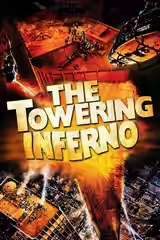
Dante's Peak follows the template The Towering Inferno set, but the earlier film gives its trapped people decisions to make while the building burns, where this one gives its people a mountain to look up at. The Towering Inferno is the better made and the more frightening, though at 165 minutes it is also far longer. Choose Dante's Peak for a shorter, lighter evening.
What should I watch after Dante's Peak?
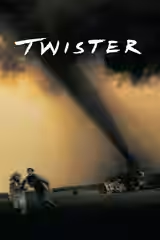
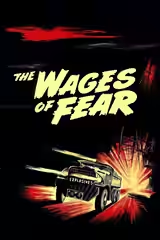
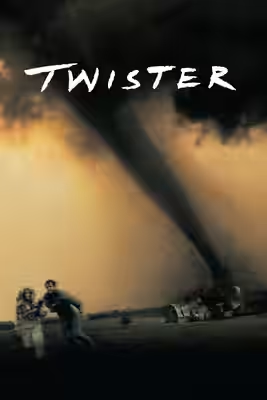
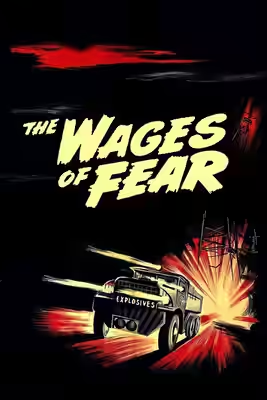
After Dante's Peak, try The Towering Inferno (1974, Fi1m 68): The template this one follows, with a cast who actually have decisions to make. Then Twister (1996, Fi1m 64): Scientists in trucks chasing a thing that wants them dead, with better jokes; and The Wages of Fear (1953, Fi1m 90): Men driving slowly over ground that may kill them; the original and still the tensest.

Cast

If you liked this, try…

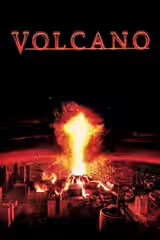
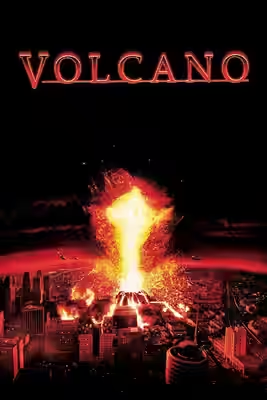
  1. Volcano (1997) · not reviewed yetThe other volcano film of that year, louder, sillier and set in Los Angeles traffic.

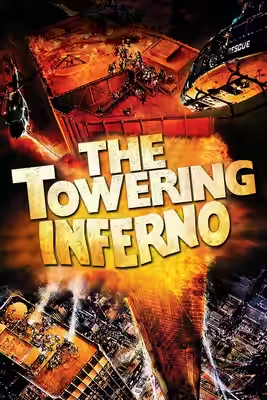
  2. The Towering Inferno (1974, Fi1m 68)The template this one follows, with a cast who actually have decisions to make.

  3. Twister (1996, Fi1m 64)Scientists in trucks chasing a thing that wants them dead, with better jokes.

  4. The Wages of Fear (1953, Fi1m 90)Men driving slowly over ground that may kill them; the original and still the tensest.

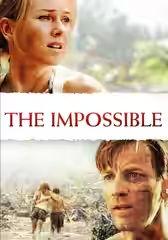
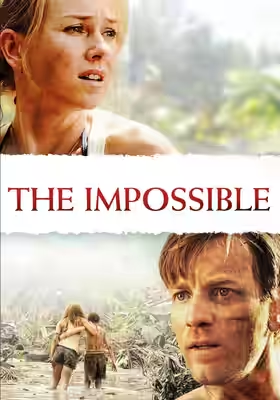
  5. The Impossible (2012, Fi1m 72)A disaster film that remembers to be frightened of the water and of what comes after.

Free account

Know what to watch tonight

Two lists that know where things are streaming, collections you can share, your own score beside ours, and Discover that remembers what you have seen.

  • Want to see, sorted by what is streaming now
  • Seen, with your score out of ten
  • No adverts, ever