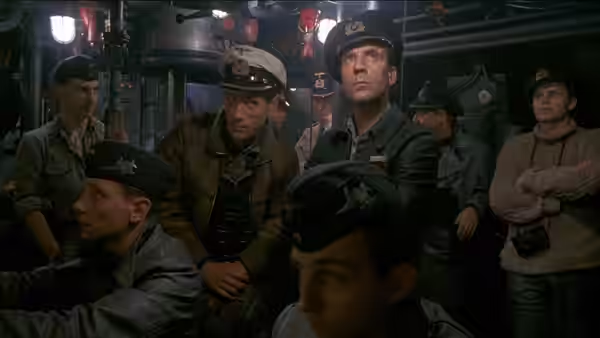
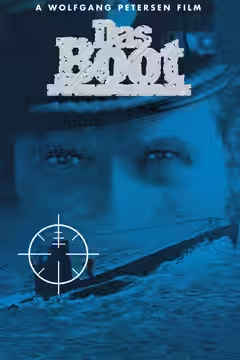
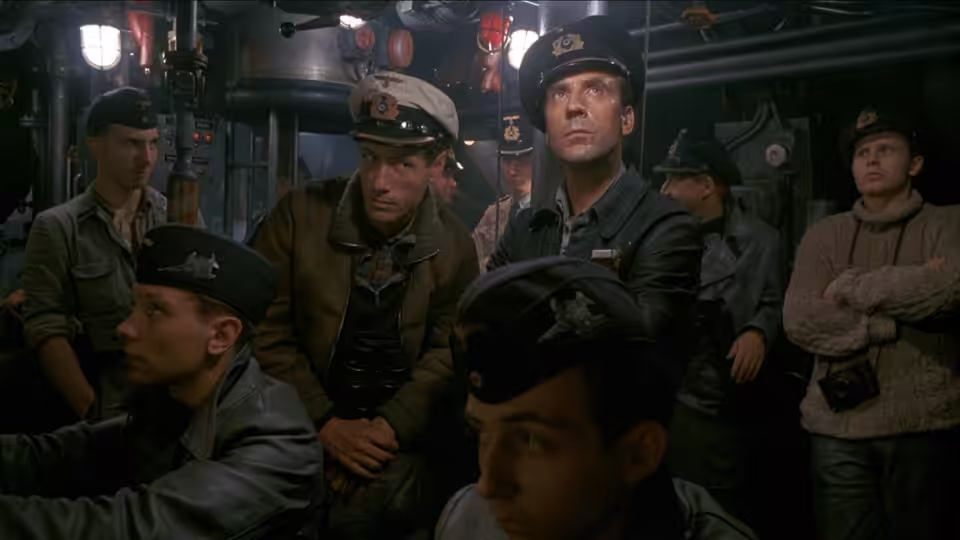
Crew members gather in a submarine compartment, watching with concern
Film review

Das Boot

1981 · Directed by Wolfgang Petersen · 2h 30m

In a sentenceThere is not enough room in this submarine to have a private panic

During the Second World War, a German U-boat sets out on a mission with a crew living and working in cramped quarters. The captain, known as Der Alte (Jürgen Prochnow), is responsible for men whose survival depends on the vessel and one another. Among them are Werner (Herbert Grönemeyer) and the chief engineer (Klaus Wennemann). Routine and waiting occupy much of their time, but danger can reach them without warning. Wolfgang Petersen’s adaptation of Lothar-Günther Buchheim’s novel follows the crew through the practical demands of service at sea and the strain of confinement.

Plays from YouTube when you press play; nothing loads from them until then.

Fi1m review

Wolfgang Petersen’s submarine drama is gripping, humane and worth the strain. Jürgen Prochnow’s captain gives it weight, though several of the men around him never become much more than frightened faces in a confined space.

Das Boot is a war film we recommend warmly, provided a relaxing evening is not the requirement. Wolfgang Petersen follows a German U-boat crew through a Second World War mission and makes their confinement hard to shake off. At 150 minutes, the film gives waiting and routine enough time to become oppressive before the danger makes us miss them. It is exceptionally effective at making us care whether these men survive, even when it has given us little else to know about them.

Jürgen Prochnow’s captain is the main reason that concern holds. Prochnow makes command seem like a demanding job, requiring concentration rather than a supply of stirring speeches. We watch him because the other men need him to know what to do, and because he cannot make the boat any less vulnerable. It is a restrained performance that gives Petersen a reliable centre, keeping the fear personal when the action could easily reduce everyone to a collection of shouted orders.

Jost Vacano’s cinematography is just as important: the cramped interior remains legible, even when there seems scarcely enough space for the crew to move. The action is exciting without making the submarine feel conveniently larger whenever the camera needs access. Rolf Zehetbauer’s production design gives the men a convincing place to work, with equipment claiming space that people might reasonably want for themselves. The closeness does not wear off once we have understood the layout; Petersen keeps making us sit with it.

Hannes Nikel’s editing lets the tedious stretches register instead of treating them as an inconvenience to be hurried past. That patience pays off during the depth-charge sequences, since the men spend so much time in a place where they cannot get out of one another’s way. We were frightened by the explosions heard from inside the boat, with so little visible to tell us how much worse things might get. The sound makes us listen as intently as the crew, waiting for the next explosion.

Klaus Doldinger’s music helps sustain the tension, though it sometimes gives fear more encouragement than it needs. The film has already made the men’s helplessness clear through the sounds outside their confined quarters. Petersen’s compassion works with similar directness: we spend enough time with the crew for their distress to matter, regardless of their uniforms. His view of war is not complicated, but the physical misery gives it more force than a speech could.

The weakness is how unevenly those men are developed. Herbert Grönemeyer’s Werner and Klaus Wennemann’s chief engineer belong to a crew we believe in as a working group, but several individuals remain difficult to describe beyond their function aboard. Prochnow has enough weight to cover some of that thinness, though he cannot supply everybody else’s inner life. A war film can make a group worth caring about without giving each man an elaborate history; here, a little more distinction would have made the anxiety more personal.

Those limits do not blunt the film’s command of suspense. By the standards of a war thriller, this is patient filmmaking, willing to spend time on the dull business of endurance and trusting us to stay alert. Allow it your full attention, and choose something else if enclosed spaces already make you uneasy.

Critical consensus AI synthesised

81
Positive
7
Mixed
2
Negative
0

Most critics praise Das Boot for making the cramped conditions aboard a German U-boat central to its tension. The reviews repeatedly single out the sound, camerawork and physical detail, with the depth-charge sequences drawing particular praise for conveying the crew’s vulnerability and the chaos of war. Several also value the film’s compassion: its attention to men working under pressure gives the action human weight, while the captain’s performance receives specific recognition.

The reservations concern the writing more than the technical execution, and the responses range from enthusiastic praise to qualified approval. Time Out admires the claustrophobic spectacle but finds the anti-war ironies trite, while Radio Times praises the action camerawork yet considers the characters beyond the captain underdeveloped. The main disagreement is therefore about how much the film achieves beyond suspense: its humanity and anti-war stance persuade most critics, but not all.

Empire
1 January 2000 · Nick de Semlyen
90*

The critic praises the film's technical brilliance and humanism, noting how the depth charge sequence powerfully conveys the senseless chaos of war through sound and claustrophobic realism. It is described as one of the greats for its execution and anti-war message.

Read the full review →
RogerEbert.com
4 April 1997 · Roger Ebert
85*

Ebert highlights the film's intense, realistic portrayal of life aboard a cramped German U-boat during a harrowing WWII mission, praising its dispassionate depiction of the crew's experiences and the director's pure craftsmanship in building tension through sound and detail.

Read the full review →
The New York Times
10 February 1982 · Janet Maslin
85*

Maslin commends the film's critical attitude toward war combined with its quiet compassion and precise, verisimilar storytelling of a U-boat crew's mission, noting the sympathetic tone and strong performances, especially the captain's.

Read the full review →
Variety
1 January 1981 · Variety Staff
85*

The review describes the expensive production as an authentic, life-or-death account of a single U-boat mission in 1941, emphasizing its descent into hellish conditions and the realistic portrayal of the crew under the captain.

Read the full review →
Los Angeles Times
2 August 1985 · Kevin Thomas
80*

Thomas finds the extended version more grueling than the theatrical cut, but says its added length deepens the film’s anti-war message. He praises Jürgen Prochnow’s performance and the film’s claustrophobic depiction of the crew’s hardships.

Read the full review →
Radio Times
★★★ · David Parkinson
60

The critic finds it a tense U-boat epic based on real events, praising the camera work for action but complaining that characters besides the captain lack depth.

Read the full review →

Straight answers AI written, from our review

Is Das Boot worth watching?
Das Boot is worth watching for anyone who can sit through 150 minutes of confinement, waiting and sudden danger, and we scored it 89. Jürgen Prochnow's restrained captain holds it together, though several of the crew never become more than frightened faces. Choose something else if enclosed spaces already make you uneasy.

How long is Das Boot, and what is it rated?
Das Boot runs 2h 30m. It is a drama and history film.
Where can I watch Das Boot in Ecuador?
Das Boot is not on any streaming or rental service in Ecuador at the moment. It is available in 14 other countries; change your country at the top of the page to see where. Availability is checked daily.
How violent or frightening is Das Boot, and is it suitable for children?
Das Boot carries a UK 15 certificate, and its fear comes less from graphic violence than from being trapped in a submarine while depth charges explode outside. We found those sequences frightening because so little is visible and the sound does the work. It is unsuitable for younger children and hard going for anyone prone to claustrophobia.
How does Das Boot compare to Master and Commander: The Far Side of the World?
Das Boot is the tenser and more oppressive of the two, while Master and Commander: The Far Side of the World gives its shipboard routines and burden of command far more room to breathe. Both take the dull business of life at sea seriously. Choose Petersen's film for sustained dread, and Weir's for warmth and adventure.
Is Das Boot based on a true story or a book?
Das Boot is adapted from Lothar-Günther Buchheim's novel about a German U-boat crew in the Second World War, rather than being a direct dramatisation of a single true story. Our review does not measure how closely Wolfgang Petersen follows the book. You need no knowledge of the novel to be gripped by the film.
What should I watch after Das Boot?
After Das Boot, try Le Trou (1960, Fi1m 88): Confined men, practical work and suspense built from the smallest sounds. Then Sorcerer (1977, Fi1m 88): Exhausted men depend on failing machinery, and the tension allows little relief; and The Ascent (1977, Fi1m 88): A harsher wartime ordeal, with the moral questions given nowhere to hide.

Cast

Awards

Academy Awards, 1983

Nominated
Best Cinematography
Nominated
Best Director
Nominated
Best Film Editing
Nominated
Best Sound
Nominated
Best Sound Editing

If you liked this, try…

  1. The Cruel Sea (1953) · not reviewed yetAnother naval war film that takes exhaustion and professional responsibility seriously.

  2. Le Trou (1960, Fi1m 88)Confined men, practical work and suspense built from the smallest sounds.

  3. Sorcerer (1977, Fi1m 88)Exhausted men depend on failing machinery, and the tension allows little relief.

  4. The Ascent (1977, Fi1m 88)A harsher wartime ordeal, with the moral questions given nowhere to hide.

  5. Master and Commander: The Far Side of the World (2003, Fi1m 86)Shipboard routines and the burden of command, with more room to breathe.

Free account

Know what to watch tonight

Two lists that know where things are streaming, collections you can share, your own score beside ours, and Discover that remembers what you have seen.

  • Want to see, sorted by what is streaming now
  • Seen, with your score out of ten
  • No adverts, ever