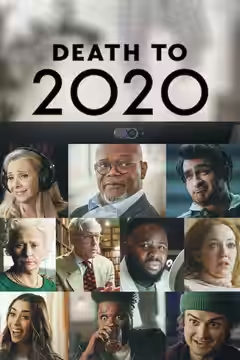
Charlie Brooker’s mockumentary hires a fine cast to say what everyone already thought about 2020, and the news clips do most of the work. Kudrow, Grant and Morgan earn their minutes; the other fifty or so are the year replayed with captions.
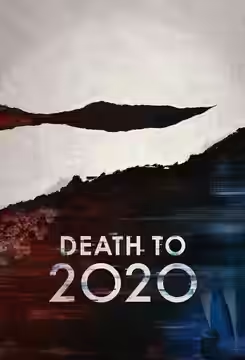
Death to 2020 is a 71-minute mockumentary that looks back at the year in the style of a prestige documentary: archive footage, a solemn narrator (Laurence Fishburne) and a row of experts lit against dark rooms. Charlie Brooker is one of 18 credited writers, and the shape is his. It is the end-of-year Wipe he used to make for the BBC, with film stars where he used to sit. The idea is sound. It arrived on 27 December 2020, before the year was quite finished with us, and it has the feel of something delivered in a hurry so as not to miss the wake.
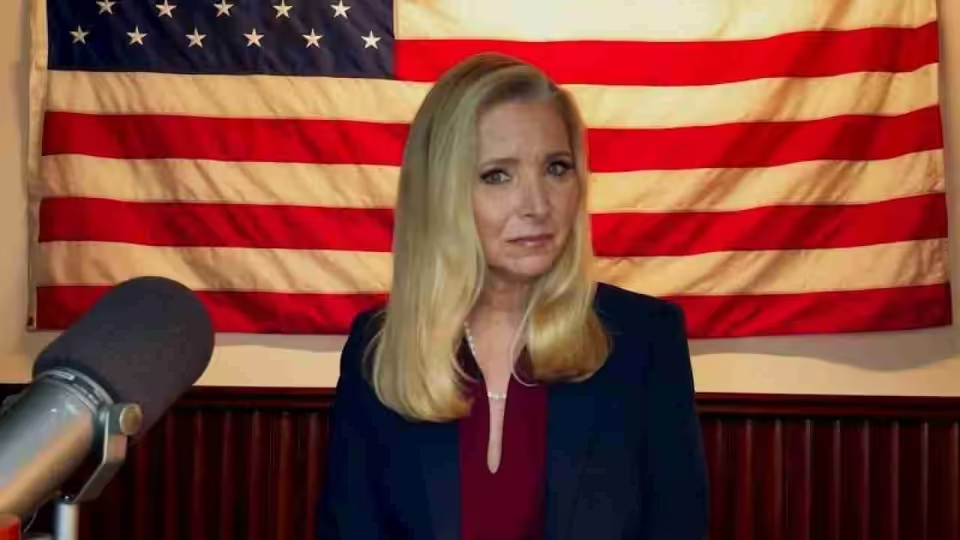
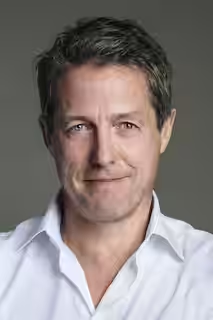
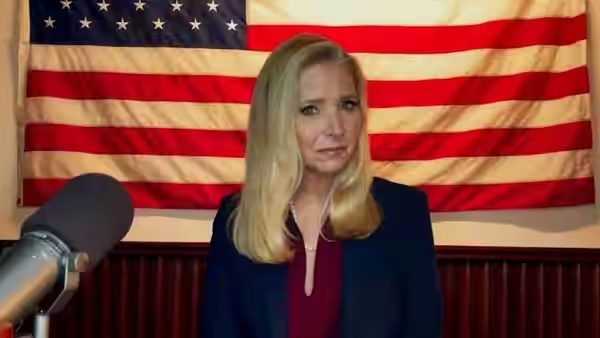
The cast are better than the script, and three of them justify a look. Lisa Kudrow plays Jeanetta Grace Susan, an unofficial spokesperson for the Trump White House, who denies things the interviewer has just shown her, flatly and without blinking, then denies having denied them. It is a precise piece of acting about a common kind of lying, and Kudrow never once reaches for the laugh. Hugh Grant’s Tennyson Foss is a historian in corduroy who cannot hold a fact for the length of a sentence, played with the same pleasure in being disliked that Grant found in Paddington 2. Diane Morgan, as Gemma Nerrick, introduced as one of the five most average people in the world, gets the best lines because hers are written for a character rather than at a target.
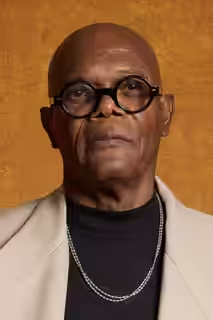
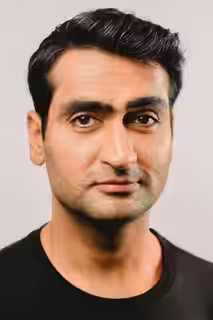
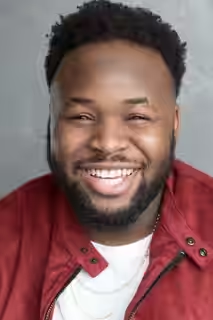
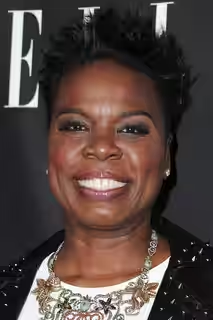
Cristin Milioti has the only strand with any movement in it. Kathy Flowers begins the year as a suburban mother with a phone and ends it somewhere we will not describe, and Milioti lets the change reach her eyes before it reaches her mouth. Samuel L. Jackson, as the reporter Dash Bracket, is given the job of saying what the audience is already thinking, which is thankless, and he does it without complaint. Kumail Nanjiani’s tech billionaire Bark Multiverse and Joe Keery’s Duke Goolies are each one joke told several times, and Samson Kayo’s scientist Pyrex Flask and Leslie Jones’s Dr. Maggie Gravel are on hand mostly to be exasperated.
The trouble is that the jokes are the ones everyone made at the time. The film shows a clip of a politician saying something foolish, then cuts to an actor saying that it was foolish, and 18 writers have not found a third beat. The sharpest writing is in the narration, a dozen or so descriptions of public figures that Fishburne delivers in the voice of a man reading a will. Between them the archive does the work. We laughed, properly, four times in 71 minutes, and we know it was four because by the halfway mark we had started counting, having noticed how much of the running time was footage we had watched the first time round and how little the film added to it. Then we were irritated, and irritation is not the feeling a comedy should leave you holding.
Alice Mathias and Al Campbell direct, and the mimicry is exact. Jamie Cairney and Adam Silver light the interviews the way prestige documentaries light them: a soft key from a window, a bookshelf out of focus, the subject a little off centre. Damon Tai and Jason Boxall cut between archive and talking heads at a pace that never lets a clip settle, which keeps things moving and also means nothing lands harder than anything else. Tracey Ullman’s Queen Elizabeth II and Angelo Irving’s Boris Johnson are impressions, and the film has the sense to use them briefly.
Brooker’s Wipe programmes worked because he was on screen, cross and specific, and because a year of television was a smaller target than a year of history. Here the target is everything, the writers’ room is large, and the film has the smoothed quality of something everyone agreed on. Most critics split down the middle on it. So do we, though we land on the colder side: the performances deserve a script that had something to say about the year beyond that it was bad.
It carries a 15 certificate and a tagline that ends in an exclamation mark, which tells you the level of the analysis. If you would like to be reminded of 2020 by people better dressed than you were at the time, this does it in 71 minutes. If you would rather not be reminded at all, that is a complaint about the year and not the film, though the film gives you few reasons to overrule it.