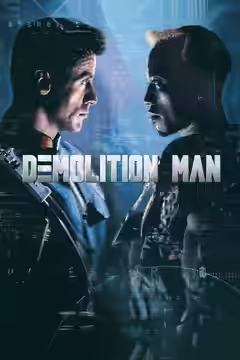
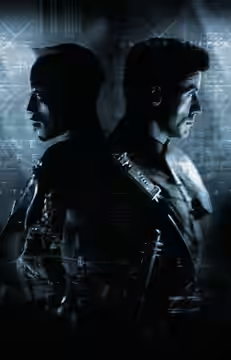
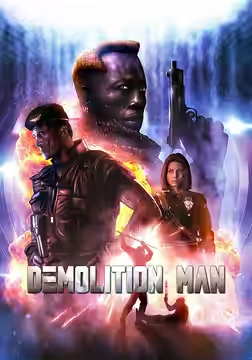
John Spartan (Sylvester Stallone) stands shirtless in a bright, blue-lit chamber
Film review

Demolition Man

1993 · Directed by Marco Brambilla · 1h 55m

In a sentenceThe future is pastel, nobody swears, and the only restaurant is Taco Bell; frankly we have been to worse

Los Angeles, 1996. Sergeant John Spartan (Sylvester Stallone), known to the force as the Demolition Man for the buildings he has levelled, goes into a derelict warehouse after the killer Simon Phoenix (Wesley Snipes), who is holding hostages. The warehouse comes down, the hostages are found dead, and both men are sentenced to decades frozen in a cryogenic prison. In 2032 Phoenix is thawed for a parole hearing and walks out into San Angeles, a city of pastel walls and electric cars where nobody has been murdered in years and the machines fine you for swearing. The police, led by Chief George Earle (Bob Gunton), have no idea what to do. Lieutenant Lenina Huxley (Sandra Bullock), who collects twentieth-century junk and longs for a bit of excitement, proposes thawing the one man who knows how Phoenix thinks.

Plays from YouTube when you press play; nothing loads from them until then.

Fi1m review

Stallone and Snipes are thawed into a tidy, polite 2032 and the jokes about it are sharper than anyone had a right to expect. The action is not. Sandra Bullock, mangling the slang of a century she has only read about, walks off with the film.

Demolition Man has a better idea than it knows what to do with. Los Angeles, 1996: Sergeant John Spartan (Sylvester Stallone) brings a warehouse down on the killer Simon Phoenix (Wesley Snipes), and both men are frozen as punishment. In 2032 Phoenix is thawed and loose in San Angeles, a city so gentle that its police have forgotten how to arrest anyone, and the department defrosts Spartan because he is the last man who remembers how violence works. That setup hands the writers, Daniel Waters, Robert Reneau and Peter M. Lenkov, a whole film of jokes about a future that has outlawed rudeness, and it is the jokes we remember. The fights we had to look up.

David L. Snyder builds the city as a place where every edge has been sanded off. Walls are white or cream, cars are rounded and silent, and the police station looks like the lobby of a hotel that does not expect guests. Alex Thomson lights the 1996 prologue in firelight and orange smoke, with the sky above Los Angeles glowing like a furnace, and then lights 2032 in flat, even white that flatters nobody and is exactly right. Bob Ringwood puts the citizens in long tunics in colours chosen not to startle and puts Phoenix in bleached hair and clothes that look assembled from three other outfits, so that he reads as a stain on the picture from the moment he wakes up.

The comedy is where the film earns its keep. A machine on the wall fines Spartan a credit every time he swears, and he keeps swearing, and it keeps printing tickets. The lavatories contain three seashells and no paper, and the film never once explains what you are meant to do with them, which is the smartest decision anyone involved made. Taco Bell has won the franchise wars and is now the only restaurant. Huxley greets every crisis with a twentieth-century phrase she has got slightly wrong, and Bullock plays her with such bright, eager wrongness that we laughed out loud several times and were not ashamed of it. She is the one performer here who understands that the straight line in a comedy is a job and not a punishment.

Snipes does the other half of the work. His Phoenix bounces, grins, flips out of frame, and is plainly the only person in 2032 having a good time, and his pleasure is catching. Nigel Hawthorne plays Dr Raymond Cocteau, the man who designed this city, with the soft, patient voice of someone who has already won. Denis Leary turns up underground as Edgar Friendly, leader of the people who would not be tidied away, and delivers a single speech about wanting to eat red meat and run through the streets naked at the speed of a man who has been given one scene and intends to use it. Stallone is the straight man, which he can do, but the one-liners written for him land like dropped furniture.

The action is the problem, and it is a large one for an action film. Marco Brambilla stages the opening raid well, with a helicopter, a burning building and a sense of where everyone is. After that the set pieces settle into gunfights in white corridors, and Stuart Baird cuts them fast without ever telling us the geography, so bodies fall and we are not sure who shot them. Elliot Goldenthal’s score hits every punch with a wall of brass and drums, which would be fine if the punches were worth it. The finale is a long fight in a dark place we will not describe, beyond saying that we checked our watch twice and were irritated with a film that had been so good company an hour earlier.

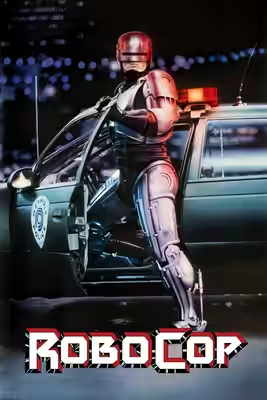
RoboCop (1987) had much the same idea, a slick corporate future and a cop who does not fit it, and it followed the idea all the way to its conclusions. Demolition Man takes the easy joke every time it is offered one. A society that fines swearing is a soft target, and the film knows it, which is why it also gives us Cocteau as a tyrant and Friendly’s sewer as a filthy, free alternative and then chooses the sewer because the sewer has bacon. It is not an argument so much as a menu.

See it with someone who laughs easily and does not mind waiting through the shooting. It runs 115 minutes, carries a 15 certificate, and is at its best when nobody on screen is holding a gun.


Critical consensus AI synthesised

60
Positive
3
Mixed
2
Negative
2

Most critics find Demolition Man more fun than it has any right to be, and the praise clusters on its tone rather than its plot: a tongue-in-cheek send-up of a politically correct future that knows how silly it is. Stallone’s willingness to play against his own image draws warm notices, as does his pairing with Wesley Snipes, and Sandra Bullock is picked out as the comic highlight. The kinder reviews call the action fast and comic-book in the best sense.

The reviews split widely, and the split runs along time. The notices from the film’s release are the harshest: the Los Angeles Times finds it stuck between loud action and dopey parody, with the set pieces stalling between the opening rescue and the finale, and Variety calls it a noisy, derivative pastiche, praising only the production design. The warmer verdicts come later, from Empire, Radio Times and, most recently, Slant Magazine.

Slant Magazine
11 December 2024 · ★★★★½ · Derek Smith
90

Smith calls the film an endlessly entertaining, tongue-in-cheek sci-fi action satire and praises Arrow Video’s release as an embarrassment of riches. He particularly singles out the film’s blend of thrilling action and goofy comedy, with Sandra Bullock a comedic standout.

Read the full review →
Empire
1 January 2000 · Phillipa Bloom
82*

Bloom finds the film fast, furious, and thoroughly enjoyable, praising its playful sense of fun. She singles out the chemistry between Stallone and Snipes and the film’s comic-book action spectacle.

Read the full review →
Radio Times
★★★★ · John Ferguson
80

The critic says the film comes close to being Sylvester Stallone’s best. They praise Stallone’s tongue-in-cheek performance and the film’s playful send-up of political correctness.

Read the full review →
Time Out
· NF
64*

The page is identified as a film review, but the critic’s verdict is unavailable in the supplied capture. Its description characterizes the film as a cruel satire of a politically correct society.

Read the full review →
The New York Times
8 October 1993 · Janet Maslin
50*

The review’s verdict and specific praise or complaint cannot be verified from the blocked page. The available page text contains only an access prompt.

Read the full review →
Los Angeles Times
8 October 1993 · Kenneth Turan
30*

Turan finds the film caught between loud action and dopey science-fiction parody, making it more trying than entertaining. He praises the opening rescue sequence’s staging but complains that the action largely freezes until the finale.

Read the full review →

Straight answers AI written, from our review

Is Demolition Man worth watching?
Demolition Man is worth watching for anyone who enjoys a satirical future more than a well-staged gunfight, and we scored it 68. The jokes about a polite, pastel 2032 are sharp and Sandra Bullock is a delight, but the action is cut so fast that we often lost track of who was shooting whom.
How long is Demolition Man, and what is it rated?
Demolition Man runs 1h 55m. It is a crime and action film.
Where can I watch Demolition Man in Ukraine?
Demolition Man is not on any streaming or rental service in Ukraine at the moment. It is available in 35 other countries; change your country at the top of the page to see where. Availability is checked daily.
How violent or frightening is Demolition Man, and is it suitable for children?
Demolition Man carries a 15 certificate in the UK and an R in the US, and is not suitable for children. It opens with a warehouse collapse and dead hostages, then settles into frequent gunfights and a long, dark final fight, with swearing throughout; it is loud rather than frightening, and teenagers of fifteen and over should take it in their stride.
How does Demolition Man compare to RoboCop?
Demolition Man borrows its slick corporate future from RoboCop and plays it mostly for laughs, where the earlier film follows the idea through and stages its action properly. RoboCop is the better and far more violent film, and the one to choose if you want satire with teeth; Demolition Man is the gentler, sillier evening, carried by Bullock and Snipes rather than by its set pieces.
What should I watch after Demolition Man?
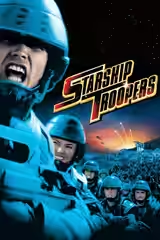
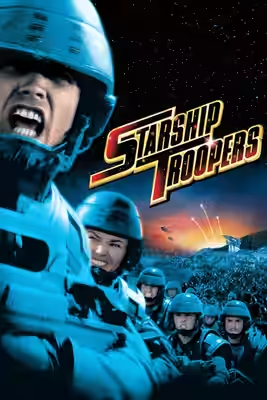
After Demolition Man, try RoboCop (1987, Fi1m 91): The corporate future this film borrows from, with the satire finished and the action staged properly. Then Brazil (1985, Fi1m 83): Gilliam’s polite bureaucratic nightmare, where the forms are the violence and nobody escapes them; and Starship Troopers (1997, Fi1m 79): Verhoeven again, cheerful fascists in pressed uniforms, and a joke the audience took a decade to get.

Cast

If you liked this, try…

  1. Sleeper (1973) · not reviewed yetA man thawed into a tidy future, done as pure slapstick with better jokes about food.

  2. RoboCop (1987, Fi1m 91)The corporate future this film borrows from, with the satire finished and the action staged properly.

  3. Brazil (1985, Fi1m 83)Gilliam’s polite bureaucratic nightmare, where the forms are the violence and nobody escapes them.

  4. Starship Troopers (1997, Fi1m 79)Verhoeven again, cheerful fascists in pressed uniforms, and a joke the audience took a decade to get.

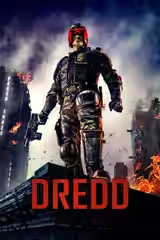
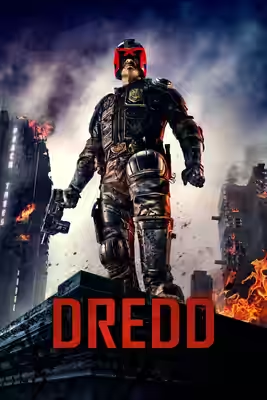
  5. Dredd (2012) · not reviewed yetOne tower block, one long day, and the clean, legible action this film never manages.

Free account

Know what to watch tonight

Two lists that know where things are streaming, collections you can share, your own score beside ours, and Discover that remembers what you have seen.

  • Want to see, sorted by what is streaming now
  • Seen, with your score out of ten
  • No adverts, ever