Film review

Elvis

2022 · Directed by Baz Luhrmann · 2h 39m · MPA PG-13

In a sentenceEvery concert is thrilling and every time one ends Tom Hanks turns up in a fat suit to explain it

Las Vegas. Colonel Tom Parker (Tom Hanks), Elvis Presley’s manager, lies in a hospital bed and begins to tell the story of the boy he made famous, insisting he was not the villain of it. His account goes back to Memphis in the mid-1950s, where the young Elvis (Austin Butler) drives a truck, has cut one record, and is booked low on the bill of a country show at the Louisiana Hayride headlined by Hank Snow (David Wenham). Parker is in the crowd. He watches the girls scream at a boy in a pink suit and decides he has found his new attraction. Elvis’s mother Gladys (Helen Thomson) and father Vernon (Richard Roxburgh) wonder what their son is getting into.

Plays from YouTube when you press play; nothing loads from them until then.

Fi1m review

Baz Luhrmann’s Elvis film is at its best when Austin Butler is on a stage, which is not often enough in 159 minutes. The concerts are electric; the rest is Tom Hanks’s Colonel Parker narrating, and the narration keeps Presley at arm’s length.

Baz Luhrmann’s film about Elvis Presley is narrated by the man who managed him. Colonel Tom Parker (Tom Hanks) tells the story from a Las Vegas hospital bed, insisting all the while that he was not the villain, and the film lets him. It is a strange choice, and it is the choice that decides the film. Whenever Austin Butler is on a stage, Elvis is a proper music film, loud and alive. Whenever he steps off it, Hanks steps in to explain what we have just watched, and the life goes out of the picture.

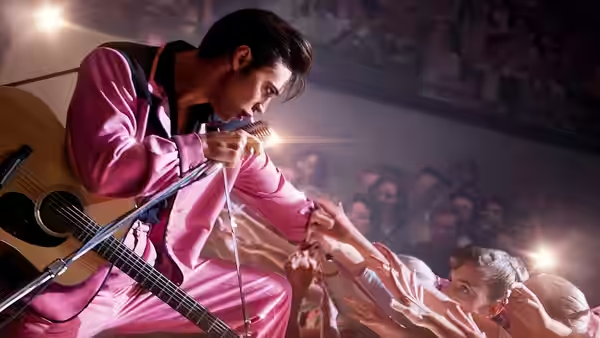
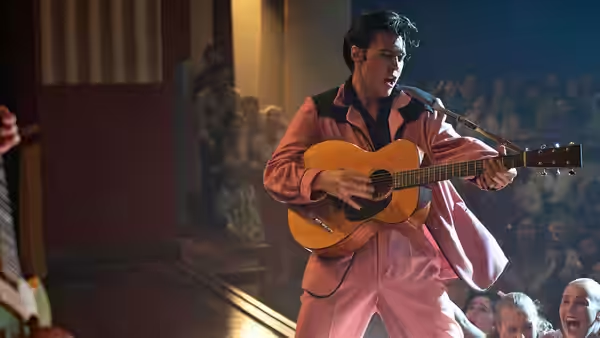
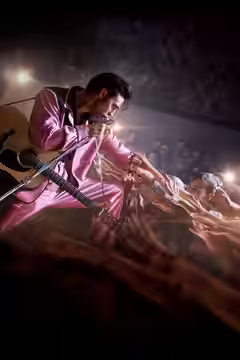
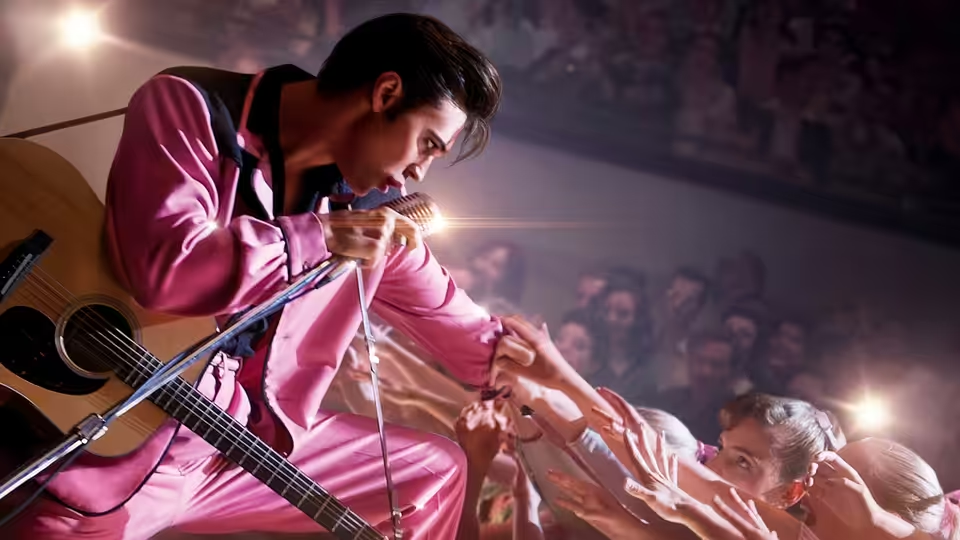
At the Louisiana Hayride the young Elvis stands at a microphone in a pink suit, his legs start to shake, and Luhrmann cuts from the hips to the faces of girls in the crowd who do not yet know what is happening to them. Mandy Walker lights the stage hot and white and keeps the camera low, so the boy looks enormous and the hall looks small. Matt Villa and Jonathan Redmond cut the number so that every twitch lands on a beat. Butler does the rest: the lip, the planted feet, the sideways look at the band as if checking they have noticed too.

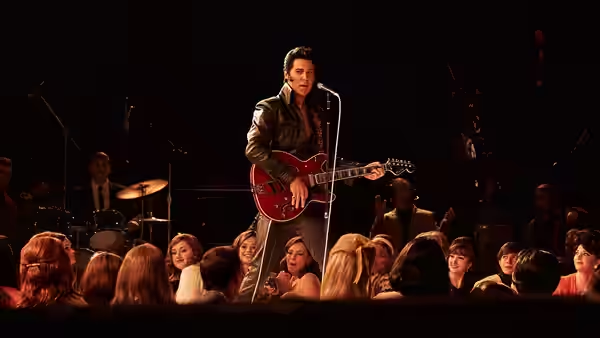
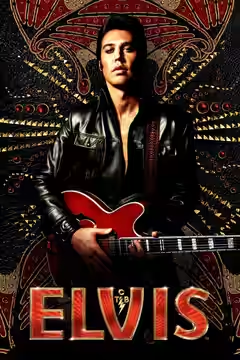
He is remarkable across the whole span, and the later stretch is where he surprised us. There is a sequence built around a television special in 1968, and we found ourselves more moved than we had any right to be by a man in a leather suit singing a ballad. For once the film stops moving. Butler is allowed to stand still and sing to the end of the song, and Elliott Wheeler’s arrangement lets the recording breathe instead of dressing it up. It is the one time the film trusts a song to do the work.

The rest of the time we are with Parker, and Parker is a problem. Hanks plays him under a bulb of prosthetic flesh, with an accent from nowhere, rolling his consonants like a Bond villain who has taken up cabaret. It is a performance of great commitment, and we could not tell you one thing Parker wants beyond money. The film picks up his habit of describing feelings rather than having them. He tells us the crowd went wild. We could see that. He tells us Elvis was lonely. We would have liked to be shown.

The first twenty minutes are the worst of it. We were irritated, then bored, then cross at being bored by something built with this much care. Carnival rides, split screens, comic-book panels, songs sliced into three-second pieces so that nothing has time to be a song. Luhrmann has always cut like this; the difference is that Romeo + Juliet (1996) knew when to stop and sit in a room, and this takes an hour to learn the trick.

The supporting cast suffers for the pace. Olivia DeJonge’s Priscilla is given a handful of scenes and a hairstyle. Helen Thomson’s Gladys, Elvis’s mother, is the only person he seems to love in a way we can see, and she leaves the film too soon. Kelvin Harrison Jr. is elegant as B.B. King, but he is there to deliver a point about who made this music and who got paid for it. The point is made cleanly once, in song, by Gary Clark Jr. as Arthur ‘Big Boy’ Crudup, and then again in dialogue in case we missed it.

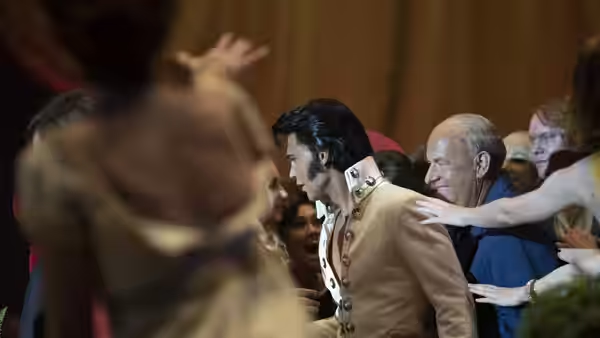
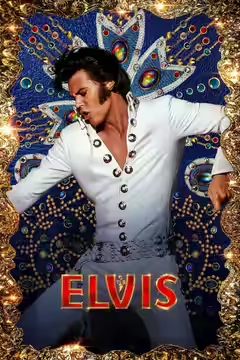
Catherine Martin and Karen Murphy build a Graceland of white carpet and a Las Vegas showroom of gold, and Martin’s costumes track the man from pink lamé to jewelled jumpsuits. Walker shoots the Vegas years in a bronze haze, so the last act looks like a room with the curtains drawn. But the film gets there with fifty minutes still to run, and stages the same argument between star and manager three times.

See it in a cinema, where the songs are loud enough to drown the narration and Butler’s hips fill the wall. At home you will hear more of Parker, which is not a recommendation. It carries a 12A and runs 159 minutes, of which perhaps forty are the film Luhrmann wanted to make.

Critical consensus AI synthesised

69
Positive
16
Mixed
5
Negative
2

Most critics come away entertained, and the praise lands in the same two places. Austin Butler’s performance is admired almost without exception, singled out for its physical energy and for the way it holds across three decades; several reviews call it star-making. The concert sequences are the other point of agreement, with the 1968 comeback special and the Las Vegas years picked out as the stretches where Luhrmann’s maximalism and the material meet. For most, the excess is the point.

The reservations cluster around what the film leaves out. A recurring complaint is that it keeps Presley at arm’s length, with little interest in his interior life, and that telling the story through Colonel Tom Parker’s narration pays off only intermittently. Some note historical simplifications. The spread is wide: a handful of raves sit against two firm rejections, with Sight and Sound and The Ringer arguing the style smothers the subject, though both still praise Butler.

Total Film
24 June 2022
90*

The critic finds the biopic terrifically enjoyable with swagger and a star-making turn from Austin Butler, praising Luhrmann's exuberant style that strikes the right balance of bombast and character beats.

Read the full review →
Los Angeles Times
23 June 2022 · Katie Walsh
85*

Butler delivers a fully transformed, star-making turn as Elvis in Luhrmann's opulent, maximalist biopic that resurrects the King and makes him relevant again. The manic filmmaking and focus on Elvis's exploitation and revolutionary energy create an intoxicating, dynamic portrait.

Read the full review →
The Guardian
26 June 2022
85*

The critic calls Baz Luhrmann’s whirlwind biopic cinematic dynamite with electrifying performances from Austin Butler and Tom Hanks. It singles out Butler’s physical, emotional and electrical energy in the title role for particular praise.

Read the full review →
Time Out
25 May 2022 · ★★★★ · Phil de Semlyen
80

Luhrmann bounces back with a larger-than-life, energising and wildly entertaining anthem to the King that centres the Black roots of the music. Austin Butler delivers a show-stopper performance as Elvis.

Read the full review →
The Hollywood Reporter
25 May 2022 · festival review · David Rooney
75*

The critic praises the film's kinetic, maximalist style and Austin Butler's performance as Elvis but criticizes the narrative focus on the exploitative Colonel Tom Parker and the resulting emotional distance from the subject.

Read the full review →
Variety
25 May 2022 · festival review · Owen Gleiberman
75*

Luhrmann's film is a fizzy, deliriously energetic pop-opera biopic that captures the Elvis mythology in a compelling if scattershot way until the powerful Vegas sequences. Butler's performance improves markedly in the later years, building to something moving and true despite the film's imperfections.

Read the full review →

Cast

Awards

Academy Awards, 2023

Nominated
Best Picture

Golden Globes, 2023

Nominated
Best Motion Picture – Drama

David di Donatello for Best International Film, 2022

Nominated
David di Donatello for Best International Film

If you liked this, try…

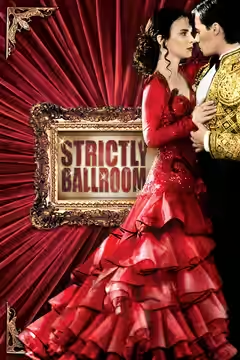
Strictly Ballroom poster83

Strictly Ballroom

1992 · Luhrmann before the money, with the same love of sequins and a story that holds.

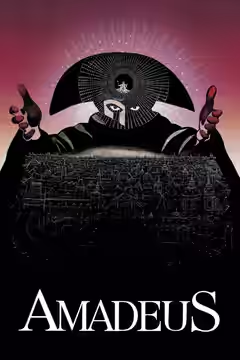
Amadeus poster91

Amadeus

1984 · Another genius told by the jealous man beside him, and the device actually works.

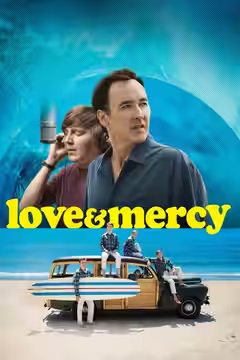
Love & Mercy poster

Love & Mercy

2014 · Brian Wilson, a controlling handler and a quieter, sadder account of what management costs.

Control poster80

Control

2007 · A music film in black and white with no glitter at all, and it stings.

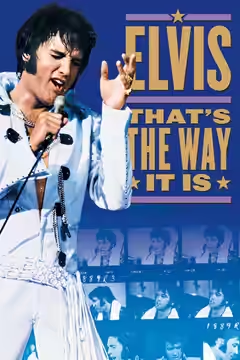
Elvis: That's the Way It Is poster

Elvis: That's the Way It Is

1970 · The real man in Las Vegas, in rehearsal and on stage, no narrator required.