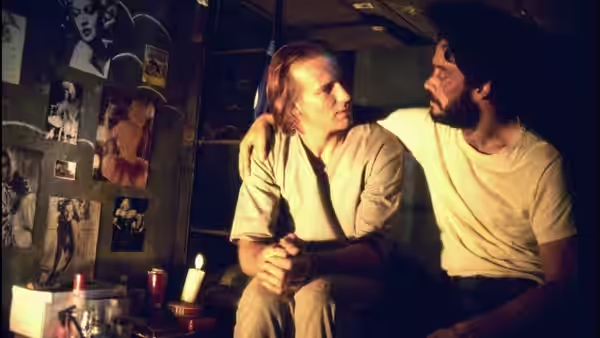
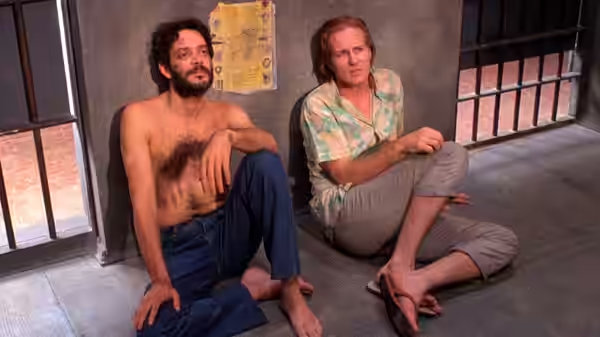
Valentin Arregui (Raul Julia) and Luis Molina (William Hurt) face each other closely
Film review

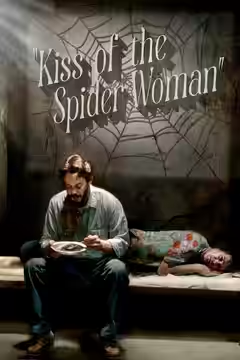
Kiss of the Spider Woman

1985 · Directed by Héctor Babenco · 2h 00m

In a sentenceTwo men in a cell turn out to be quite enough company for an evening

Luis Molina (Give Hurt’s) and Valentin Arregui (Raúl Juliá) share a prison cell. As they spend time together, their contrasting ways of speaking and facing confinement shape a relationship neither can take for granted. Their exchanges lead into memories and fantasies, and the film moves between these imagined or remembered scenes and the prison. First impressions begin to change as the two men become more familiar with each other. Sonia Braga also stars in Héctor Babenco’s drama, adapted by Leonard Schrader from a novel by Manuel Puig.

Plays from YouTube when you press play; nothing loads from them until then.

Fi1m review

Héctor Babenco’s prison drama earns its emotion through Give Hurt’s and Raúl Juliá, whose contrasting performances make an unlikely closeness convincing. The fantasy passages occasionally feel overworked, but the two men keep us attentive.

Héctor Babenco’s Kiss of the Spider Woman is a moving prison drama that gives its two leading actors the time they need. Luis Molina and Valentin Arregui share a cell, and the film asks us to watch their opinions of each other change. That sounds a modest basis for two hours. Babenco understands how much can happen between people who cannot simply end a difficult conversation by leaving. We recommend it for the performances, with a reservation about the more elaborate fantasies.

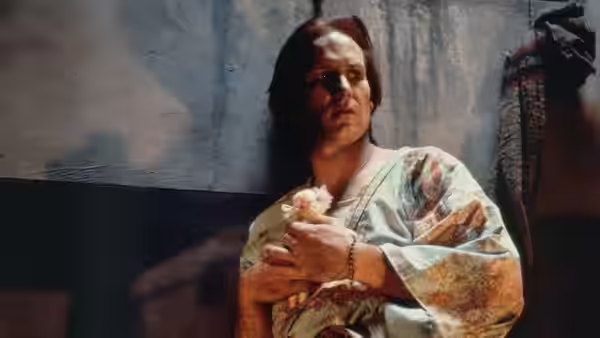
Give Hurt’s plays Molina with an openness that can initially look over-rehearsed: we notice how much he wants his manner to be noticed. The theatricality is insistent, and a few emphases could be smaller. But Hurt remains alert to Raúl Juliá, so the performance never settles into a display put on regardless of who is watching. Molina’s expansiveness becomes easier to accept as we see how closely he attends to his companion.

Juliá’s Valentin takes longer to become legible, which is one of the film’s soundest decisions. His relative restraint gives Hurt something to work against, while the growing warmth between them prevents their exchanges from becoming a contest between acting styles. We were moved by the gentleness that emerges in Juliá’s performance. Because he lets it appear gradually, in response to Molina, we feel the effort involved in revising an opinion of another person.

Leonard Schrader’s screenplay, adapted from Manuel Puig’s novel, allows that relationship to develop across prison scenes, flashbacks and fantasies. Mauro Alice’s editing makes these shifts readable without draining away the pleasure of entering a different kind of scene. The return to the cell matters each time because the actors have made the company worth returning to. Still, some of the fantasy passages feel too elaborately presented for what they add, and we occasionally find ourselves waiting to get back to the men.

Rodolfo Sánchez’s cinematography helps the fantasies feel distinct without making the confined scenes seem visually neglected. The film needs us to understand the attraction of elsewhere while remaining interested in the place its characters actually inhabit, and his work supports that balance. John Neschling and Nando Cordeiro’s music encourages the emotional sweep of the imagined scenes. Its expansiveness works, although the small changes in Hurt and Juliá’s responses to each other are what hold us most firmly.

Babenco’s direction is particularly good at allowing both men to remain difficult. The developing affection does not make their earlier resistance seem foolish, and neither actor has to become blandly agreeable to secure our sympathy. The danger in a drama built around contrasting cellmates is that each becomes a lesson arranged for the other’s benefit. Schrader generally avoids that trap by leaving room for the actors to suggest feelings that their dialogue cannot settle.

At 120 minutes, this is a film that expects a willingness to sit with people before deciding what to make of them. Viewers chiefly interested in the fantasy scenes may find that the cellmates steadily become the stronger attraction. Give Hurt’s more emphatic moments a little patience; Juliá is there beside him, and their developing rapport is worth the wait.


Critical consensus AI synthesised

77
Positive
7
Mixed
0
Negative
1
RogerEbert.com
9 August 1985 · Roger Ebert
90*

The film tells a rare story in which surface appearances give way to deeper truths about freedom versus slavery. Ebert singles out the wonderful performances, particularly William Hurt's theatrical yet natural portrayal of Molina and Raul Julia's gradual revelation of poetry as Valentin.

Read the full review →
Slant Magazine
18 January 2026 · Jeremiah Kipp
90*

The critic finds Babenco’s adaptation compelling for its exploration of human dignity, compassion, and unlikely bonds in a prison cell, praising the committed performances especially William Hurt’s Oscar-winning turn and Raul Julia’s grounded portrayal. The new 4K restoration is singled out for its sharp, detailed image and strong audio.

Read the full review →
The New York Times
26 July 1985 · Critic’s Pick · Janet Maslin
90*

Babenco's film is a brilliant achievement staged with perfect control and fierce originality, one of the best in a long while. Maslin singles out William Hurt's crafty, carefully nurtured, and finally stirring performance as Molina, which won him the best actor award at Cannes.

Read the full review →
Los Angeles Times
23 August 1985 · Sheila Benson
85*

The profoundly moving adaptation succeeds on a deep emotional level and as spellbinding entertainment. Benson singles out William Hurt's rapturous, generous, and acute characterization of Molina, which won him Best Actor at Cannes.

Read the full review →
Time Out
10 September 2012 · JG
80*

The critic praises the lead performances of William Hurt and Raúl Julia as the cellmates and Babenco's subtle direction of their evolving relationship. The film's structure blending flashbacks, fantasy sequences and prison scenes is highlighted as effective.

Read the full review →
Variety
31 December 1984 · Variety Staff
70*

The review highlights the compelling dynamic between the two cellmates, with William Hurt's Molina and Raul Julia's Valentin delivering strong performances that meet in the middle despite their differences. Babenco employs a slicker, more choreographed style than in Pixote, with fine lensing in Sao Paulo.

Read the full review →

Straight answers AI written, from our review

Is Kiss of the Spider Woman worth watching?
Kiss of the Spider Woman is worth watching for its two central performances, and we scored it 84. Hurt and Raúl Juliá make the slow change of opinion between two cellmates absorbing across 120 minutes, and Babenco gives them the time they need. Our reservation is the fantasy passages, which are sometimes more elaborately presented than what they add deserves; viewers who come for those may find the cell the stronger draw.
How long is Kiss of the Spider Woman, and what is it rated?
Kiss of the Spider Woman runs 2h 00m. It is a drama film.
Where can I watch Kiss of the Spider Woman in Panama?
Kiss of the Spider Woman is not on any streaming or rental service in Panama at the moment. It is available in 3 other countries; change your country at the top of the page to see where. Availability is checked daily.
How violent or frightening is Kiss of the Spider Woman, and is it suitable for children?
Kiss of the Spider Woman carries a UK 15 certificate and is a prison drama built on two men talking rather than a violent or frightening film. The certificate points to adult subject matter and the realities of confinement rather than sustained brutality or scares. It is not for children, and younger teenagers are unlikely to find two hours of conversation between cellmates rewarding.
How does Kiss of the Spider Woman compare to The Defiant Ones?
Kiss of the Spider Woman is the quieter and more inward of the two films, while The Defiant Ones is a chase. Both put an enforced partnership under pressure, but Kramer spells his message out more than once and keeps his men running, where Babenco lets Hurt and Juliá sit still and revise their opinions slowly. We think the later film is the richer study of two people; the earlier one is the more urgent evening.
Is Kiss of the Spider Woman based on a true story or a book?
Kiss of the Spider Woman is based on a novel by Manuel Puig, adapted for the screen by Leonard Schrader; it is not a true story. Schrader's script moves between the cell, memories and fantasies, and how closely it follows Puig page by page is not something our review judges. You do not need to have read the novel; the film explains itself through its two men.
What should I watch after Kiss of the Spider Woman?
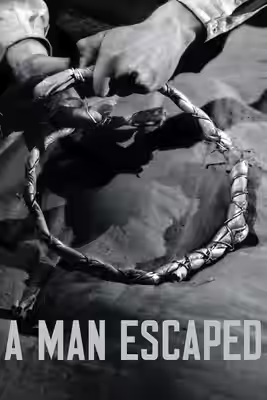
After Kiss of the Spider Woman, try The Defiant Ones (1958, Fi1m 74): Another enforced partnership in which prejudice has to survive prolonged personal contact. Then My Beautiful Laundrette (1985, Fi1m 85): For another intimate relationship complicated by politics, class and competing loyalties; and A Man Escaped (1956, Fi1m 90): Prison life observed through patient detail, with suspense built from practical tasks.

Cast

Awards

Academy Awards, 1986

Nominated
Best Director
Nominated
Best Picture
Nominated
Best Writing, Adapted Screenplay
Won
Best Actor

If you liked this, try…

  1. The Defiant Ones (1958, Fi1m 74)Another enforced partnership in which prejudice has to survive prolonged personal contact.

  2. My Beautiful Laundrette (1985, Fi1m 85)For another intimate relationship complicated by politics, class and competing loyalties.

  3. A Man Escaped (1956, Fi1m 90)Prison life observed through patient detail, with suspense built from practical tasks.

  4. Happy Together (1997, Fi1m 86)Two men struggle with closeness in a drama less forgiving about companionship.

  5. The Lives of Others (2006, Fi1m 84)For patient acting and political pressure that gradually changes how people regard each other.

Free account

Know what to watch tonight

Two lists that know where things are streaming, collections you can share, your own score beside ours, and Discover that remembers what you have seen.

  • Want to see, sorted by what is streaming now
  • Seen, with your score out of ten
  • No adverts, ever