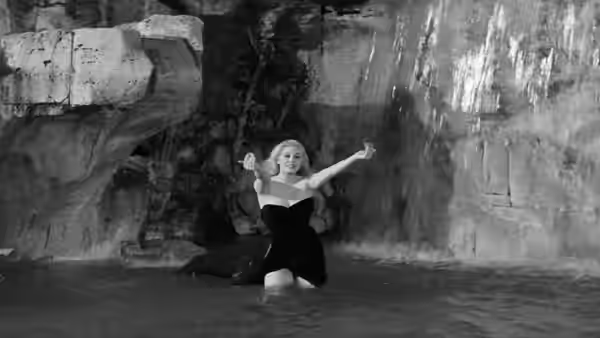
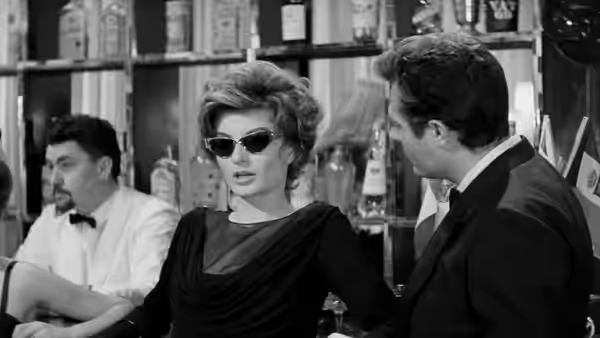
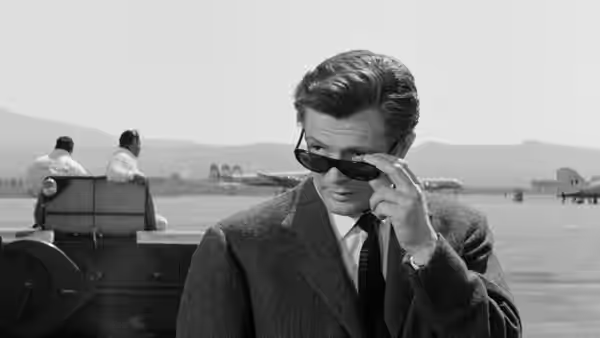
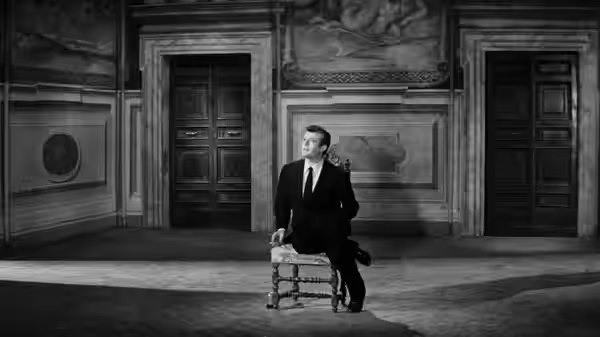
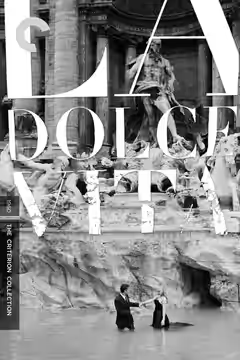
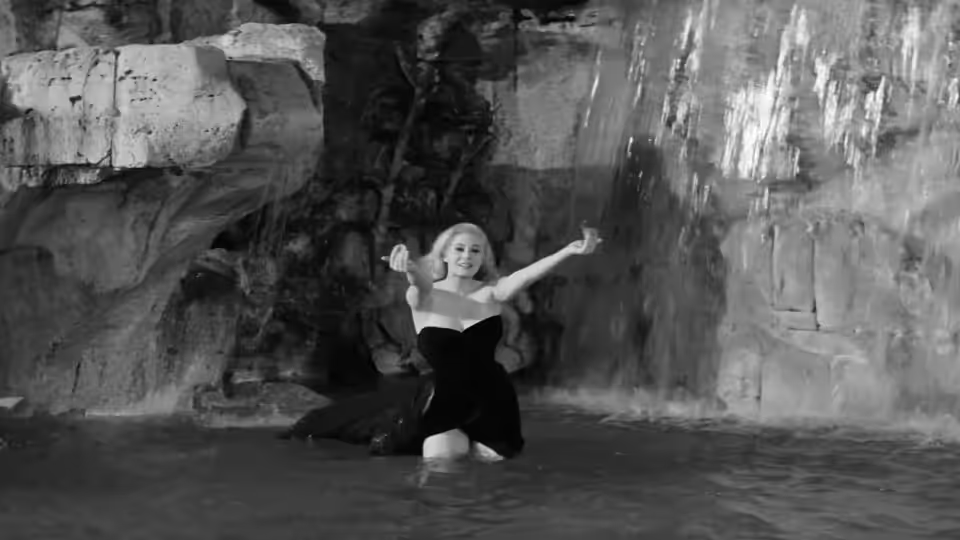
Sylvia (Anita Ekberg) kneels in the Trevi Fountain with her arms raised
Film review

La Dolce Vita

1960 · Directed by Federico Fellini · 2h 54m · Statens medieråd 15

In a sentenceThe Trevi Fountain looks inviting, which is more than we can say for most of the company

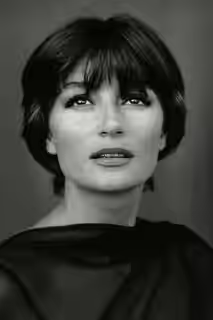
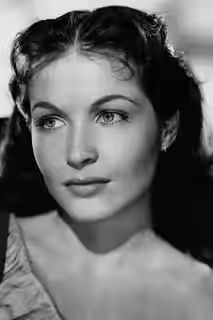
In postwar Rome, Marcello Rubini (Marcello Mastroianni) moves through a society absorbed by celebrity and the pursuit of pleasure. His encounters bring him into the company of Maddalena (Anouk Aimée), Emma (Yvonne Furneaux) and Sylvia (Anita Ekberg). A statue of Jesus flies above the city, while Sylvia appears at the Trevi Fountain. Religion and celebrity both become public spectacles as Marcello follows the attractions of the city. The story proceeds through a succession of encounters among people pursuing pleasure and attention, with little separation between private lives and public display.

Plays from YouTube when you press play; nothing loads from them until then.

Fi1m review

Federico Fellini makes celebrity life tempting enough to explain its hold, and Marcello Mastroianni gives the satire a quietly disheartening human centre. The length tests our patience, but the wit, images and performances earn a strong recommendation.

Federico Fellini makes the people in La Dolce Vita attractive enough that we cannot congratulate ourselves simply for noticing their faults. There is pleasure in this account of celebrity life in postwar Rome, and the film lets us enjoy it without pretending that enjoyment makes us innocent. We recommend it warmly, though 174 minutes give some of its observations longer than they need. Marcello Mastroianni holds it together by making Marcello Rubini agreeable company even when the people around him begin to wear.

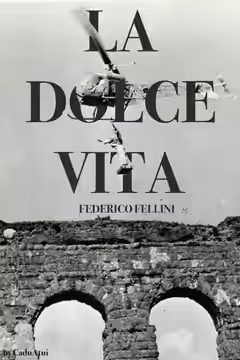
We were unexpectedly unsettled by the flying statue of Jesus. It is funny to see a sacred figure turned into a public spectacle, but the ease of that transformation is also unpleasant. The image gives the film’s criticism of Catholic hypocrisy a visible, ridiculous form without needing anybody to explain it. Celebrity and religion can both command a crowd, and the director is interested in what people stop asking once they have something remarkable to stare at.

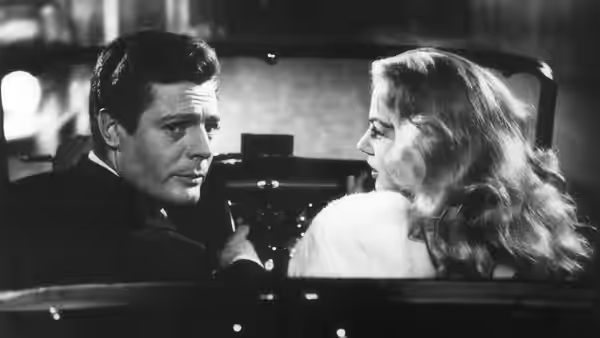
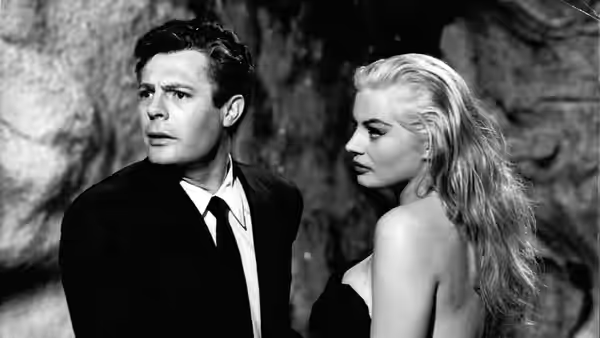
Marcello Mastroianni is crucial because he does not play Marcello Rubini as a ready-made warning about bad company. His ease is persuasive, and so is the disappointment that seems to remain after the interest of each new encounter has passed. Anita Ekberg’s Sylvia can dominate an image without making it feel overacted; the Trevi Fountain encounter needs that confidence. Anouk Aimée as Maddalena and Yvonne Furneaux as Emma give the human exchanges weight. Their work keeps the film from becoming a catalogue of people we are meant to disapprove of.

Otello Martelli’s black-and-white cinematography gives the Trevi Fountain encounter a beauty that makes any easy dismissal of this life seem dishonest. The water and stone matter as much as the famous face: we are allowed to look for long enough to understand the attraction. Piero Gherardi’s production design supports that sense of a Rome arranged for display, where the surroundings can hold our attention as firmly as the people. This is a place we can enjoy looking at even when its inhabitants become tiring.

Leo Catozzo’s editing respects the separate episodes instead of forcing them to behave like steps towards one tidy destination. That freedom suits a film about people forever finding something else to look at, but it also permits repetitions that would have been easier to excuse in a shorter film. Nino Rota’s score helps considerably: its lingering sadness gives these encounters a consequence that their participants do not always seem to feel. We hear the weariness even when the spectacle continues to entertain.

The length becomes a problem when another encounter merely confirms what several earlier ones have already made clear. A few episodes feel sufficiently alike in purpose that their individual pleasures cannot quite excuse the accumulated delay. As a satire of celebrity, the film is sharpest when it remembers why attention is desirable and how easily any of us might want some. Its enjoyment of these people usually prevents its disapproval from becoming smug.

Give it an evening when there is nothing else to fit in, and allow for the occasional impatience. The episodic shape makes interruptions tempting, but stepping away whenever the company becomes tiresome would remove something the film wants us to experience. It rewards a large image and sustained attention, particularly when the temptation is to treat its famous sights as things we already know. Keep the telephone out of reach.
Critical consensus AI synthesised

83
Positive
6
Mixed
2
Negative
0

Most critics respond warmly to La Dolce Vita, with praise centred on Fellini’s satire of celebrity, decadence and social hypocrisy. The reviews repeatedly single out Marcello Mastroianni’s performance, while the dreamlike imagery and black-and-white cinematography receive broad approval. Nino Rota’s score is another strength, and several accounts emphasise how familiar the film’s treatment of fame and the paparazzi remains. The prevailing view is of a film whose excitement coexists with melancholy and disgust.

The reservations concern length and structure rather than the performances or visual craft. Variety suggests that the running time tests some viewers while absorbing others. Eye for Film finds the film overlong and scattered, yet still admires its attack on celebrity and social decay. The available verdicts therefore range from enthusiastic praise to qualified admiration, with no outright rejection; even the more reserved accounts identify substantial strengths.

Radio Times
★★★★★ · David Parkinson
100

Parkinson presents the film as a scathing satire of Italian decadence and Catholic hypocrisy. He praises Mastroianni’s performance and singles out the memorable Trevi Fountain encounter with Anita Ekberg.

Read the full review →
Time Out
22 September 2024 · ★★★★★ · David Fear
100

The five-star rating signals an enthusiastic verdict. The page highlights the film’s striking images, including Anita Ekberg at the Trevi Fountain and the flying statue of Jesus.

Read the full review →
The Guardian
3 January 2020 · Peter Bradshaw
90*

Bradshaw regards the film as a brilliant, surreal masterpiece that captures the excitement and melancholy of postwar Rome. He especially praises Fellini’s dreamlike imagery and the ending’s sudden shift from night to morning.

Read the full review →
Empire
1 January 2000 · David Parkinson
85*

Parkinson praises the film as a masterpiece that has aged remarkably well. He especially singles out Fellini’s sharp satire of celebrity culture and the paparazzi.

Read the full review →
Los Angeles Times
10 April 1992 · Kevin Thomas
80*

Thomas calls the film an arguably great, enduring work whose portrait of celebrity culture has grown more familiar over time. He especially praises its haunting Nino Rota score, ravishing black-and-white cinematography, and memorable episodes.

Read the full review →
Variety
31 December 1959 · Variety Staff
75*

The review suggests the film’s length may test some viewers, but others will be absorbed throughout. It praises the uniformly strong performances, especially Marcello Mastroianni and Yvonne Furneaux, along with the cinematography and score.

Read the full review →

Straight answers AI written, from our review

Is La Dolce Vita worth watching?
La Dolce Vita is warmly recommended for its wit, images and performances, and we score it 88 out of 100. Mastroianni gives its satire of celebrity a quietly disheartening human centre, while Fellini makes the pleasures of Rome persuasive. At 174 minutes, the episodic story repeats some observations, so it suits an evening with time and patience to spare.
How long is La Dolce Vita, and what is it rated?
La Dolce Vita runs 2h 54m and is rated 15 by the Statens medieråd in Sweden. It is a comedy and drama film.
Where can I watch La Dolce Vita in Sweden?
La Dolce Vita is streaming on MUBI and Amazon Prime Video in Sweden, and it is also available to rent from Amazon Prime Video from kr 39.00. Availability is checked daily; the links above go straight to each service.
How violent or frightening is La Dolce Vita, and is it suitable for children?
La Dolce Vita has a UK 12A certificate, meaning children under 12 need an accompanying adult at the cinema. We find the flying statue of Jesus unsettling because it turns religion into public spectacle, rather than because of any physical threat. Its adult social satire and 174-minute running time make it a more natural choice for teenagers and adults than younger children.
How does La Dolce Vita compare to The Rules of the Game?
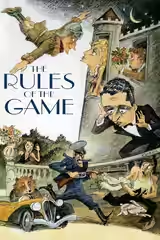
La Dolce Vita is our choice for a leisurely satire of celebrity, while The Rules of the Game better suits an appetite for romantic intrigue. Both find troubling behaviour beneath social charm: Fellini follows successive encounters around Rome, while Renoir makes small evasions painfully recognisable. We find Fellini’s repetitions test patience; Renoir’s busy opening instead demands concentration to distinguish the people.
What should I watch after La Dolce Vita?
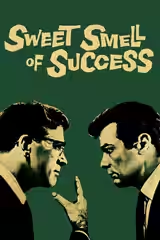
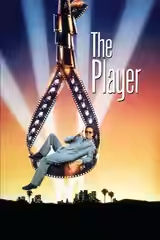
After La Dolce Vita, try The Rules of the Game (1939, Fi1m 91): Another social gathering where charm does little to excuse appalling behaviour. Then Sweet Smell of Success (1957, Fi1m 88): For sharper elbows, uglier favours and celebrity treated as a daily business; and The Player (1992, Fi1m 85): For another charming guide through a business skilled at excusing itself.

Cast

Awards

Academy Awards, 1962

Nominated
Best Director
Nominated
Best Writing, Original Screenplay
Won
Best Costume Design, Black-and-White

Cannes Film Festival, 1960

Won
Palme d'Or

If you liked this, try…

  1. The Rules of the Game (1939, Fi1m 91)Another social gathering where charm does little to excuse appalling behaviour.

  2. Sweet Smell of Success (1957, Fi1m 88)For sharper elbows, uglier favours and celebrity treated as a daily business.

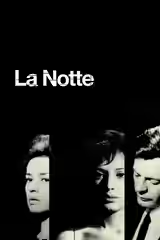
  3. La Notte (1961) · not on Fi1m yetA quieter night among people struggling to say why they are unhappy.

  4. The Player (1992, Fi1m 85)For another charming guide through a business skilled at excusing itself.

  5. The Day He Arrives (2011) · not on Fi1m yetRepeated encounters and awkward drinking make another city feel difficult to leave.