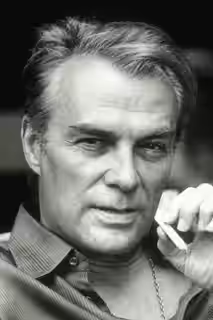
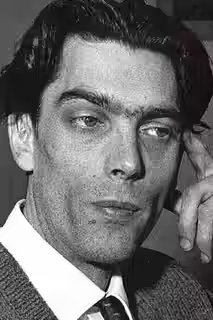
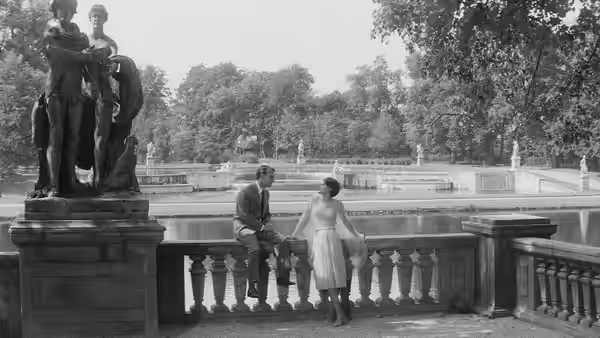
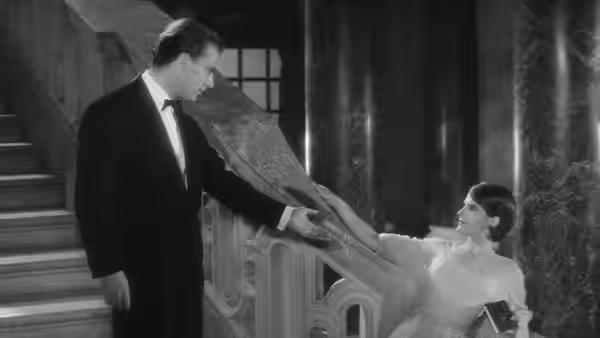
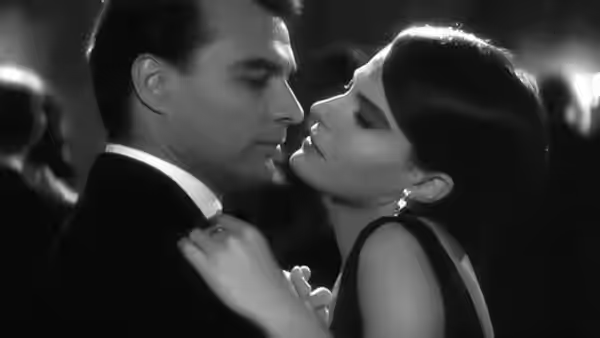
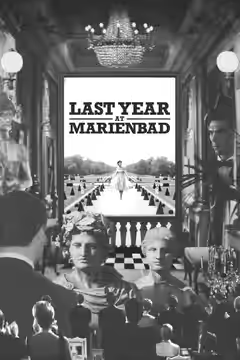
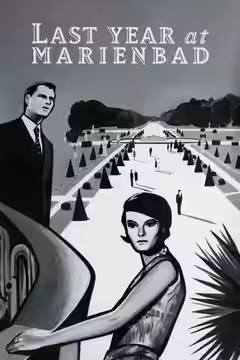
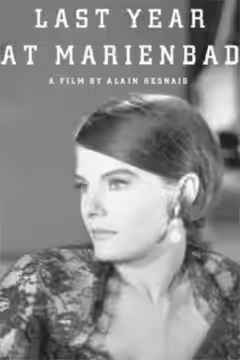
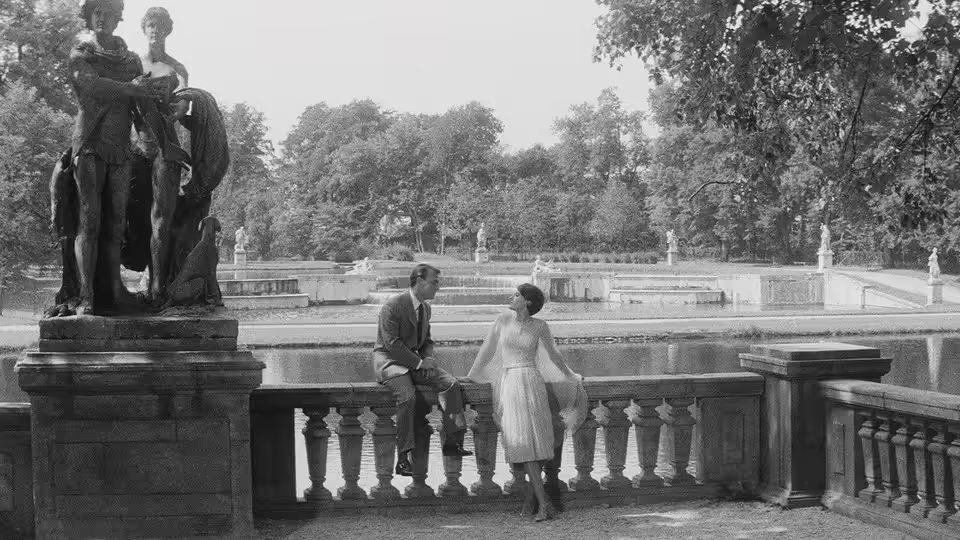
X (Giorgio Albertazzi) and A (Delphine Seyrig) stand beside a statue on a hotel terrace
Film review

Last Year at Marienbad

1961 · Directed by Alain Resnais · 1h 35m

In a sentenceHe remembers everything, she remembers nothing, and the hotel is not saying

A vast hotel, all corridors, mirrors and chandeliers, somewhere in Europe. A man with an Italian accent, X (Giorgio Albertazzi), approaches a woman, A (Delphine Seyrig), and tells her they met last year, possibly at Marienbad, and that she asked him to wait a year before going away with him. She says she has never seen him. Watching them is M (Sacha Pitoëff), lean-faced, perhaps her husband, who beats every guest at a game with matchsticks. X returns with more detail each time: a garden with statues, a balustrade, her bedroom. The film shows what he describes, and the pictures do not always agree with the words.

Plays from YouTube when you press play; nothing loads from them until then.

Fi1m review

Alain Resnais’s puzzle about a man who insists a woman remembers him is exactly made, hard to shake and colder than it needs to be. It held us for an hour and wore on us after, and we still recommend it, with a caveat.

Alain Robbe-Grillet was a novelist before he was a screenwriter, and he wrote Last Year at Marienbad as a script in which what we see and what we are told would not agree. Alain Resnais, two years on from Hiroshima mon amour, filmed it. The result runs 95 minutes and contains one situation, played over and over. A man, X (Giorgio Albertazzi), tells a woman, A (Delphine Seyrig), that they met a year ago, that she asked him to wait a year, and that the year is up. She says it never happened. The film never tells us who is right, and it does not intend to.

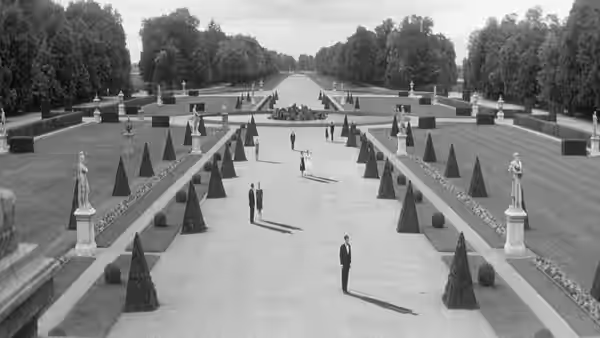
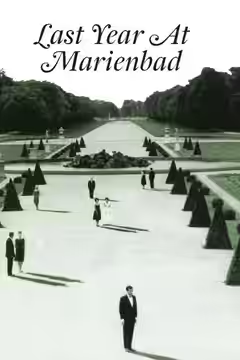
What it does instead is look, and Sacha Vierny’s camera is the reason to see it. It moves at walking pace down corridors lined with mirrors and gilt, past guests standing as still as the statues, while Albertazzi’s voice describes the ceilings and the silence in a murmur that never rises. Jacques Saulnier’s production design gives every room more than it can hold: stucco, chandeliers, framed engravings of gardens. The best-known shot puts the guests in a formal garden at midday, each casting a long hard shadow, while the clipped trees around them cast none. We stopped the film and went back to check. It is not a trick of the light, it is a decision, and it tells you how to watch everything else.

Jasmine Chasney and Henri Colpi cut the film against its own narration. X describes a closed door and we see it standing open. A scene in her bedroom is shown three or four ways, the light stronger each time until the walls are almost white. Bernard Evein’s costumes join in: Seyrig is in black feathers, then white satin, then black again, and the film does not mind if she changes between one shot and the next of what is meant to be the same moment. Francis Seyrig’s score is an organ, mostly, and it plays through nearly everything like a church service that has forgotten how to end.

We should be honest about how it went for us. For the first forty minutes we were held completely; the corridors, the voice and the shadows had us leaning in. Somewhere past the hour we grew restless, then bored, then irritated at the organ. Some of that is intended. Robbe-Grillet wants you to feel a year passing in a hotel where nothing happens. We do not think all of it is intended, and a film this exact ought to know the difference.

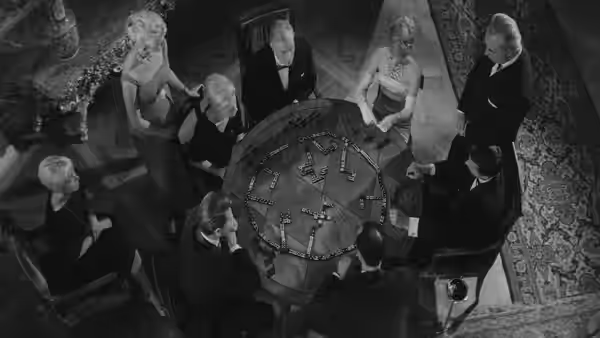
The performances are poses more than acting, and that is the brief. Seyrig holds her hand to her mouth, turns her head, holds. It looks like a fashion plate until the moment she starts to speak at length, and then a frightened person shows through and the whole film gets warmer for a minute. Albertazzi does his work with his voice, the Italian accent making every sentence sound recited rather than remembered. Sacha Pitoëff, as M, the lean man who may be her husband, has the film’s one joke: a game with matchsticks that he plays against every guest and wins every time. “I can lose,” he says, “but I always win.” He also has the most frightening face in the building.

Resnais had made a film about memory before, and Hiroshima mon amour had people in it. This has figures. The readings it has attracted over more than sixty years, that she is dead, that he is, that this is a seduction or an assault or a ghost story, are all supported by something on screen and all contradicted by something else. We have come to think the film is not hiding an answer. It is a machine for making you argue, and it works.

See it in a cinema if one near you is showing it, because at home the temptation to pause and look something up is strong and fatal. Do not try to solve it. Nobody has in more than sixty years, and the ones who say they have are guessing.
Critical consensus AI synthesised

78
Positive
11
Mixed
3
Negative
0
Little White Lies
8 June 2011 · 5/5/5 · Anton Bitel
100

Bitel finds the film an elegant, chillingly constructed enigma that remains perplexing and elusive. He praises Sacha Vierny’s fluid cinematography and the screenplay’s dizzying, maze-like construction.

Read the full review →
Radio Times
★★★★★ · David Parkinson
100

Parkinson calls the film a triumph and a complex cinematic riddle. He praises its camera movement, symbolic décor, abstract structure and stylised performances.

Read the full review →
Los Angeles Times
1 February 2008 · Kevin Thomas
90*

The critic finds the film beautiful, compelling, and ultimately life-affirming. He singles out its dreamlike atmosphere and exploration of memory and romantic longing.

Read the full review →
The Guardian
7 July 2011 · Peter Bradshaw
90*

Bradshaw calls the film a profoundly mysterious, disturbing masterpiece that looks more brilliant with age. He praises its eerie atmosphere and enduring capacity to generate competing interpretations.

Read the full review →
Empire
1 January 2000 · David Parkinson
80*

Parkinson finds the film compelling and baffling, ultimately judging it a uniquely beautiful and mesmerising artwork. He praises its stylised imagery and non-linear form for making viewers active participants in interpreting it.

Read the full review →
Slant Magazine
19 August 2024 · ★★★★ · Budd Wilkins
80

Wilkins praises the film as a gorgeous, haunting study of memory, persuasion, and obsession. He singles out its sumptuous monochromatic cinematography and baroque production design.

Read the full review →

Straight answers AI written, from our review

Is Last Year at Marienbad worth watching?
Last Year at Marienbad is worth watching for anyone with patience for a puzzle that refuses to be solved, and we scored it 82. Sacha Vierny's camera and Jacques Saulnier's hotel are the reason to see it; the organ score and the repetition wore on us after the first hour. See it in a cinema if you can, because pausing to look things up is fatal.
How long is Last Year at Marienbad, and what is it rated?
Last Year at Marienbad runs 1h 35m. It is a drama and romance film.
Where can I watch Last Year at Marienbad in Poland?
Last Year at Marienbad is not on any streaming or rental service in Poland at the moment. It is available in 3 other countries; change your country at the top of the page to see where. Availability is checked daily.
How does Last Year at Marienbad compare to Hiroshima Mon Amour?
Last Year at Marienbad is the colder and more exacting of Alain Resnais's two films about memory, and Hiroshima mon amour is the one with people in it. The earlier film earns its emotion through Emmanuelle Riva and Eiji Okada; the later one gives you figures and poses and asks you to argue. Start with Hiroshima if you want to be moved, Marienbad if you want to be baffled.
What should I watch after Last Year at Marienbad?
After Last Year at Marienbad, try Hiroshima mon amour (1959, Fi1m 87): Resnais on memory two years earlier, with a woman who remembers too much. Then Certified Copy (2010, Fi1m 84): Kiarostami’s couple who may or may not be married, arguing their way round a Tuscan town; and The Exterminating Angel (1962, Fi1m 87): Buñuel traps the well-dressed in a drawing room and lets them rot politely.

Cast

Awards

Academy Awards, 1963

Nominated
Best Writing, Original Screenplay

International Submission to the Academy Awards, 1962

Nominated
International Submission to the Academy Awards

Venice Film Festival, 1961

Won
Golden Lion

If you liked this, try…

  1. Hiroshima mon amour (1959, Fi1m 87)Resnais on memory two years earlier, with a woman who remembers too much.

  2. Certified Copy (2010, Fi1m 84)Kiarostami’s couple who may or may not be married, arguing their way round a Tuscan town.

  3. The Exterminating Angel (1962, Fi1m 87)Buñuel traps the well-dressed in a drawing room and lets them rot politely.

  4. Vertigo (1958, Fi1m 92)A man rebuilds a woman to match a memory; Hitchcock did it in colour.

  5. The Shining (1980, Fi1m 88)Another hotel where the corridors go on too long and the past will not stay put.