Group gathered at outdoor table as standing man greets seated blonde woman
Film review

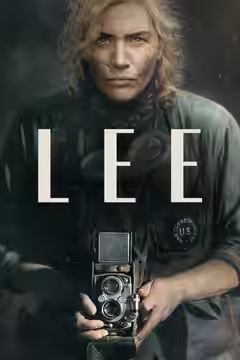
Lee

2024 · Directed by Ellen Kuras · 1h 57m

In a sentenceWinslet swears her way across liberated Europe while the script reads her CV aloud behind her

Ellen Kuras directs Kate Winslet as Lee Miller, the American model turned photographer who went to war for British Vogue. The film opens in France in the late 1930s, where Miller is drinking and arguing with Roland Penrose (Alexander Skarsgård), Solange D’Ayen (Marion Cotillard) and Nusch Eluard (Noémie Merlant), and follows her to London, where the Vogue editor Audrey Withers (Andrea Riseborough) gives her a camera and a job. When war comes, Miller talks her way towards the front and falls in with the Life photographer David Scherman (Andy Samberg). The story is told from an interview years later, with a young man (Josh O’Connor) asking the questions. Runs 117 minutes; certificate 15.

Plays from YouTube when you press play; nothing loads from them until then.

Fi1m review

Kate Winslet is fierce, funny and worn down to the bone as Lee Miller, and Andy Samberg is a quiet surprise beside her. The film around them is handsome, careful and dutiful, and it explains its subject far more than it shows her.

Lee Miller was a model, then a Surrealist photographer, then a war correspondent for Vogue, and Ellen Kuras, the cinematographer who shot Eternal Sunshine of the Spotless Mind, has picked the war years for her first feature as director. The film covers roughly a decade: sunlit France before the fighting, London under the bombs, a field hospital in Normandy, Paris, Germany. Kate Winslet is the reason to see it. What surrounds her is a careful, good-looking biopic that goes where the history went and rarely stops long enough to look around.

The story is told from a kitchen table. An older Miller sits opposite a young man (Josh O’Connor) who asks her the questions a biopic needs asked, and each answer cues the next stretch of the past. It is a device with a long history and it does here what it usually does: whenever a scene threatens to speak for itself, Mikkel E.G. Nielsen cuts back to the table so that it can be said out loud. The screenplay, by Liz Hannah, Marion Hume and John Collee, has a great deal of ground to cover and covers it in order.

Winslet, who also produces, has chosen the part with a clear eye for what she does best. Her Miller drinks, smokes, tells Colonel Spencer (James Murray) exactly what she thinks of his rules for women correspondents, and does not soften a line for anyone’s benefit. What makes it more than a display of nerve is what Winslet does when the camera is lowered. Her face, in close-up, goes still and slightly grey, and the toughness looks like something she is holding up rather than something she is. It is a fine performance and a generous one, because the film keeps asking her to carry scenes that were written as summaries.

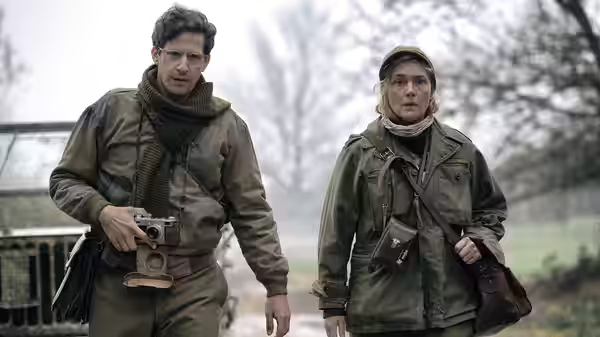
Andy Samberg is the surprise. His Scherman is watchful and dry, tells no jokes, and simply keeps her company, and the two of them arguing in a ruined hotel room about whether to go on is the best written stretch in the film. Andrea Riseborough gives Audrey Withers a brisk, unsentimental warmth that suits a woman fighting a print ration. The French friends fare worse. Marion Cotillard, Noémie Merlant and Alexander Skarsgård are given a picnic, a few reunions and very little to play, and Skarsgård’s Penrose exists mainly to be away.

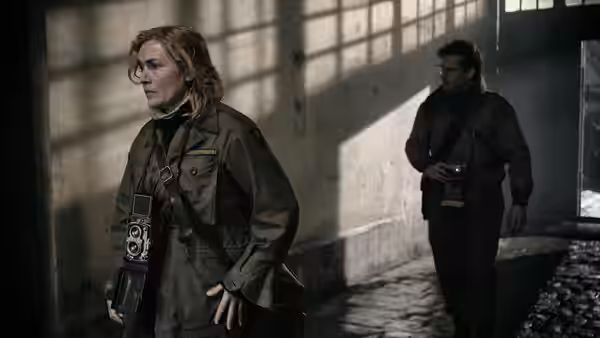
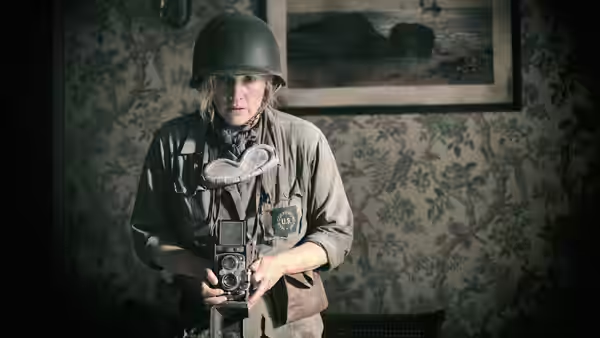
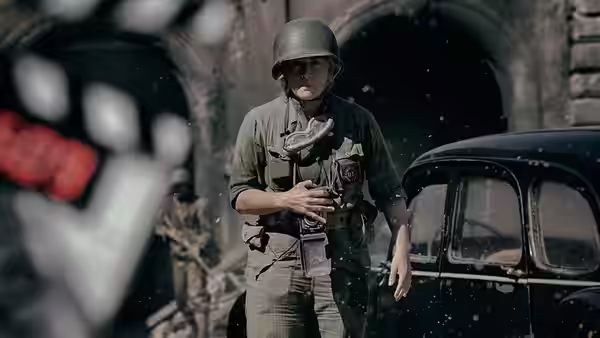
Paweł Edelman shoots the pre-war scenes in warm late-afternoon light and the war in flat greens and greys, which is sensible and never once surprising. Gemma Jackson’s field hospital, with its rows of canvas and its mud, and the bombed Paris flats with the pictures still on the walls, are more specific than anything the dialogue manages. Michael O’Connor puts Winslet in army kit that never quite fits her, which is the right idea. Alexandre Desplat’s score is piano and strings under nearly everything, telling us a scene is sad in case the picture had not, and the film would have been better with half of it.

Then there is the sequence in the camps, and here Kuras finally trusts the images. The music stops, the talking nearly stops, and Winslet and Samberg walk through what they find with their cameras up. We sat very still and did not want it to end quickly, because ending quickly would have felt like looking away, and the film for once declines to look away. It is the only time Lee does what Miller did, which was to point the lens and hold it. The photographs the film recreates from that trip, including the one everybody has seen, are all the stronger for the silence around them.

There is a late scene that sets out to explain Miller, and we will not describe it. We will say that Miller’s own photographs never explained anything, and that the film would have done better to follow her example. As biopics of difficult women go, this is a decent one with a strong centre, more honest about its subject’s manners than most and less curious about her mind than it should be.

See it for Winslet, for Samberg, and for twenty minutes in Germany that we have not shaken. Go in expecting a portrait rather than a film, and you will get roughly what you paid for. It runs 117 minutes and carries a 15.


Critical consensus AI synthesised

62
Positive
4
Mixed
3
Negative
2

Every review agrees on Kate Winslet. Critics describe her Lee Miller as prickly, magnetic and raw, and several say she is the only reason to see the film. The disagreement is about everything around her. The most common complaint is that the film is a conventional biopic, moving through the war photographer’s decade as a procession of events, with an interview framing device that most find adds little. The i Paper calls it drab and rushed, with a wasted supporting cast, and Collider finds it generic and dry. The Playlist blames a pedestrian screenplay while praising the concentration camp sequences, which Film Stories also singles out as the strongest passages. On the warmer side, the Los Angeles Times credits Kuras’s eye as a cinematographer, and Deadline admires the film for letting Miller resist interpretation. The spread is wide, from dismissals to four-star notices, but the middle settles on handsome, safe and carried by its lead.

Empire
9 September 2024 · Sophie Butcher
75*

The critic finds it a handsomely made, moving biopic hampered by conventional storytelling and an interview framing device, but redeemed by strong performances. Winslet and Samberg are singled out for their chemistry and emotional depth in key scenes.

Read the full review →
The Guardian
15 September 2024 · Peter Bradshaw
75*

The film is a sobering, impactful biopic that offers a woman’s-eye view of Lee Miller’s wartime photography. Winslet gives a remarkable performance capturing Miller’s toughness and magnetism, though the score feels generic.

Read the full review →
The Telegraph
12 September 2024 · Robbie Collin
65*

Winslet plays to her strengths in this handsome biopic about the model-turned-war photographer Lee Miller. It celebrates Miller as a difficult woman who defies convention but gives the subject and audience an easy ride overall.

Read the full review →
Time Out
5 September 2024 · ★★★ · Alex Sims
60

Winslet shines as the tenacious photographer, and the film effectively recreates her iconic images to highlight photography's power. However, it plods without emotional depth or strong supporting characters.

Read the full review →
The i Paper
13 September 2024 · Francesca Steele
35*

The critic calls it a disappointingly drab biopic that feels like a Wikipedia page, with Winslet magnetic but the only standout in a rushed procession of events lacking character depth. The supporting cast is largely wasted and the narrative is plodding.

Read the full review →
Financial Times
12 September 2024 · ★★★★☆ · Danny Leigh

The biopic is a powerful portrait of the woman who captured striking images of the Second World War. Winslet is vivid in close-up as Miller, and the film has snap in its handling despite a busy script.

Read the full review →

Straight answers AI written, from our review

Is Lee worth watching?
Lee is worth watching for Kate Winslet, who gives a fine, worn-down performance as the war photographer Lee Miller, and we scored it 61. The film around her is a careful, good-looking biopic that explains its subject more than it shows her, so go in for the acting and for one sequence in Germany rather than for the storytelling.
How long is Lee, and what is it rated?
Lee runs 1h 57m. It is a history and drama film.
Where can I watch Lee in India?
Lee is streaming on Zee5, Apple TV and Amazon Prime Video in India, and it is also available to rent from Amazon Prime Video and Apple TV from ₹119.00. Availability is checked daily; the links above go straight to each service.
How violent or frightening is Lee, and is it suitable for children?
Lee carries a UK 15 certificate, and it earns it with heavy drinking, swearing and a late sequence set in the concentration camps that is shown plainly and without music. It is not a frightening film and there is little combat, but the camp scenes are hard to sit through and it is not suitable for children; older teenagers who know the history will manage it.
How does Lee compare to Civil War?
Lee and Civil War both follow a woman war photographer, but Lee is a period biopic that tells you who Miller was and why, while Civil War is a tense, loud invented war that refuses to explain itself. Civil War is the better-made film and the more gripping evening; Lee is the gentler and the more conventional, and suits anyone who wants the real history and a strong central performance.
What should I watch after Lee?
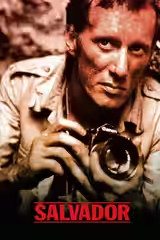
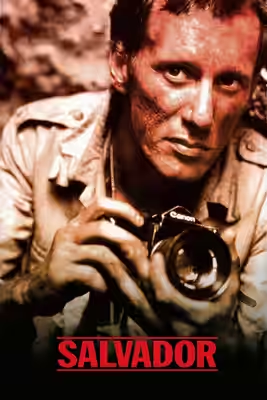
After Lee, try Civil War (2024, Fi1m 70): Kirsten Dunst’s war photographer, with Lee Miller pinned to the dashboard as a patron saint. Then Salvador (1986, Fi1m 74): Oliver Stone’s reporters are drunk, venal and right; the opposite of dutiful.

Cast

If you liked this, try…

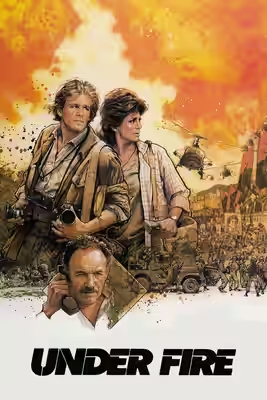
  1. Under Fire (1983) · not reviewed yetNick Nolte’s photographer in Nicaragua, and a sharper argument about whose war it is.

  2. A Private War (2018) · not reviewed yetRosamund Pike as Marie Colvin; another correspondent who would not be told to go home.

  3. Civil War (2024, Fi1m 70)Kirsten Dunst’s war photographer, with Lee Miller pinned to the dashboard as a patron saint.

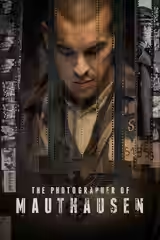
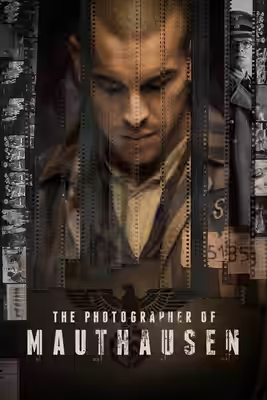
  4. The Photographer of Mauthausen (2018) · not reviewed yetA Spanish prisoner smuggles the camp’s negatives out; the same argument for the picture.

  5. Salvador (1986, Fi1m 74)Oliver Stone’s reporters are drunk, venal and right; the opposite of dutiful.

Free account

Know what to watch tonight

Two lists that know where things are streaming, collections you can share, your own score beside ours, and Discover that remembers what you have seen.

  • Want to see, sorted by what is streaming now
  • Seen, with your score out of ten
  • No adverts, ever