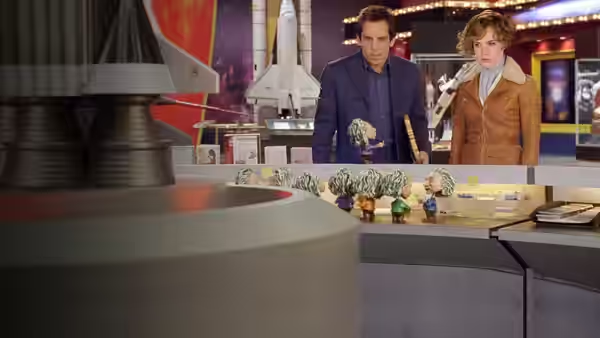
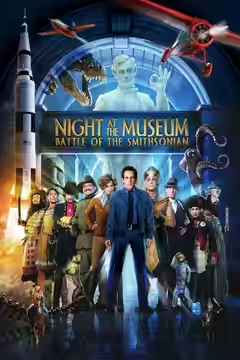
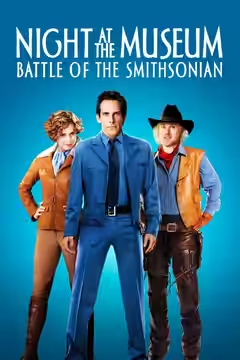
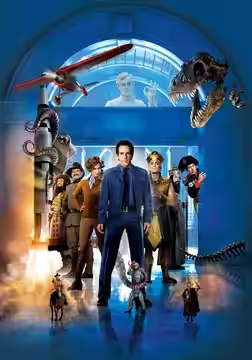
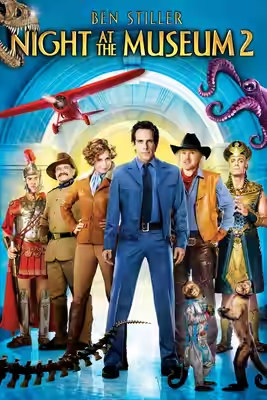
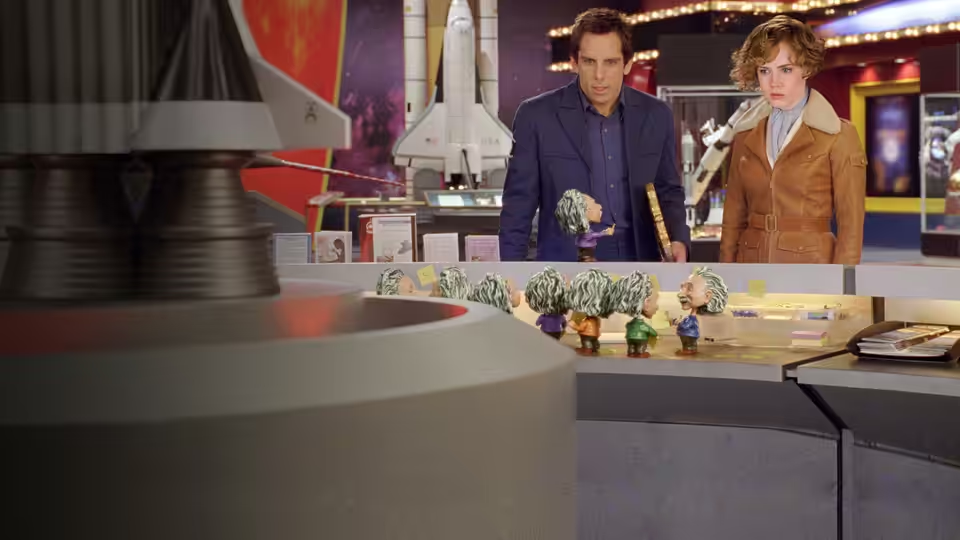
Larry Daley and Amelia Earhart examine miniature figures beside a space shuttle exhibit
Film review

Night at the Museum: Battle of the Smithsonian

2009 · Directed by Shawn Levy · 1h 45m

In a sentenceHank Azaria’s pharaoh wants to rule the world and keeps getting interrupted by the furniture

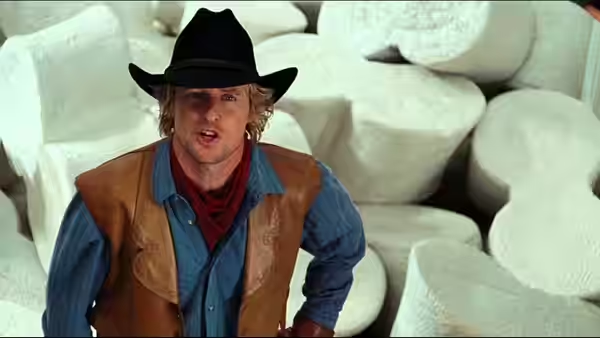
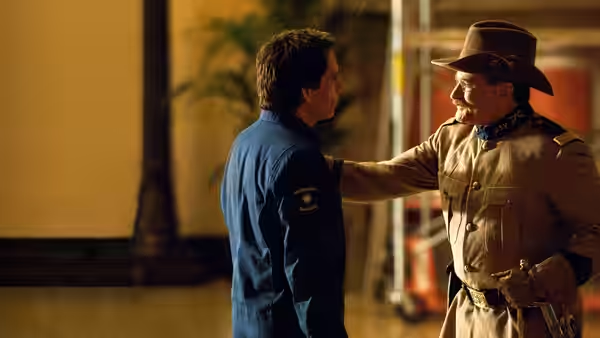
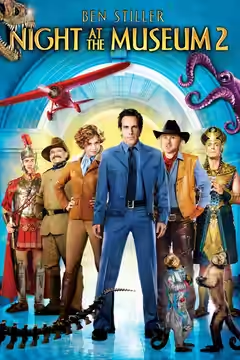
Larry Daley (Ben Stiller) has left the night shift at New York’s American Museum of Natural History to sell gadgets on television. The museum is clearing its halls, and the old exhibits, Jedediah (Owen Wilson) and Octavius (Steve Coogan) among them, are being crated for storage in the Federal Archives beneath the Smithsonian in Washington. Theodore Roosevelt (Robin Williams) stays behind; the tablet that brings them all to life does not. When night falls in Washington it wakes the whole Smithsonian, including Kahmunrah (Hank Azaria), a pharaoh who wants the tablet for himself and is recruiting Ivan the Terrible, Napoleon Bonaparte and Al Capone to get it. Larry takes a call for help, heads to the capital, and picks up an unexpected ally in Amelia Earhart (Amy Adams).

Fi1m review

Shawn Levy’s sequel moves the toys to Washington and turns the volume up. Amy Adams’s Amelia Earhart and Hank Azaria’s lisping pharaoh are good company for an hour; around them the film is mostly things falling over. Fine for a wet afternoon, forgotten by teatime.

Larry Daley (Ben Stiller) has given up the night shift at the American Museum of Natural History and now sells gadgets on television. Back at the museum the halls are being cleared for an upgrade and the old exhibits crated for the Federal Archives beneath the Smithsonian in Washington. The tablet that brings them to life goes along by mistake. Thomas Lennon and Ben Garant’s script takes about fifteen minutes to get everyone to Washington and then has one idea, which is that the biggest museum in the world is now awake, and it spends the remaining ninety showing us the contents. Larry himself is almost beside the point.

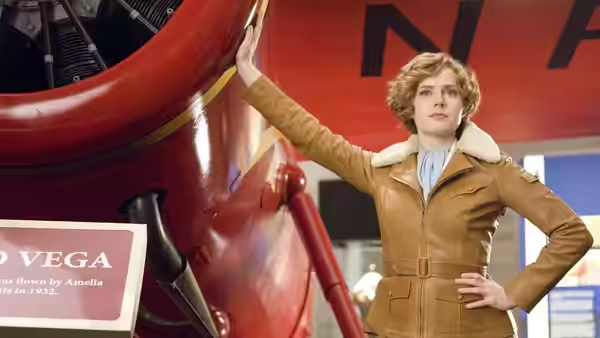
Amy Adams is the reason to stay. She plays Amelia Earhart in Marlene Stewart’s jodhpurs and leather flying jacket, talking in the clipped, breathless rhythm of a 1930s newsreel, and she is the only person on screen who appears to believe she is in an adventure. She flirts, Stiller flinches, and for stretches the film is a two-hander between a man who wants to go home and a woman who has never wanted to go home in her life. It is the warmest thing here and it costs nothing in effects.

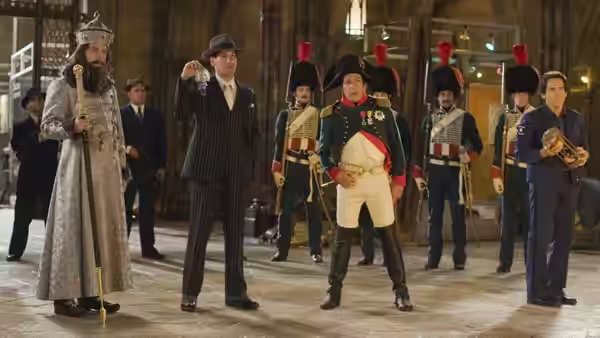
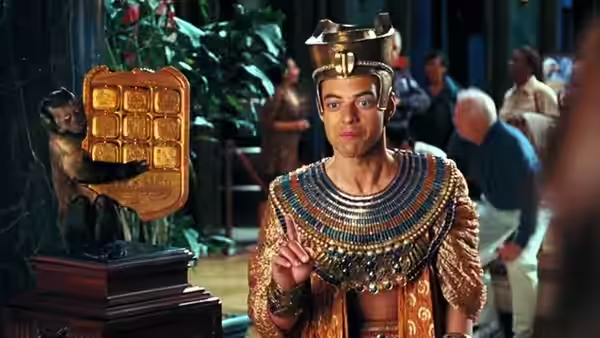
Hank Azaria’s Kahmunrah is the other one. He is the older brother of the pharaoh from the first film, he wants the tablet to open a gate and bring through an army, and he speaks with a lisp and the wounded dignity of a man passed over for promotion. We laughed, properly and more than once, at him, and the best scene in the film is just Azaria and Stiller in a doorway, bickering about the lisp while the plot waits outside. He recruits Ivan the Terrible (Christopher Guest), who objects to the translation of his name, Napoleon Bonaparte (Alain Chabat), who is touchy about his height, and Al Capone (Jon Bernthal), who arrives in black and white. Each gets one joke and is asked to tell it several times.

The sequence everyone remembers is the run through the galleries, and it deserves to be. Jeff Koons’s Balloon Dog bounds down a corridor; the couple from American Gothic lean out of their frame; Claude Paré’s halls are suddenly full of things that were never built to move. For ten minutes the effects and the sets do what the title promises, and we sat up. Then it is over, and we are back with Jedediah (Owen Wilson) stuck in an hourglass and Octavius (Steve Coogan) riding a squirrel across a lawn, which got a laugh from us and then went on for a while.

The fights are the problem. Dean Zimmerman and Don Zimmerman cut the big set pieces into fragments so short that nothing has weight, and Alan Silvestri’s brass marches over all of it at the same volume. John Schwartzman lights the Federal Archives as a long brown basement, which is probably accurate and not much to look at for forty minutes. Bill Hader’s George Armstrong Custer, a coward who talks like a hero, is a good idea given about four lines; Patrick Gallagher’s Attila the Hun is a running gag about hugging. We were bored during the final battle, and then mildly cross about it, because a film in which everything is alive has no excuse for a fight in which nothing seems to be.

What is missing is a reason for any of it. Shawn Levy’s first Night at the Museum, from 2006, was about a divorced father trying to look competent in front of his son, and that small want gave the nonsense somewhere to land. Here the son is barely in it, Robin Williams’s Theodore Roosevelt stays behind in New York with Ricky Gervais’s Dr. McPhee and his two scenes of mumbling, and Larry wants nothing but his tablet back. Getting it back is all the film has to offer him.

Most critics have split down the middle on this one and so, in the end, do we. It is 105 minutes, it is a PG that means it, and a child will enjoy the squirrel. Watch it at home with the volume a notch down; Adams and Azaria will survive that, and the battle will not miss much.

Critical consensus AI synthesised

51
Positive
3
Mixed
6
Negative
6

The reviews split almost evenly, with as many critics finding the sequel flat as finding it fun, and most of the praise landing on the same few things. The special effects, particularly the sequence in which paintings and sculptures join the chase, are singled out repeatedly as the point where the film comes alive. Amy Adams’s Amelia Earhart is the performance most often mentioned, with Hank Azaria’s Kahmunrah close behind, and several critics allow that it is faster and funnier than the first film.

The reservations cluster on story. Critics who dislike it call it overstuffed, nearly plotless and a string of loosely connected gags, with slapstick standing in where a plot should be, and Time Out notes how little story remains once the original’s father-and-son thread is dropped. The spread is wide, from four stars at the Evening Standard to one at Den of Geek. Eye for Film is the lone dissenter on Adams, finding her grating rather than buoyant.

Evening Standard
10 April 2012 · 4 stars · The Standard
77*

The critic finds the film silly, cheerful and entertaining, despite some sentiment that threatens to blunt its invention. They single out the Smithsonian gallery sequence, where paintings and sculptures join the action, as its extra punch.

Read the full review →
The Guardian
24 May 2009 · Philip French
75*

French finds the sequel superior to its predecessor despite its near-repeat premise. He praises the astonishing special effects and the film’s upbeat spirit.

Read the full review →
The Hollywood Reporter
19 May 2009 · The Associated Press
65*

The review finds the sequel improved and entertaining, though it still feels like loosely connected bits rather than a cohesive whole. It especially praises the visual effects bringing famous artworks to life, along with Amy Adams’s spirited Amelia Earhart.

Read the full review →
Screen Daily
20 May 2009 · Tim Grierson
64*

The visible page identifies this as a review but does not reveal the critic’s verdict. The paywall also conceals what the critic praises or criticizes.

Read the full review →
The New York Times
25 May 2009 · A. O. Scott
64*

The page returned only an access error, so the critic’s verdict and specific praise or complaint cannot be established. No review text was available to summarize.

Read the full review →
Empire
29 October 2008 · Helen O'Hara
60*

The critic finds it a faster, funnier improvement on the first film, but still a disappointment. Amy Adams’s Amelia Earhart and Hank Azaria’s villain stand out, while slapstick and pop-culture gags squander the family-friendly historical potential.

Read the full review →

Straight answers AI written, from our review

Is Night at the Museum: Battle of the Smithsonian worth watching?
Night at the Museum: Battle of the Smithsonian is worth watching only as a wet-afternoon family film, and we scored it 54. Amy Adams's Amelia Earhart and Hank Azaria's lisping pharaoh are good company for an hour; the fights around them are cut so fast that nothing has weight, and the film is forgotten by teatime.
How long is Night at the Museum: Battle of the Smithsonian, and what is it rated?
Night at the Museum: Battle of the Smithsonian runs 1h 45m. It is an adventure and fantasy film.
Where can I watch Night at the Museum: Battle of the Smithsonian in Croatia?
Night at the Museum: Battle of the Smithsonian is streaming on Disney+ and Netflix in Croatia. Availability is checked daily; the links above go straight to each service.
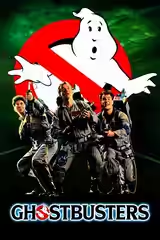
How does Night at the Museum: Battle of the Smithsonian compare to Ghostbusters?
Night at the Museum: Battle of the Smithsonian and Ghostbusters both let the impossible loose on a city, but Ivan Reitman's film is the better of the two by some distance. Ghostbusters earns its laughs through Bill Murray's deadpan and the team's easy talk; Shawn Levy's sequel has two good performances and a lot of things falling over. Children will take the museum; everyone else should take the ghosts.
What should I watch after Night at the Museum: Battle of the Smithsonian?
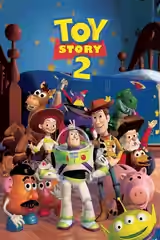
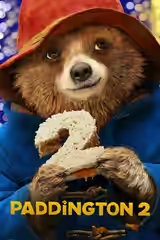
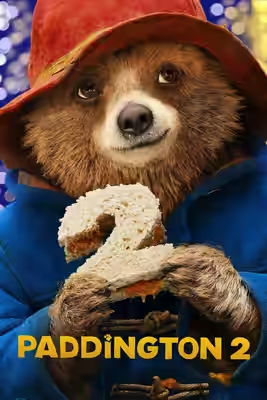
After Night at the Museum: Battle of the Smithsonian, try Ghostbusters (1984, Fi1m 80): A city overrun with the impossible and dry men in overalls refusing to be impressed. Then Toy Story 2 (1999, Fi1m 89): Things come alive when nobody is looking, and this time somebody wrote them a story; and Paddington 2 (2017, Fi1m 91): A family film that trusts jokes and kindness over noise, and is funnier for it.

Cast

If you liked this, try…

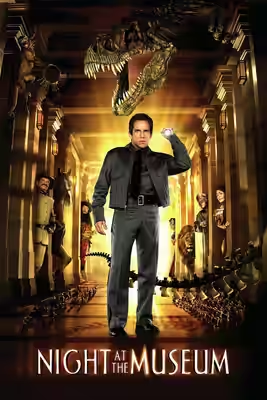
  1. Night at the Museum (2006) · not reviewed yetThe first one, smaller and about a father, which turns out to matter.

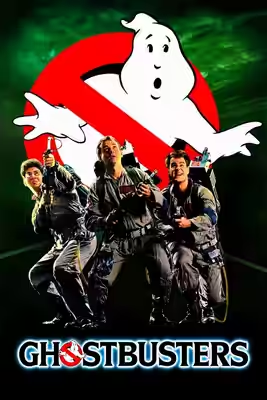
  2. Ghostbusters (1984, Fi1m 80)A city overrun with the impossible and dry men in overalls refusing to be impressed.

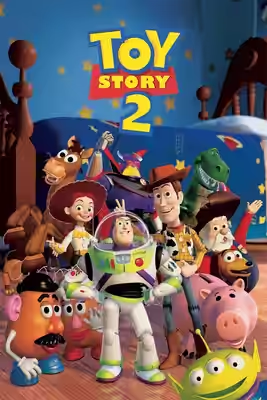
  3. Toy Story 2 (1999, Fi1m 89)Things come alive when nobody is looking, and this time somebody wrote them a story.

  4. Paddington 2 (2017, Fi1m 91)A family film that trusts jokes and kindness over noise, and is funnier for it.

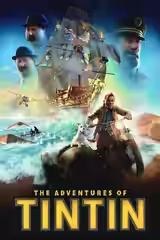
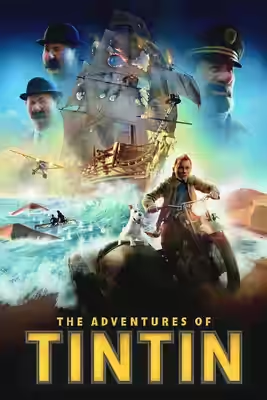
  5. The Adventures of Tintin: The Secret of the Unicorn (2011, Fi1m 77)Chases through history and museums, staged so you can actually follow them.

Free account

Know what to watch tonight

Two lists that know where things are streaming, collections you can share, your own score beside ours, and Discover that remembers what you have seen.

  • Want to see, sorted by what is streaming now
  • Seen, with your score out of ten
  • No adverts, ever