Open Your Eyes is an absorbing, overcomplicated thriller, held together by Eduardo Noriega’s controlled performance. Alejandro Amenábar makes uncertainty exciting, though the eventual explanations disappoint after so much ingenuity in keeping us guessing.
An unreliable reality gives a thriller considerable freedom to misbehave. Open Your Eyes earns that freedom for much of its running time, because Alejandro Amenábar keeps us interested in his central character even when following the story becomes work. This is a good, unsettling film with an overcomplicated script, worth the effort for those who enjoy having their perceptions challenged. The reservation matters: some of its complications merely delay what we need to know.
Eduardo Noriega provides the reason to persist. His controlled performance gives his character a recognisable continuity as the film alters our understanding of him; without that steadiness, another shift in perception would quickly become tiresome. We felt uneasy watching him, because his composure makes the uncertainty around him harder to dismiss as a thriller’s trick. There is enough restraint in the acting to let us worry about the man without being told at every stage how much we should worry.
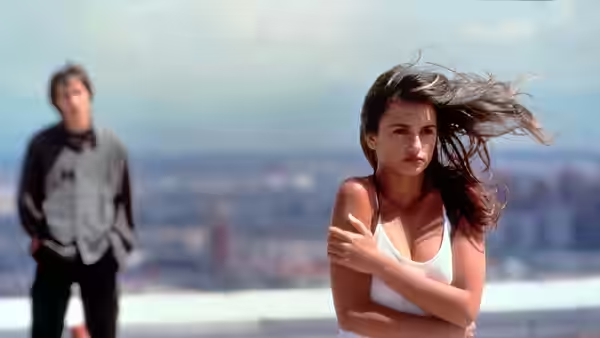
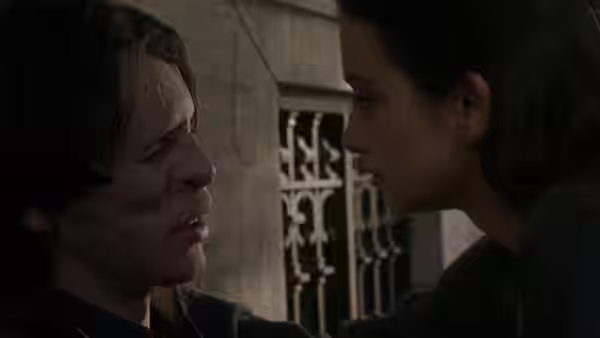
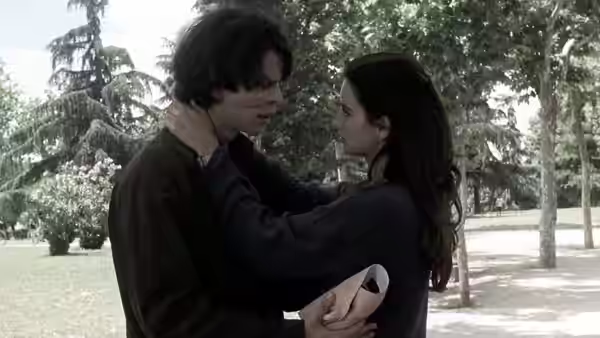
That performance also exposes a weakness in the screenplay by Mateo Gil and Alejandro Amenábar. The central character commands so much of our attention that the people around him struggle to matter independently of his predicament. Penélope Cruz’s Sofía and Fele Martínez’s Pelayo deserve the same curiosity that the film brings to its central man, but the writing keeps drawing us back to him. The emotional narrowness becomes more noticeable as the plotting grows elaborate, because each new uncertainty needs us to care about the people involved.
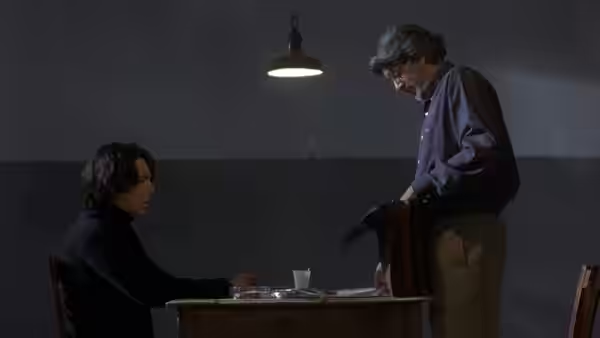
Hans Burmann’s cinematography gives those uncertainties a visual force that the dialogue cannot always supply. The images invite scrutiny, and paying attention to appearances feels worthwhile rather than merely compulsory. María Elena Sáinz de Rozas’s editing helps the shifts in perception retain their force, even when the story asks us to revise too much. We can appreciate how firmly the film controls our attention while wishing the screenplay would occasionally let an impression settle before complicating it again.
The music by Mariano Marín and Alejandro Amenábar sustains the unease effectively, though it cannot supply all the feeling that the writing sometimes lacks. The film’s interest in appearance is most persuasive when it remains attached to the central character and our changing understanding of him. His predicament gives the subject enough weight without requiring further insistence on its importance. The broader speculation about reality occasionally becomes solemn in ways that make the film feel less curious about its own questions.
For a thriller built around uncertain perceptions, Open Your Eyes has an important virtue: the confusion often creates suspense. We want the next scene because we want to understand the previous one, and Alejandro Amenábar usually makes that appetite worth indulging. The difficulty comes when the film has to account for itself. Its explanations feel hurried and disappointingly ordinary after the imagination spent preparing them, although that does not cancel the pleasure of getting there.
There is enough invention here to forgive some unnecessary complication, and Eduardo Noriega gives us someone worth following through it. At 117 minutes, the film asks for sustained attention and mostly repays it. Its weaknesses become harder to overlook if we expect the relationships to be as carefully developed as the puzzle. Choose it for an evening when a demanding thriller sounds inviting, with the warning that its answers are unlikely to be the part we remember most fondly.