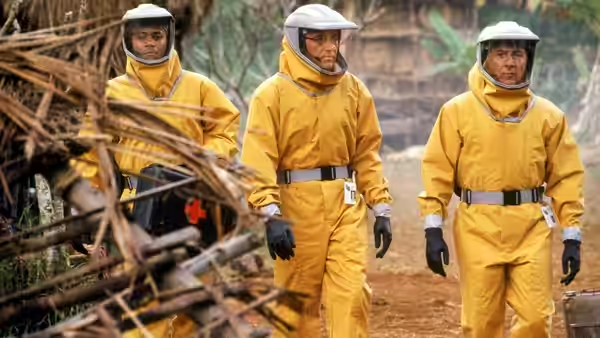
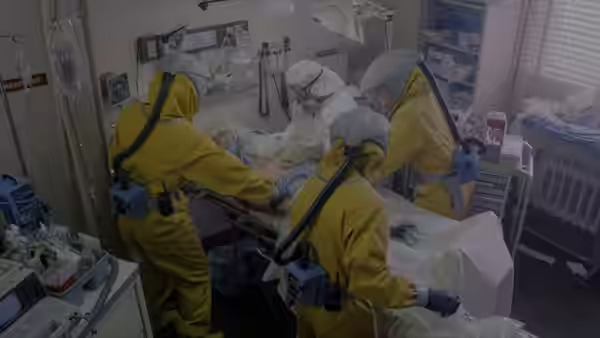
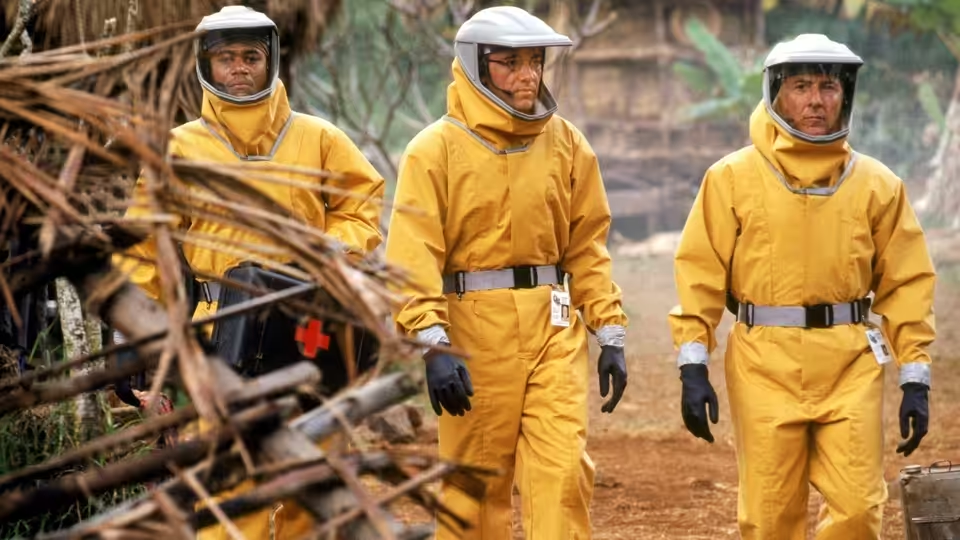
Three workers in yellow protective suits walk along a debris-strewn path
Film review

Outbreak

1995 · Directed by Wolfgang Petersen · 2h 09m

In a sentenceThe virus is the scariest thing in it, and the film keeps cutting away to helicopters

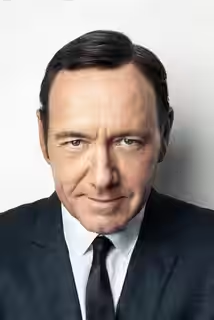
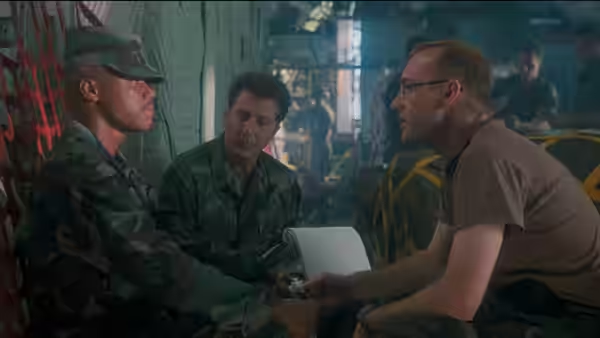
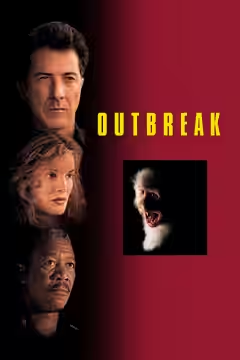
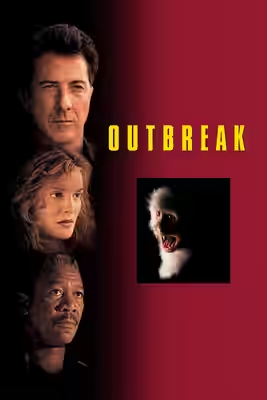
In 1967 a mercenary camp in the Motaba River Valley in Zaire is wiped out by a fever that kills in days, and the American officers who promise help bomb it instead. Twenty-eight years later Colonel Sam Daniels (Dustin Hoffman), an army virologist, is sent to a village in the same valley with Casey Schuler (Kevin Spacey) and Major Salt (Cuba Gooding Jr.) and finds every hut full of the dead. Back home his superior, General Billy Ford (Morgan Freeman), tells him to drop it, and his ex-wife Robby Keough (Rene Russo) has left for the Centers for Disease Control in Atlanta. Meanwhile a smuggler, Jimbo Scott (Patrick Dempsey), lands in California with a monkey he cannot sell and lets it go in the woods near the town of Cedar Creek, where people begin to fall ill.

Plays from YouTube when you press play; nothing loads from them until then.

Fi1m review

Wolfgang Petersen’s virus thriller is properly frightening for an hour, with one cough in a cinema we have never quite shaken off. Then the script by Robert Roy Pool and Laurence Dworet hands the plot to the helicopters and never gets it back.

Wolfgang Petersen, who kept a submarine crew in a steel tube for the whole of Das Boot (1981), here lets loose a fever that kills in days and sends the United States Army after it. Outbreak is two films. The first is a tight, frightening thriller about how a disease travels and who decides what to tell the public. The second is a chase, and the chase wins. It is still worth an evening, mostly for the hour in which the virus is the star.

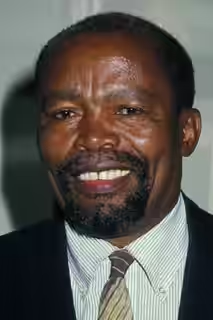
It opens in 1967, in a mercenary camp in the Motaba River Valley in Zaire, where men are dying with blood in their eyes and the American officers who come to help leave and then bomb the place flat. Twenty-eight years later Colonel Sam Daniels (Dustin Hoffman), an army virologist, is sent to a village in the same valley and finds the same thing. Michael Ballhaus shoots the village in dust and amber: bodies under sheets, flies, and a single doctor, Benjamin Iwabi (Zakes Mokae), who has seen this before and tells Daniels so without raising his voice. Daniels’s boss, General Billy Ford (Morgan Freeman), orders him to leave it alone. Then a smuggled monkey reaches California.

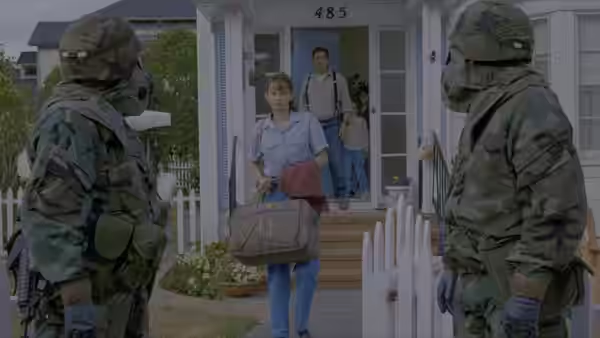
The best sequence in the film is set in a small-town cinema. A man with the fever laughs at the screen and coughs, and Ballhaus follows the spray in slow motion through the projector beam until it drifts down into the open mouth of a woman in the row behind. We watched it with a hand over our own mouth, and we were still thinking about it on a crowded train a week later. Nothing else in the film frightens like it. Petersen then has the town, Cedar Creek, sealed off by soldiers, and the scenes of families talking through plastic sheeting and parents kept from their children at a roadblock are quiet, well staged and horrible.

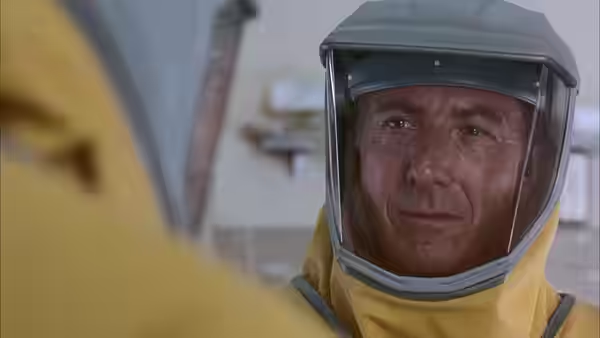
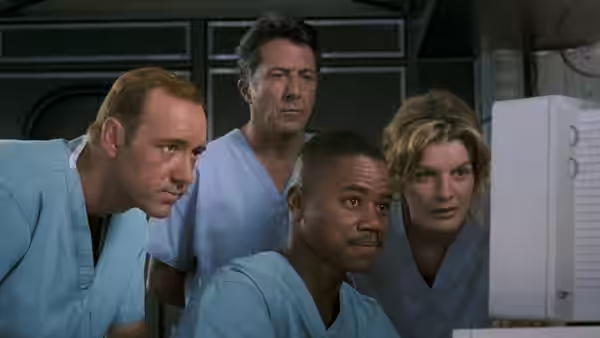
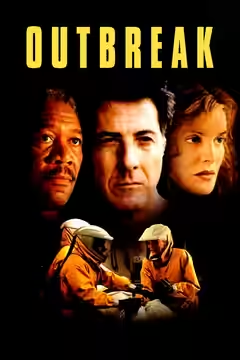
William Sandell builds the army’s laboratory as a run of airlocks and glass walls, and Erica Edell Phillips puts the scientists in blue pressure suits with a hose hanging from the back, so that every conversation inside is shouted and slightly late. Hoffman is at his best in these rooms. He is small, quick and argumentative, and he plays Daniels as a man who knows he is right and knows nobody wants to hear it. Kevin Spacey’s Casey Schuler stands beside him being drily funny, and Cuba Gooding Jr.’s Major Salt looks as if he might be sick inside his helmet and then is not. Freeman gives Ford a tiredness that tells us more about the chain of command than any line of dialogue does. Donald Sutherland’s General McClintock snarls at everyone from his first scene, which rather gives away what the film thinks of him.

Rene Russo plays Robby Keough, Daniels’s ex-wife, who has left for the Centers for Disease Control in Atlanta, and the script by Robert Roy Pool and Laurence Dworet asks the divorce to carry the film’s heart. It cannot. Their scenes are a couple of arguments about who keeps the dogs and a lot of looking at each other through glass, and Russo, who is sharp whenever the writing lets her be, is given a woman defined by what she is not doing with her husband. The dialogue elsewhere is of the kind in which people announce their jobs to each other.

Then the helicopters arrive. The last forty minutes send Hoffman into the air after a monkey and some generals, and a man who is persuasive at a microscope is not persuasive hanging out of a door at a thousand feet. Four editors are credited, Stephen E. Rivkin, Neil Travis, Lynzee Klingman and William Hoy, and the final stretch looks as if it was cut by all of them in separate rooms. James Newton Howard’s score, which had been content to tick quietly under the laboratory scenes, hits the drums every time a rotor turns. By the second helicopter we were bored, and then cross about it, because the film had already shown us it could frighten us with a cough.

The Andromeda Strain (1971) spent its whole length in one laboratory and did not need a single explosion. Outbreak has the same material and stops trusting it after the hour mark. See it for that hour, for the cinema scene, and for Hoffman and Freeman in their suits, and feel free to make the tea once the rotors start. It runs 129 minutes and carries a 15 certificate.

Critical consensus AI synthesised

65
Positive
4
Mixed
4
Negative
1
Radio Times
★★★★ · Tony Sloman
80

Sloman finds it an exciting, effective thriller, despite Hoffman lacking the heroic quality the role needs. He praises Petersen’s handling of the effects and the strong supporting cast.

Read the full review →
Empire
1 January 2000 · Ian Nathan
75*

Nathan finds the film an entertaining, nerve-rattling thriller despite a slack final quarter and a corny script. He praises its gripping first hour and potent premise, while faulting the late shift toward an implausible action chase.

Read the full review →
RogerEbert.com
10 March 1995 · ★★★/4 · Roger Ebert
75

The page could not be read, so its verdict and specific praise or criticism cannot be verified. The URL identifies it as RogerEbert.com’s review of the 1995 film.

Read the full review →
Variety
12 March 1995 · Todd McCarthy
75*

McCarthy finds the film an absorbing, commercially potent thriller despite its shift from plausible suspense to improbable action. He particularly praises Wolfgang Petersen’s fluid direction and the film’s technical craft.

Read the full review →
The New York Times
10 March 1995
65*

The URL identifies this as a review of Outbreak, but the article text is inaccessible. Its headline singles out Dustin Hoffman as the hero and the virus as the villain; the critic’s overall verdict cannot be verified.

Read the full review →
The New Yorker
20 March 1995 · Terrence Rafferty
64*

Rafferty’s Current Cinema piece discusses Outbreak alongside I Am Cuba, but the accessible page does not reveal his verdict. The archive listing provides no specific praise or complaint about either film.

Read the full review →

Straight answers AI written, from our review

Is Outbreak worth watching?
Outbreak is worth watching for its first hour, when the virus is the frightening thing in it, and we scored it 66. The small-town cinema scene and Hoffman and Freeman in pressure suits are the reasons to sit down. Once the helicopters take over in the last forty minutes, the film stops trusting its own fear.
How long is Outbreak, and what is it rated?
Outbreak runs 2h 09m. It is an action and drama film.
Where can I watch Outbreak in Peru?
Outbreak is streaming on Netflix in Peru. Availability is checked daily; the links above go straight to each service.
How violent or frightening is Outbreak, and is it suitable for children?
Outbreak carries a 15 certificate in the UK and is frightening in a way that lingers rather than shocks, with bodies under sheets, blood in the eyes of the dying and a cough in a cinema we have never quite shaken off. It is not for young children. Teenagers who can take a disease thriller will manage it, though the scenes of families separated at a roadblock are quietly horrible.
How does Outbreak compare to Contagion?
Outbreak is the louder and less disciplined of the two, and Contagion is the better film. Soderbergh keeps the science in and the helicopters out, and is cold and quick where Petersen turns to chases and generals. Choose Outbreak for Hoffman and one frightening hour, and Contagion if you want the fear kept up for the whole length.
What should I watch after Outbreak?
After Outbreak, try Contagion (2011, Fi1m 78): Soderbergh’s version of the same fear, with the science kept in and the helicopters left out. Then Das Boot (1981, Fi1m 89): Petersen’s best film, in which the enclosed space is the whole point and nobody escapes it.

Cast

If you liked this, try…

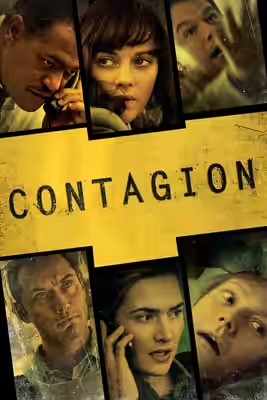
  1. Contagion (2011, Fi1m 78)Soderbergh’s version of the same fear, with the science kept in and the helicopters left out.

  2. The Andromeda Strain (1971) · not reviewed yetRobert Wise locks four scientists in a laboratory and lets the procedure do the frightening.

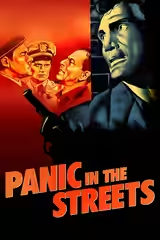
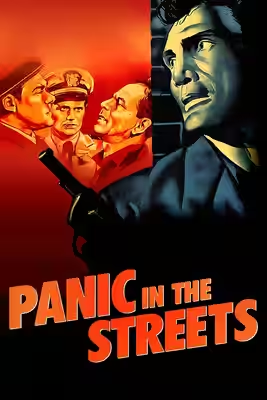
  3. Panic in the Streets (1950) · not reviewed yetElia Kazan chases plague through New Orleans in forty-eight hours; lean, sweaty and quick.

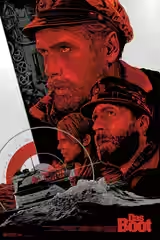
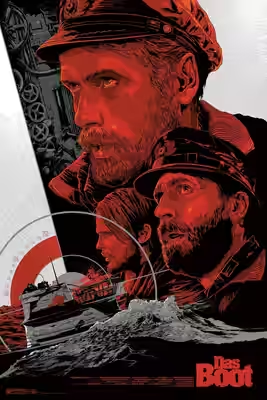
  4. Das Boot (1981, Fi1m 89)Petersen’s best film, in which the enclosed space is the whole point and nobody escapes it.

  5. Flu (2013) · not reviewed yetA Korean city quarantined by its own army, played louder and with far less patience than this.

Free account

Know what to watch tonight

Two lists that know where things are streaming, collections you can share, your own score beside ours, and Discover that remembers what you have seen.

  • Want to see, sorted by what is streaming now
  • Seen, with your score out of ten
  • No adverts, ever