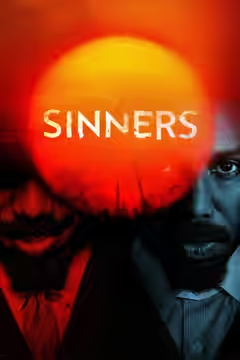
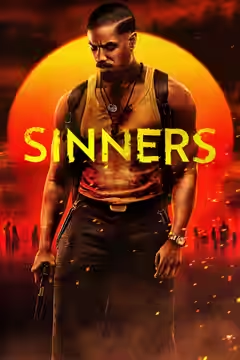
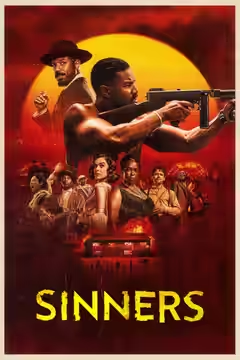
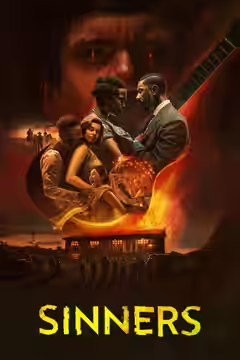
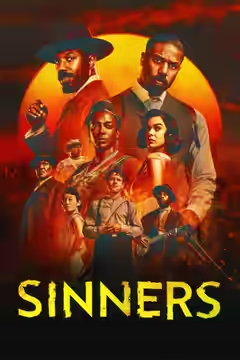
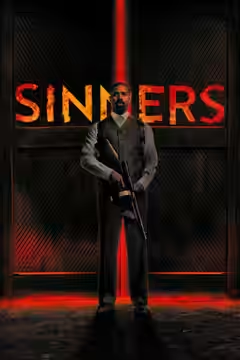
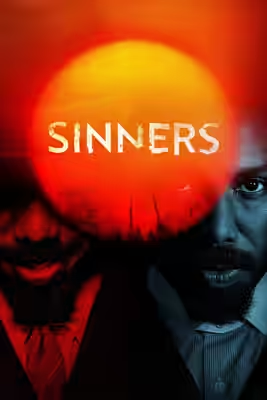
Sinners poster

Sinners

2025 · Directed by Ryan Coogler
2h 18mHorrorActionThriller15
79
Fi1m score
81
Critics · 12
Audience · not yet

Where to watch in the UK

Checked 10 September at 22:29. Prices and availability change; the service’s page is the last word.

Synopsis

Mississippi, 1932. Twin brothers Smoke and Stack (both played by Michael B. Jordan) come home to the Delta with a plan to open a juke joint that same night. They recruit their cousin Sammie (Miles Caton), a blues musician, and Delta Slim (Delroy Lindo), a harmonica player. Cornbread (Omar Benson Miller) takes the door. Annie (Wunmi Mosaku), whom Smoke left behind, and Mary (Hailee Steinfeld), whom Stack did, both turn up. By nightfall the mill is full and the band is playing. Then a stranger called Remmick (Jack O’Connell) arrives outside and asks, politely, to be let in.

Fi1m review

In a sentenceThe best night out in the Delta, ruined, as most are, by strangers who want to come in and sing

Ryan Coogler’s vampire film about a juke joint in 1932 Mississippi is at its best before the vampires arrive, and the hour of music that opens it is as good as anything he has made. The siege that follows is well staged and more ordinary.

Smoke and Stack, twins played by Michael B. Jordan, come back to the Mississippi Delta in 1932 with money, a truck and a sawmill they intend to turn into a juke joint by that evening. Ryan Coogler, writing and directing, spends his first hour on the getting ready: who will play, who will cook, who will stand on the door, who is still angry about being left. It is the best hour he has directed. After dark, a stranger called Remmick (Jack O’Connell) turns up outside with two friends and a fiddle, and Sinners becomes the vampire film its poster promised. That film is good. The one before it was better.

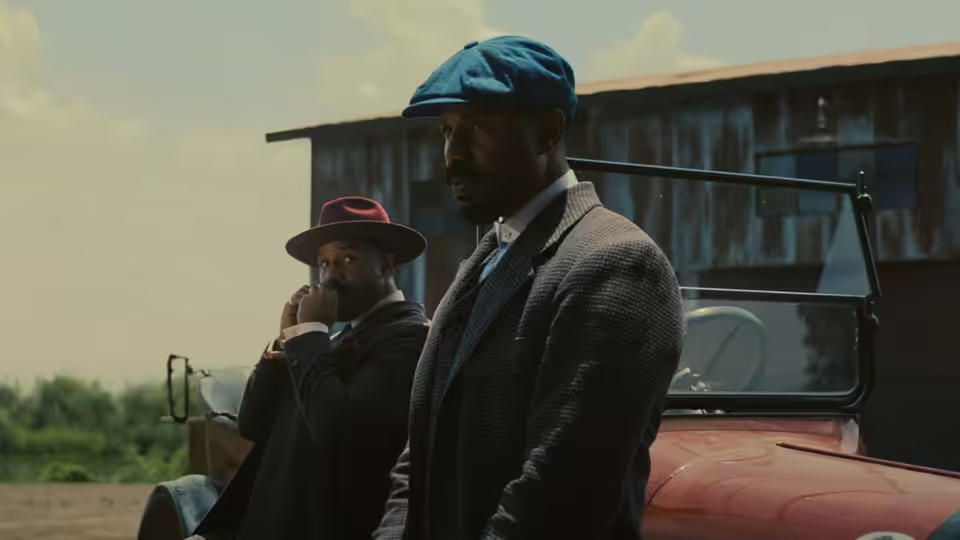
Autumn Durald Arkapaw shoots on large-format film, and the daylight scenes have the depth that only that sort of negative gives you: cotton fields that go back for miles, dust in the air, sweat on skin you feel you could touch. Hannah Beachler’s mill is a real building with a bad roof and a plank floor, and by the time the lamps are lit and the bodies are moving it feels like a place that could hold everyone who has ever wanted to dance on a Saturday. Ruth E. Carter puts the brothers in city suits that are a little too good for the town, and everyone else in cotton that has been washed until it is soft. Nobody looks like they are wearing a costume.

The scene the film will be remembered for comes in the middle. Sammie (Miles Caton) gets up to play, and as the song builds the camera leaves him and travels the mill, and the dance floor starts to fill with people who should not be there, musicians from before and after 1932, until the roof is on fire and nobody has noticed. It runs for several minutes in what plays as a single move. We sat forward, then realised some time later that we had not blinked. Ludwig Göransson’s score does the hard work here, laying electric guitar and drums under a Delta blues song without making it sound like a remix, and the effect is of one music reaching forward and back to shake hands with all the others.

Jordan is fine as both brothers and better as Smoke, the quieter one, who carries a gun he would rather not use and a grief he would rather not name. Delroy Lindo’s Delta Slim has the film’s best speech, delivered from the back of a truck about a man he once knew, and Lindo plays it with the ease of someone who has decided the scene is his. Wunmi Mosaku’s Annie is the one person in the mill who understands what has arrived outside, and Mosaku makes her fear practical rather than theatrical. Caton, in his first film, has a low, unhurried singing voice and a face that does not yet know how to lie, which is exactly what Sammie needs. Hailee Steinfeld has less to do and does it sharply.

O’Connell’s Remmick is the best idea in the second half. He is courteous, he wants to be liked, and he and his friends sing folk songs at the door with real feeling, which is more unsettling than any amount of hissing. He also has a reason for wanting in, and it connects to the film’s argument about who gets to own a music. But once the rules of the siege are set, Coogler follows them. Michael P. Shawver’s cutting, patient all evening, gets busy; people run into the dark and come back changed, and we knew who would and roughly when. We felt the film get smaller. A picture that had been about a whole town became a picture about a doorway, and we had seen that picture before.

Set against Coogler’s own work, this is the first film he has made from nothing but his own script, after Fruitvale Station, Creed and Black Panther, and it is the loosest and most personal of them. It is also, at 138 minutes, the one most in need of a stern friend; there are two speeches in the last half hour that explain what the juke joint scene had already shown us.

See it on the largest screen within reach, and go for the music. The vampires are a reasonable excuse to stay.

Critical consensus AI synthesised

81
Positive
12
Mixed
0
Negative
0

The reviews are uniformly favourable and the spread is narrow: nobody dislikes it, and the argument is only over how much to like it. Praise clusters around Ryan Coogler’s nerve in stacking a 1932 Mississippi period drama, a vampire film and a blues musical into a single night, and around his ability to hold the pile together. Michael B. Jordan’s dual role is singled out repeatedly, as are the juke joint musical sequences, Ludwig Göransson’s score and the 70mm photography, with several critics also noting Miles Caton’s debut. The reservations are consistent too. Most critics find the film overstuffed, and a few think the change of gear into pulpy horror costs it something: Time Out calls the shift jarring, NME finds the final act stop-start, Vulture argues it never quite works as horror, and the Financial Times, the coolest of the group at three stars, reads the genre collision as a loss of nerve rather than a show of it.

The New York Times
17 April 2025 · Manohla Dargis
90*

The critic calls it a genre-defying, mind-bending fantasia overflowing with great performances, dancing vampires, and ideas about love and history. She singles out the blues musician's role as a time traveler connecting generations.

Read the full review →
The Independent
10 April 2025 · ★★★★ · Clarisse Loughrey
80

The critic praises the film's inventive fusion of historical epic, horror and action as a bold original idea in a sickly cinema landscape. They single out the electric genre-mashing and strong supporting cast for praise.

Read the full review →
The i Paper
18 April 2025 · Christina Newland
80*

The critic calls it one of the most satisfying and fun blockbusters of the year, praising its blend of supernatural horror with political and historical themes. They single out the evocative atmosphere, strong performances and genre-bending story.

Read the full review →
Time Out
10 April 2025 · ★★★★ · Elizabeth Weitzman
80

The critic finds Coogler's film an audacious epic packing multiple genres into one day in 1932 Mississippi, with stunning settings, stirring music and electric party scenes. The shift to pulpy vampire horror feels somewhat jarring and cumbersome after the rich world-building.

Read the full review →
Empire
15 April 2025 · Helen O’Hara
75*

The critic describes it as a wildly original, defiantly weird and gorgeously made film that twists the vampire myth into something thematically dense. They single out the world-building, performances and idiosyncratic take on colonialist vampires.

Read the full review →
Screen Daily
10 April 2025
75*

The critic describes an ambitious melding of pop spectacle and serious intent that has much to say about race and class divisions, with expertly staged fright sequences. The picture is overstuffed at times but consistently engaging thanks to its pulpy action and thematic points.

Read the full review →

Cast

Stills

Awards

Academy Awards, 2026

Won
Best Actor
Won
Best Cinematography
Won
Best Original Score
Won
Best Writing, Original Screenplay

Black Reel Award for Best Film, 2026

Won
Black Reel Award for Best Film

Black Reel Award for Best Screenplay, Adapted or Original, 2026

Won
Black Reel Award for Best Screenplay, Adapted or Original

Black Reel Award for Outstanding Ensemble, 2026

Won
Black Reel Award for Outstanding Ensemble

FIPRESCI Grand Prix, 2025

Nominated
FIPRESCI Grand Prix

If you liked this, try…

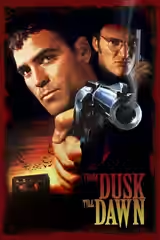
From Dusk Till Dawn poster

From Dusk Till Dawn

1996 · Another film that opens as one genre and lets the vampires in at half-time.

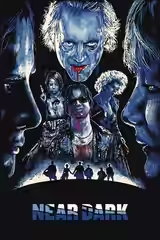
Near Dark poster

Near Dark

1987 · Vampires as a travelling family in the American nowhere, with a bar scene to match.

Ganja & Hess poster

Ganja & Hess

1973 · A black American vampire film about hunger, faith and inheritance, stranger than anything since.

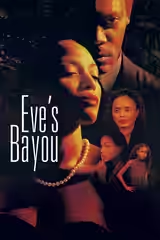
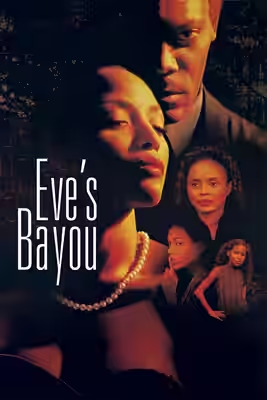
Eve's Bayou poster

Eve's Bayou

1997 · Louisiana, family secrets, hoodoo and heat, without a single fang.

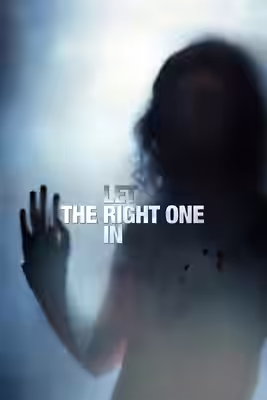
Let the Right One In poster

Let the Right One In

2008 · Swedish, snowbound and quiet, and equally clear that the monster must be invited.