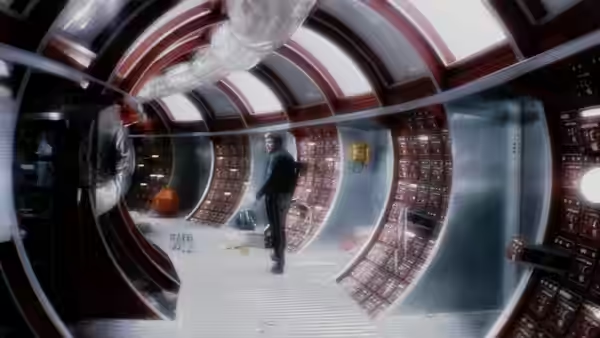
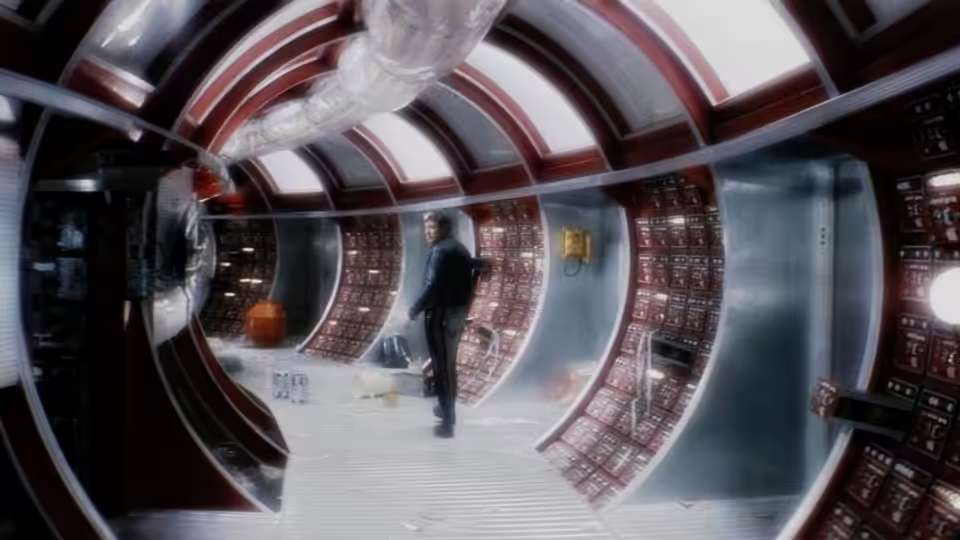
a man stands alone in a curved corridor lined with control panels
Film review

Solaris

1972 · Directed by Andrei Tarkovsky · 2h 47m

In a sentenceA remote space station turns out to be an impractical place to get over someone

On Earth, Kris Kelvin (Donatas Banionis) prepares for a journey to a remote station near the planet Solaris. There, Dr. Snaut (Jüri Järvet) and Dr. Sartorius (Anatoly Solonitsyn) face a world that appears to respond to human needs. Kelvin wants to understand what is happening, but the crew’s memories and desires complicate the enquiry. Before the journey into space, the film spends time with the natural world Kelvin is leaving behind. At the station, the effort to understand an unfamiliar form of life becomes entangled with questions about the people who have come to study it.

Plays from YouTube when you press play; nothing loads from them until then.

Fi1m review

Andrei Tarkovsky’s Solaris makes space travel feel painfully lonely. Its grief and strange planetary images justify the patience it asks, though the long philosophical conversations sometimes explain what the performances have already made clear.

Solaris is moving science fiction, though it asks for more patience than it always needs. Andrei Tarkovsky adapts Stanisław Lem’s novel with Friedrich Gorenstein, sending Kris Kelvin (Donatas Banionis) to a remote station near a planet whose behaviour defeats ordinary explanation. The journey is supposed to bring him closer to understanding another form of life, but human memories and needs keep getting in the way. We recommend it warmly, with a warning about the long philosophical conversations.

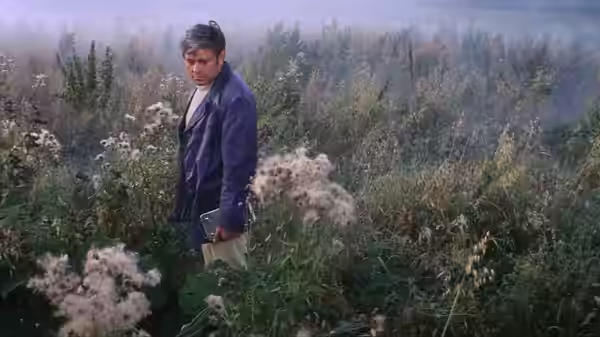
The opening on Earth is essential to that journey, even when its length seems hard to account for. Vadim Yusov gives the natural world enough time on screen for us to begin missing it before the film has properly left. We felt homesick during this stretch; the sustained attention to nature makes leaving it seem a considerable loss. Once the station takes over, we keep remembering how much there was to look at outside.

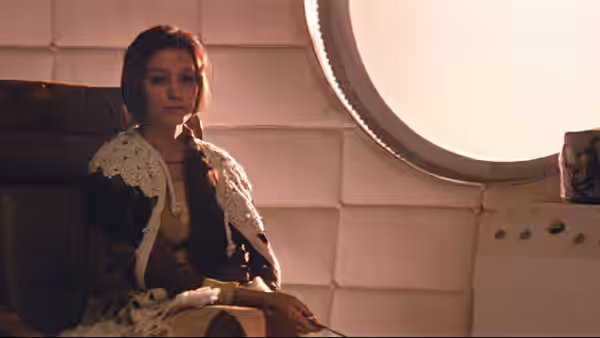
Donatas Banionis makes Kelvin a difficult man to reach, which is useful until it becomes frustrating. His reserve gives the film somewhere to start, but it can also make a conversation feel longer than the thought behind it. Natalya Bondarchuk, as Hari, supplies much of the hurt that keeps the questions about love from becoming an exercise. We believe in the need for another person when she is on screen, even when the dialogue seems determined to turn that need into a discussion.

Vadim Yusov’s images of Solaris are more unsettling than any tidy explanation of the planet would be. They seem unstable under our gaze, making the effort to inspect them part of the unease. Mikhail Romadin’s production design gives the station a sense of human occupation, and the attention to art and objects helps prevent it becoming merely a setting for arguments. The music, credited to Eduard Artemyev and Vyacheslav Ovchinnikov, sustains the strangeness without making it feel like a warning before a shock.

The editing by Lyudmila Feiginova and Nina Marcus allows the long takes to establish their own pace, and often the extra time changes what we notice. An image we have understood can still become more disquieting if we are left with it. The philosophical conversations are less consistently rewarding: we sometimes finish considering a question well before the conversation does. Across 167 minutes, those stretches are a real obstacle, particularly when the film seems to be insisting on the seriousness of something its actors have already made clear.

We are used to science fiction rewarding curiosity with a clearer view of how something works. Here the closer attention goes to the people doing the looking, and to their habit of treating an unknown world as something that ought to answer their questions. There is a severity to that view of human beings, but the film’s grief prevents it from becoming smug. Its demands on our attention are substantial. Choose it when there is time to sit with the silences without waiting for the next event.

Critical consensus AI synthesised

75
Positive
12
Mixed
2
Negative
0

Most critics respond warmly to Solaris as science fiction concerned with memory, grief and human failings rather than technology. Praise centres on Tarkovsky’s patient visual storytelling, the eerie space imagery and the emotional weight of its questions about love and identity. The reviews repeatedly describe a film that demands close attention but rewards it with lingering unease and passages of tenderness. Its philosophical concerns are widely seen as inseparable from its human ones.

The main division concerns what that patience achieves. Admirers find the length creates space for reflection; even some enthusiastic reviews acknowledge that watching can be a chore. The two mixed assessments retain substantial praise: Time Out admires the camerawork and human enquiry but finds the climax insufficiently rigorous, while Slant Magazine finds affecting passages within a meandering treatment of scientific interference. The spread is broadly positive, with reservations concentrated on pace and narrative discipline.

Little White Lies
4 February 2017 · William Carroll
90*

The critic hails Tarkovsky’s film as the benchmark for science fiction, praising its exploration of human narcissism, memory and existence through a meditative lens on a remote space station. The piece singles out the film’s visual beauty and philosophical depth, particularly the final shot that opens up questions of reality and belief.

Read the full review →
RogerEbert.com
19 January 2003 · Roger Ebert
90*

Ebert praises the film as a profound, meditative work that uses length to create an environment for reflection on human nature, memory, and reality rather than conventional entertainment. He singles out the zero-gravity scene with floating candles and characters as a magical centerpiece and highlights the ending's invitation to reconsider the entire narrative.

Read the full review →
The AV Club
25 May 2011 · A- · Scott Tobias
90

Tarkovsky views space as an abstract realm of consciousness and treats the story more as a ghost story than conventional sci-fi, with spectacular images of the planet that have a trance-like instability. The film is a challenging, difficult sit even by Tarkovsky standards, but its strange ambience lingers.

Read the full review →
Empire
1 January 2000 · David Parkinson
70*

Tarkovsky’s mesmerising adaptation of Stanislaw Lem’s novel is still superior to Steven Soderbergh’s remake. It concentrates on the eerie realisation that there’s nothing more terrifying out in space than our own selves.

Read the full review →
Los Angeles Times
18 May 2017 · Mark Olsen
70*

Olsen sees the re-release of Solaris as an opportunity to appreciate its poetic, metaphysical take on science fiction anew, noting its more graspable story compared to Stalker. He praises its enveloping, overwhelming quality on the big screen and its provocative addition to philosophical sci-fi discussions.

Read the full review →
The New Yorker
8 February 2021 · Alex Ross
70*

Ross views Solaris as Tarkovsky's attempt at transcendental science fiction focused on haunted memories and unresolved conflicts rather than space mechanics, calling it transfixing despite the director later deeming it his weakest. He highlights the majestic long takes, philosophical dialogues, and Bach soundtrack as hallmarks.

Read the full review →

Straight answers AI written, from our review

Is Solaris worth watching?
Solaris is worth watching for patient viewers drawn to science fiction about grief and human needs; we score it 87. Its unsettling planetary images and performances make the loneliness felt, but at 167 minutes, the long philosophical conversations sometimes keep explaining what we already understand.
How long is Solaris, and what is it rated?
Solaris runs 2h 47m. It is a drama and science fiction film.
Where can I watch Solaris in Peru?
Solaris is not on any streaming or rental service in Peru at the moment. It is available in 4 other countries; change your country at the top of the page to see where. Availability is checked daily.
How does Solaris compare to Arrival?
Solaris and Arrival both make an encounter with the unknown painfully personal, but Solaris asks for more patience with silence and philosophical conversation. We favour Solaris for its sustained loneliness and unsettling images; Arrival is the better choice for first-contact tension, with Amy Adams making its strange ideas feel human.
Is Solaris based on a true story or a book?
Solaris is adapted from Stanisław Lem’s novel, not a true story, with Andrei Tarkovsky and Friedrich Gorenstein responsible for the adaptation. Knowing the book is not necessary: the film makes its concerns with grief, memory and human needs felt through the performances, even when its philosophical conversations become demanding.

Cast

Awards

Cannes Film Festival, 1972

Won
Cannes Film Festival Grand Prix

If you liked this, try…

La Jetée poster

La Jetée

1962 · Memory and longing carry a science-fiction story told largely through still photographs.

After Life poster

After Life

1998 · A patient, humane enquiry into which memories we would choose to keep.

Arrival poster86

Arrival

2016 · Another encounter with the unknown that makes grief an urgent personal concern.

The Spirit of the Beehive poster87

The Spirit of the Beehive

1973 · Quiet rooms, watchful faces and a child’s struggle with what images can mean.

Aniara poster

Aniara

2018 · For a harsher account of loneliness aboard a spacecraft, with less consolation.

Solaris (1972) review: slow science fiction with real grief (Peru) | Fi1m