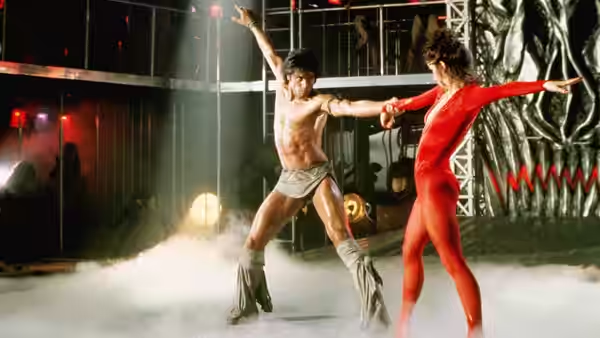
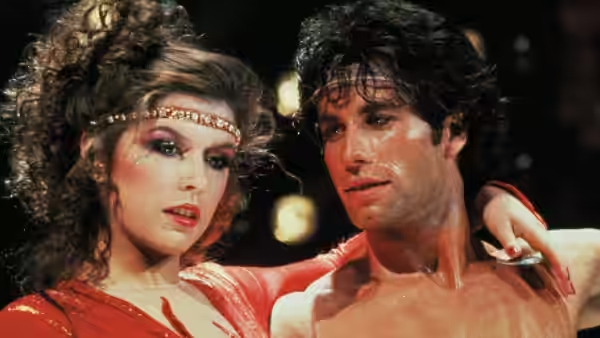
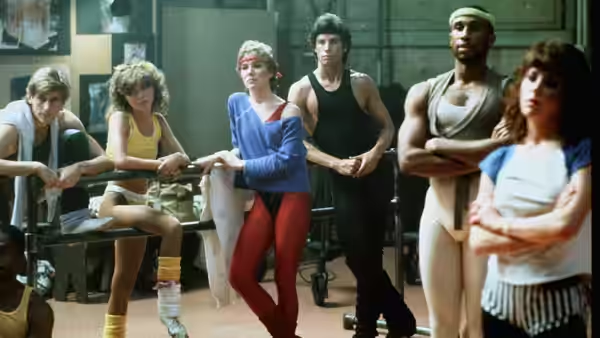
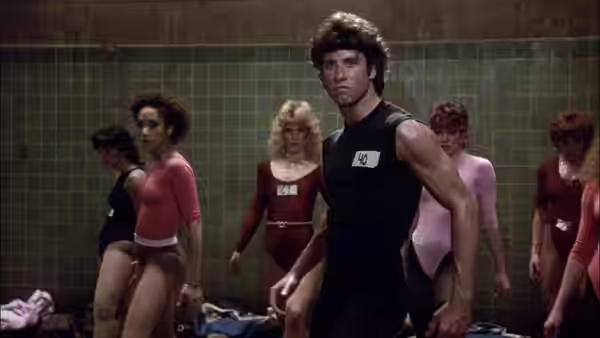
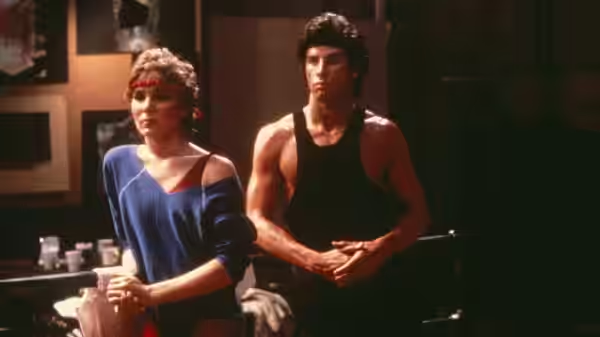
Tony Manero (John Travolta) and Laura dance together onstage
Film review

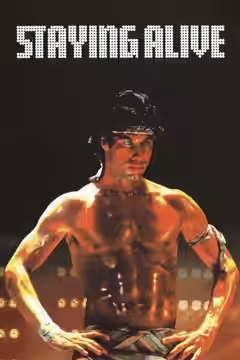
Staying Alive

1983 · Directed by Sylvester Stallone · 1h 36m

In a sentenceTony Manero would be easier to cheer for if he occasionally noticed somebody else

Tony Manero (John Travolta) pursues Broadway success, with professional ambition and romance competing for his attention. The people around him include Jackie (Cynthia Rhodes), Laura (Finola Hughes) and Jesse (Steve Inwood), while his determination to get ahead governs his dealings with others. Tony wants a place on stage and is inclined to put his own needs first. His pursuit of a career brings that self-absorption into his personal relationships, as the demands of performing compete with the demands of the people around him.

Plays from YouTube when you press play; nothing loads from them until then.

Fi1m review

John Travolta’s effort cannot rescue a sequel that mistakes Tony Manero’s ambition for a personality. Sylvester Stallone gives the pursuit of Broadway success plenty of insistence, but too little reason to care.

Sylvester Stallone’s Staying Alive is a poor sequel that asks us to take Tony Manero’s ambition more seriously than his behaviour warrants. The pursuit of Broadway success ought to give John Travolta’s character something demanding to work towards, with other people entitled to needs of their own. Instead, Tony’s determination occupies so much attention that there is little space left to discover what makes him interesting. The thin characterisation makes 96 minutes feel longer than they should.

John Travolta supplies commitment, and the film does not suffer from a leading actor unwilling to put in the work. We were bored by Tony, because his persistent self-absorption gives us so little to consider beyond his desire to get ahead. The screenplay by Norman Wexler and Sylvester Stallone does too little to examine his manipulative behaviour. An unpleasant lead can hold our attention, but the writing needs to find something worth investigating beneath the unpleasantness. Here his narrow set of wants soon becomes wearing.

Cynthia Rhodes plays Jackie and Finola Hughes plays Laura, and both have the difficult job of sustaining our interest around such a self-involved lead. There is effort in the performances, but the writing gives them too little help. The tendency to push emotions harder only makes the shortage of convincing human behaviour more noticeable. Even when a performer makes an impression, the film returns us to Tony without making his company any more rewarding.

Nick McLean’s cinematography at least gives us a reason to keep looking at John Travolta. His physical commitment comes across clearly, and watching him work provides some welcome pleasure when the character has exhausted our patience. Robert F. Boyle’s production design does its share in making theatrical success seem worth pursuing. These contributions help establish the attraction of Tony’s goal, though the screenplay still struggles to make us care about his pursuit of it.

The music from Robin Gibb, Maurice Gibb and Barry Gibb provides welcome relief from the dialogue. Its momentum helps us through stretches in which the drama has run short of things to say. Peter E. Berger, Mark Warner and Don Zimmerman handle the editing, but the film’s forward movement cannot conceal how often it repeats its point about Tony wanting success. We understand his ambition well before the film finishes insisting on it.

The familiar underdog formula is the deeper problem, and it makes the comparison with Rocky understandable. We need some interest in the person doing the work before that work can become an absorbing drama. Against Saturday Night Fever, this sequel shows too little curiosity about Tony and too much readiness to applaud his persistence. Sylvester Stallone’s direction keeps pressing for an emotional response that the screenplay has not done enough to earn.

There is nothing contemptible about the labour here, and the performers deserved a script that understood why an audience might resist Tony. His struggle could have carried another film, provided it had allowed him more complexity and the people around him more independence. The effort on screen earns some respect, but it does not make this worth recommending. If John Travolta is the reason for watching, be prepared to wish the dialogue would stop.


Critical consensus AI synthesised

41
Positive
0
Mixed
2
Negative
4

The available verdicts lean firmly against Staying Alive, with no consistent praise emerging from the review summaries. Critics find the sequel weaker than Saturday Night Fever and fault its treatment of Tony Manero, whose ambition does little to make him a fuller character. The complaints concern characterisation, writing and performance: Tony remains self-absorbed and manipulative, while the performers’ efforts cannot compensate for weak material and overacting.

The differences are chiefly in emphasis rather than enthusiasm. Radio Times faults Stallone for retreading Rocky instead of making the sequel work on its own terms. Slant Magazine allows that the film is not quite as bad as its reputation, but still finds it boring and largely pointless. Two of the six entries provide no accessible verdict, so their inferred scores cannot reliably establish a more sympathetic critical minority.

RogerEbert.com
· Roger Ebert
64*

The review text is inaccessible, so its verdict cannot be determined. No praise or complaint can be reliably identified from the page content provided.

Read the full review →
The New Yorker
22 August 1983 · Pauline Kael
64*

The issue archive identifies a Current Cinema review of the film but does not show Kael’s verdict. It provides no praise or complaint from the review itself.

Read the full review →
Radio Times
★★ · John Ferguson
40

Ferguson calls the sequel a clunker that Travolta would likely prefer to forget. He faults Stallone for retreading Rocky rather than making the sequel work on its own terms.

Read the full review →
Time Out
· SGr
30*

The critic gives the film a negative verdict. They complain that Tony Manero remains one-dimensional, bovine, manipulative and self-obsessed.

Read the full review →
Variety
31 December 1982 · Variety Staff
30*

The critic finds the sequel inferior to Saturday Night Fever. The review recounts Tony Manero’s rise to Broadway success but singles out the predecessor as the stronger film.

Read the full review →
Slant Magazine
17 June 2008 · Sarah D. Bunting and Joe Reid
20*

The critic finds the sequel boring and largely pointless, despite saying it is not quite as terrible as its reputation suggests. The article singles out the overacting and weak writing as failures that the performers’ efforts cannot overcome.

Read the full review →

Straight answers AI written, from our review

Is Staying Alive worth watching?
Staying Alive is not worth recommending, and we score it 38 out of 100 despite John Travolta’s physical commitment and the welcome relief of the music. Travolta admirers may find enough pleasure in watching him work, but Tony Manero’s self-absorption and the repetitive writing make his pursuit of Broadway success a slog.
How long is Staying Alive, and what is it rated?
Staying Alive runs 1h 36m. It is a drama and music film.
Where can I watch Staying Alive in Chile?
Staying Alive is not on any streaming or rental service in Chile at the moment. Availability is checked daily.
How does Staying Alive compare to All That Jazz?
Staying Alive is the weaker backstage drama beside All That Jazz, which gives professional ambition the scrutiny, humour and difficult humanity Tony Manero needs. We recommend All That Jazz for a more searching account of what show business costs; its central figure is often hard to like, but the film finds more to examine in him.
What should I watch after Staying Alive?
After Staying Alive, try All That Jazz (1979, Fi1m 84): Backstage ambition gets the scrutiny, humour and difficult humanity Tony needs. Then The Red Shoes (1948, Fi1m 92): A more searching account of what professional dancing demands from private lives; and Fame (1980, Fi1m 70): Performance ambitions become more involving when several people are allowed to matter.

Cast

Awards

Golden Raspberry Award for Worst Actor, 1984

Nominated
Golden Raspberry Award for Worst Actor

Golden Raspberry Award for Worst New Star, 1984

Nominated
Golden Raspberry Award for Worst New Star

Golden Raspberry Award for Worst Supporting Actress, 1984

Nominated
Golden Raspberry Award for Worst Supporting Actress

If you liked this, try…

  1. All That Jazz (1979, Fi1m 84)Backstage ambition gets the scrutiny, humour and difficult humanity Tony needs.

  2. The Red Shoes (1948, Fi1m 92)A more searching account of what professional dancing demands from private lives.

  3. Fame (1980, Fi1m 70)Performance ambitions become more involving when several people are allowed to matter.

  4. Strictly Ballroom (1992, Fi1m 83)Competitive dancing leaves welcome room for wit, affection and other people’s feelings.

  5. Shall We Dance? (1996) · not reviewed yetA gentler dance drama with curiosity about people beyond their talent.

Free account

Know what to watch tonight

Two lists that know where things are streaming, collections you can share, your own score beside ours, and Discover that remembers what you have seen.

  • Want to see, sorted by what is streaming now
  • Seen, with your score out of ten
  • No adverts, ever