James Gunn’s Superman is kind, bright and busy. David Corenswet makes a warm and credible hero and Nicholas Hoult a Luthor worth disliking, but the film keeps adding characters and crises until the last act is mostly noise.
James Gunn’s Superman skips the origin. There is no rocket, no cornfield, no glasses coming off for the first time; a few lines of text at the start tell us what we need, and the film begins with Superman already famous, already at work and already in trouble, because he has stepped into a war abroad and half the world thinks he had no right to. Gunn, who writes and directs, wants a Superman who is simply good, in public, in an age that finds that suspicious. It is a decent idea and the film means every word of it. It is also so busy that the idea has to shout to be heard.
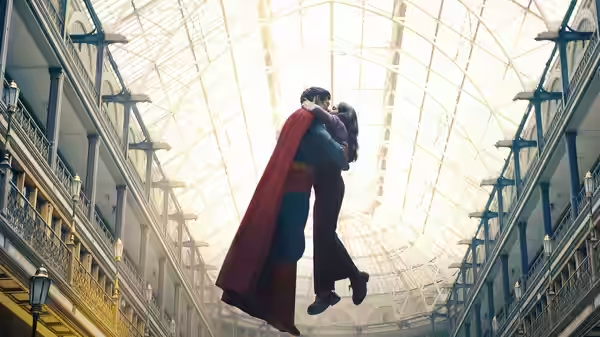
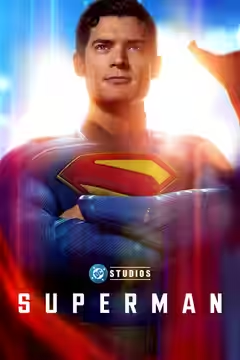
David Corenswet is the reason to see it. He is large and open-faced and plays the man as somebody who wants badly to be liked and is hurt when he is not, which is a more interesting Superman than the untroubled god we usually get. Rachel Brosnahan’s Lois is quicker than him and knows it, and their long argument in her flat, the two of them on a sofa disagreeing about what he did and why, is the best written scene in the film. Nobody flies during it. Nothing blows up. We would have taken another twenty minutes of it.
Nicholas Hoult’s Lex Luthor is a bald tech billionaire with a private army, a bank of screens and a grievance he cannot put down. Hoult plays him tight and sweating, a man losing an argument with someone who is not arguing, and his way of winning is to change the subject, on every screen in the world, until the public forgets what the question was. It is the film’s sharpest thought and Hoult carries it.
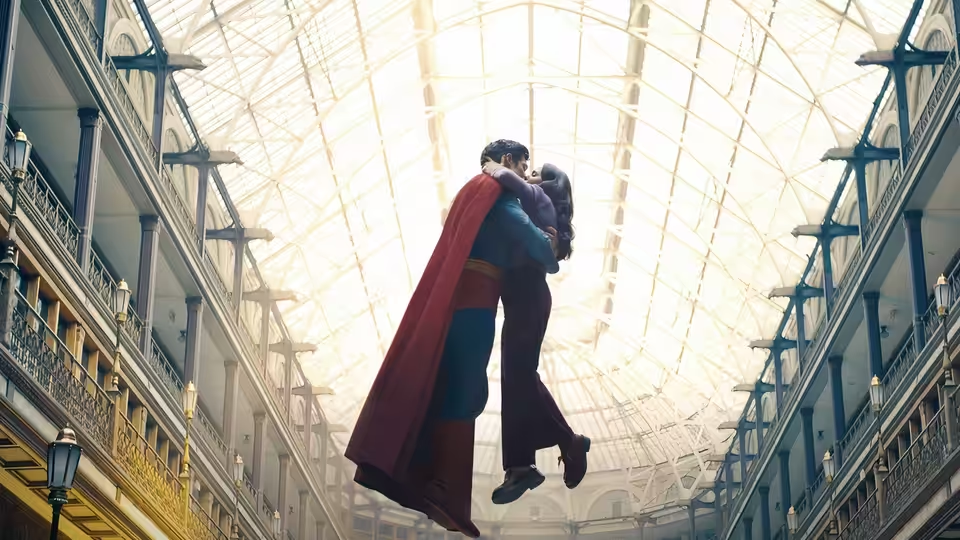
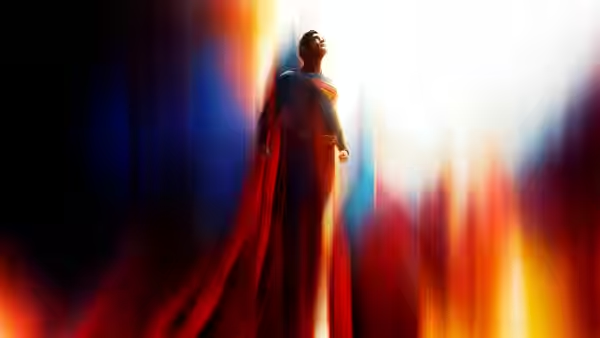
Henry Braham shoots all of this in bright, saturated primaries, the camera swooping alongside Superman on wide lenses so that Metropolis bends at the edges of the frame. Beth Mickle’s city is clean and slightly retro, with Luthor’s tower a white glass box that looks like a phone. Judianna Makovsky puts the trunks back on the suit and the film does not apologise for them. John Murphy and David Fleming’s score does the heavy lifting; John Williams is credited too, and his 1978 theme turns up at the moments you would expect. It worked on us every time, which we admit with mild embarrassment.
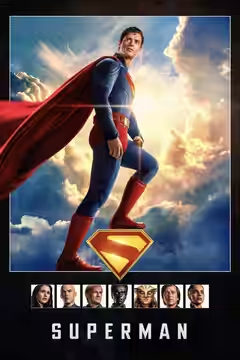
Then there is everybody else. Edi Gathegi’s Mr Terrific, deadpan and competent, gets the most to do among the other heroes and earns it. Nathan Fillion’s Guy Gardner has a haircut and one joke, repeated. Isabela Merced’s Hawkgirl has wings. María Gabriela de Faría’s Engineer is a henchwoman with a good gimmick and no inner life. Skyler Gisondo’s Jimmy Olsen has a subplot that belongs in a sillier film. And there is the dog, Krypto, who steals every scene he is in, which is a problem when the scene was supposed to be about something.
Craig Alpert and William Hoy cut fast, and for an hour that reads as energy. In the last forty minutes it reads as panic. We were tired well before the end, and then cross about being tired by a film that had, an hour earlier, made us care.
Because it had. A scene in Kansas, Clark on the porch with his adoptive father, no music under it, saying little, moved us more than anything else in the picture, and it moved us because Corenswet lets the hurt show and Gunn holds the shot. The film knows how to do this. It does it twice and then goes back to the robots.
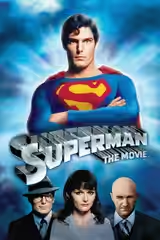
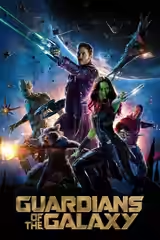
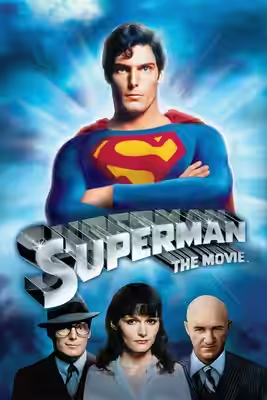
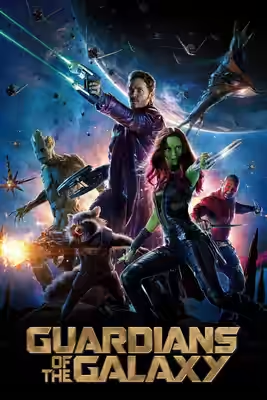
Gunn’s Guardians of the Galaxy (2014) had the same chatter and the same fondness for oddballs, and it had five people to spend them on; here he has a dozen and a mythology to restart. The Christopher Reeve films let one man and one woman stand for the whole thing, and this one keeps looking over their shoulders to see who else is arriving. See it in a cinema if you can, where the colour and the theme do their work and the noise is at least honest noise. It runs 130 minutes, carries a 12A, and would have been a better film at 110 with three fewer heroes and the same dog.