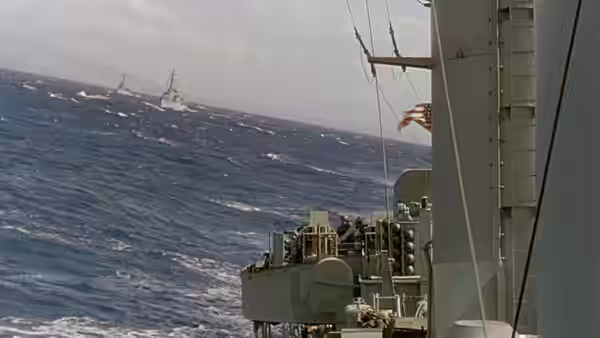
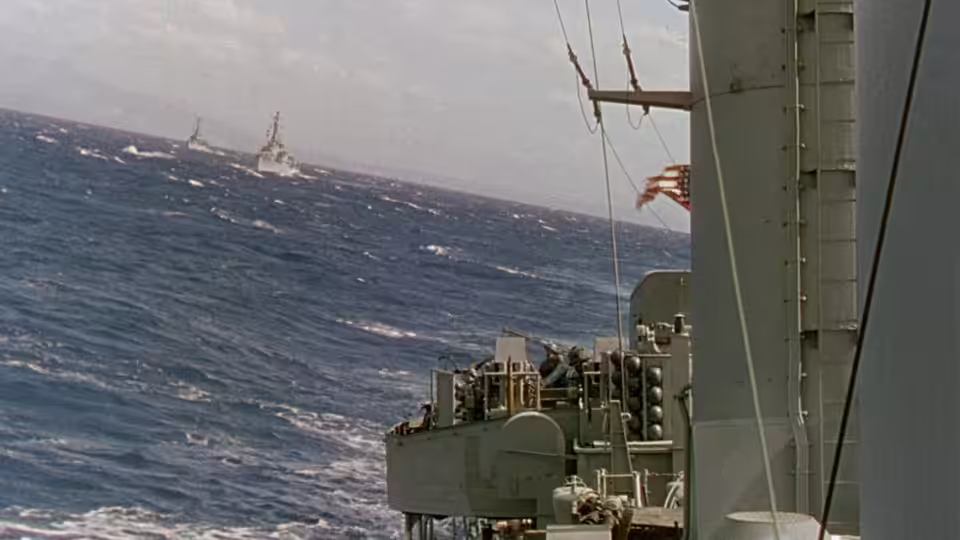
warships steaming across rough seas viewed from a naval vessel
Film review

The Caine Mutiny

1954 · Directed by Edward Dmytryk · 2h 04m

In a sentenceTwo steel balls, one quart of strawberries and the loneliest man in the Pacific

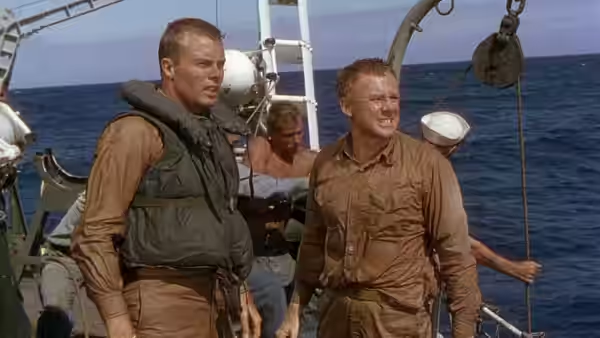
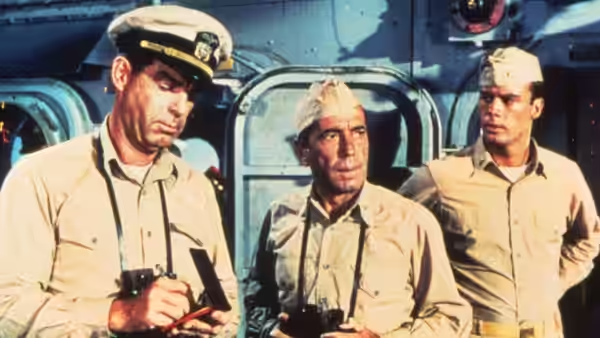
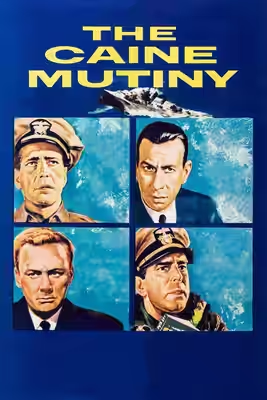
The Pacific, midway through the Second World War. Ens. Willis Seward ‘Willie’ Keith (Robert Francis), fresh from officer training and a mother (Katherine Warren) who would rather he had stayed home, reports to the USS Caine, a rusting destroyer-minesweeper run with cheerful slackness by Comdr. DeVriess (Tom Tully). Keith is appalled. Then DeVriess is relieved and Lt. Cmdr. Philip Francis Queeg (Humphrey Bogart) takes command, promising discipline and rolling two steel balls in his palm while he says so. Executive officer Lt. Stephen Maryk (Van Johnson) tries to make it work; Lt. Tom Keefer (Fred MacMurray), a novelist in uniform, starts keeping notes. When Queeg cuts his own towline while dressing down a sailor for an untucked shirt, the wardroom begins to wonder what sort of man is on the bridge. In port, Keith courts a nightclub singer, May Wynn (May Wynn).

Fi1m review

Edward Dmytryk’s film of Herman Wouk’s novel is plain, solid Hollywood carpentry with one remarkable thing in it: Humphrey Bogart, tired and frightened, playing a captain who is coming apart. The shore-leave romance is dead weight, and there is a lot of it.

Edward Dmytryk’s film of Herman Wouk’s novel puts a rusting destroyer-minesweeper called the Caine in the Pacific in the middle of the Second World War, hands it a new captain, and spends 124 minutes asking whether the officers who eventually take the ship off him were right to do it. Stanley Roberts’s screenplay trims the book to a ship, a court and a girl. The ship and the court are good. The girl is not the film’s fault, exactly, but she is its problem, and we will come to her.

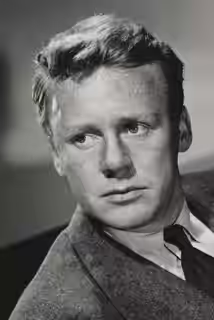
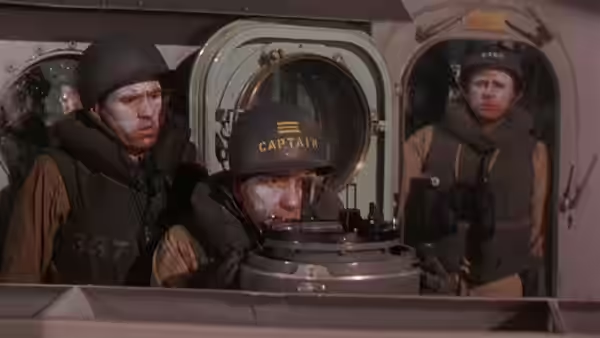
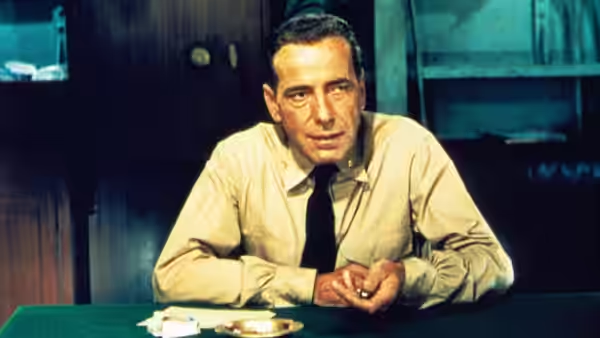
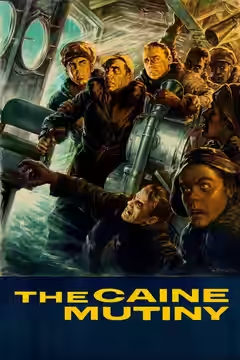
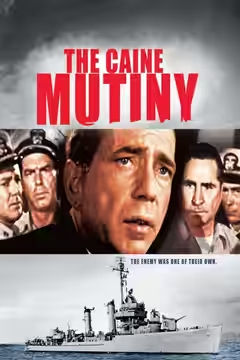
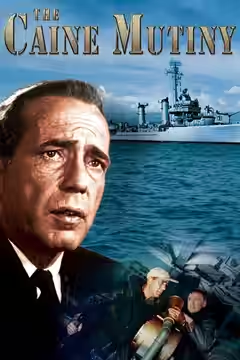
What the film has, above everything else, is Humphrey Bogart. Lt. Cmdr. Philip Francis Queeg comes aboard promising to run a taut ship, tells the wardroom he is not there to be their friend, and rolls two steel balls in his palm while he says it. Bogart plays him with none of his usual ease. He looks tired, and the tiredness is right: this is a man who has been at sea too long and knows he is not up to it. The night he turns the ship over hunting for a quart of strawberries missing from the officers’ mess, we were embarrassed for him, and then we were sorry for him, and we had not expected the second.

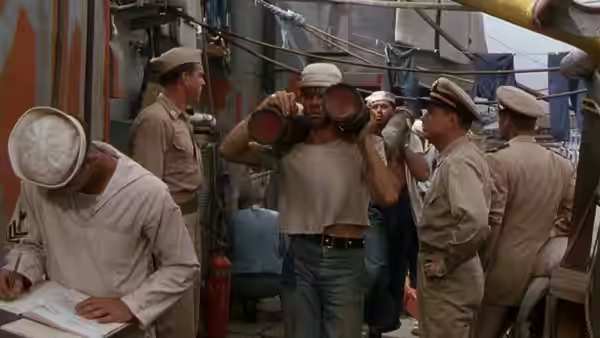
Rudolph Sternad’s Caine is a ship nobody would choose: rust down the hull, a bridge with too many men on it, a wardroom table you cannot get round without asking someone to move. Franz Planer shoots it in colour, the sea a flat hard blue and the steel a grey that never looks clean, so that Queeg’s white-glove standards look absurd before he has opened his mouth. Max Steiner gives the ship a brass march that does its job and gives the romance a wash of strings that does not. William Lyon and Henry Batista cut the shipboard scenes short and hard and let the shore scenes drift, which may be honest to the material but does not help it.

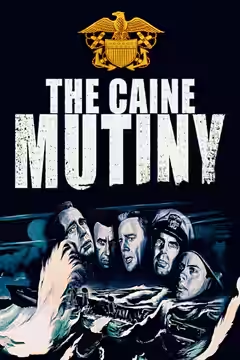
Van Johnson’s Lt. Stephen Maryk is the executive officer, a decent, slow man who obeys until he cannot, and Johnson plays the slowness as a virtue that turns into a trap. Fred MacMurray’s Lt. Tom Keefer is the ship’s novelist, the officer who talks the others into everything and puts his own name to none of it; MacMurray’s great screen quality, a friendliness you do not quite trust, has rarely been used so precisely. Tom Tully’s Comdr. DeVriess, the slovenly captain Queeg replaces, is on screen for a quarter of an hour and we missed him for the rest. Lee Marvin turns up as a sailor called Meatball and is already Lee Marvin. In the courtroom, E.G. Marshall prosecutes as a man who thinks the case is simple and José Ferrer defends as a man who wishes he were anywhere else.

Then there is Ens. Willie Keith. Robert Francis is billed second and plays the officer through whose eyes we are meant to see all this, and the film has decided he must also have a nightclub singer, May Wynn, played by an actress who is also called May Wynn, and a mother (Katherine Warren) who disapproves of her. Every time the Caine makes port the picture stops dead. We were bored ashore, plainly bored, checking how long until someone put to sea again, and the fault is not the actors’ but the screenplay’s, which keeps the shape of Keith’s education from the book without ever showing him learn anything. Jean Louis dresses the singer in gowns that belong to a different, glossier film, which is roughly where those scenes belong too.

Dmytryk directs without flourish. The camera is set down among the men and left there while they talk, and in the wardroom and the court that is enough, because Bogart is doing the work. The storm that brings matters to a head is short and rough and well staged. The closing minutes we will not describe, except to say that the film wants to be against Queeg and for the Navy at the same time, and a late speech is delivered as though it settled the question when it only changes the subject.

See it for Bogart, who is not in nearly enough of it and owns all of it, and for MacMurray, who does the most damage without raising his voice. When the Caine is at sea it is a good film. When it is in port it is waiting to be one.

Critical consensus AI synthesised

73
Positive
7
Mixed
1
Negative
0

Most critics recommend The Caine Mutiny, and almost all for the same reason: Bogart’s Captain Queeg. Playing against type as a craven, paranoid commander coming apart, he is described across the reviews as the film’s centre, and several find the character tragic rather than villainous by the time the court-martial arrives. The trial scenes draw the next most consistent praise, along with the adaptation’s success in keeping the shape and sense of the novel. One review singles out the Technicolor photography of the shipboard sequences.

The reservations are about pace and direction. Two reviews call Dmytryk’s handling stodgy, one finds the storytelling standard old-fashioned fare lifted by its cast, another thinks the final section muddled, and one admits a rough start. The spread is narrow, with most landing in the same band; the lone dissent is Time Out, which finds the strong cast never given room and Bogart’s charisma dimmed by how tired he looks.

Variety
31 December 1953 · Variety Staff
90*

The film is a highly recommendable motion picture drama that retains the essence of the novel in its intelligent adaptation. It delivers high action, drama, and striking shipboard sequences building to the court-martial.

Read the full review →
Radio Times
★★★★ · Jeremy Aspinall
80

The critic hails a first-rate drama whose compelling courtroom scenes are anchored by Bogart’s mighty performance against type as the craven, paranoiac Captain Queeg, a role that still arouses sympathy and earned the star an Oscar nomination.

Read the full review →
The AV Club
28 January 2016 · Danny Bowes
80*

The critic finds the film an engrossing, thought-provoking work after a mildly rough start. They single out the splendid Technicolor cinematography and Bogart's powerful performance playing against type as the unraveling Captain Queeg.

Read the full review →
Empire
1 January 2000 · Kim Newman
75*

The film remains a gripping drama thanks to its cast, despite being somewhat stodgily directed. Bogart's performance as the unstable Captain Queeg stands out as the highlight, turning the character into a tragic figure in the courtroom scenes.

Read the full review →
Slant Magazine
9 May 2007 · Jeremiah Kipp
70*

The critic calls the film solid but standard old-fashioned storytelling with a psychological twist, praising its excellent performances that elevate it above the ordinary, especially Bogart's layered work and the trial scene.

Read the full review →
The New Yorker
26 June 1954 · John McCarten
70*

As Navy pictures go, “The Caine Mutiny” isn’t bad and runs smoothly for the most part with sufficient hilarity and derring-do. Bogart does well as the twisted Captain Queeg, and the supporting performances by Van Johnson and others are admirable.

Read the full review →

Straight answers AI written, from our review

Is The Caine Mutiny worth watching?
The Caine Mutiny is worth watching for Humphrey Bogart's performance as a captain coming apart, and we scored it 76. When the ship is at sea or the court is in session it is a good, plain Hollywood drama; the shore-leave romance stops it dead every time it makes port. Anyone who likes Bogart or a wartime courtroom will forgive the dull stretches.
How long is The Caine Mutiny, and what is it rated?
The Caine Mutiny runs 2h 04m. It is a drama and war film.
Where can I watch The Caine Mutiny in Poland?
The Caine Mutiny is not on any streaming or rental service in Poland at the moment. It is available in 10 other countries; change your country at the top of the page to see where. Availability is checked daily.
How violent or frightening is The Caine Mutiny, and is it suitable for children?
The Caine Mutiny has no UK certificate and is a talky wartime drama rather than a violent one. What the film shows is a rusting ship, a storm that is short and rough, a captain's public breakdown over a quart of strawberries and a court martial; nothing bloodier than a cut towline. Older children who can follow the argument will be fine, younger ones will be bored ashore.
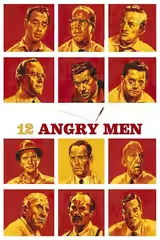
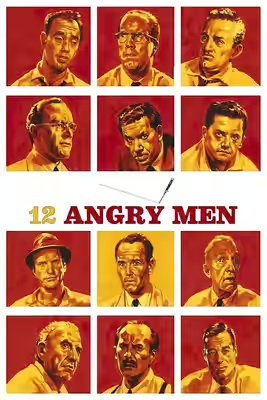
How does The Caine Mutiny compare to 12 Angry Men?
The Caine Mutiny and 12 Angry Men are both dramas about men arguing over another man's fate, and 12 Angry Men is the tighter of the two. Sidney Lumet keeps everything in one room and almost nothing is wasted; Edward Dmytryk has Bogart, who is better than anything in the later film, but pads the ship and the court with a dead-weight romance. Choose the jury for pace, the ship for the performance.
Is The Caine Mutiny based on a true story or a book?
The Caine Mutiny is adapted from Herman Wouk's novel of the same name. Stanley Roberts's screenplay trims the book to a ship, a court and a girl, and keeps the shape of Ens. Willie Keith's education without ever showing him learn anything. You do not need to have read Wouk to follow it, and readers may notice most what has been lost.
What should I watch after The Caine Mutiny?
After The Caine Mutiny, try Twelve Angry Men (1957, Fi1m 91): One room, twelve men and a verdict; the courtroom drama with the fat trimmed. Then Paths of Glory (1957, Fi1m 93): Kubrick’s military court-martial, where the men in the dock never had a chance; and Das Boot (1981, Fi1m 89): A submarine crew coming apart under a captain who mostly holds; no shore leave.

Cast

Awards

Academy Awards, 1955

Nominated
Best Actor
Nominated
Best Film Editing
Nominated
Best Original Dramatic or Comedy Score
Nominated
Best Picture
Nominated
Best Sound
Nominated
Best Supporting Actor
Nominated
Best Writing, Adapted Screenplay

If you liked this, try…

  1. Twelve Angry Men (1957, Fi1m 91)One room, twelve men and a verdict; the courtroom drama with the fat trimmed.

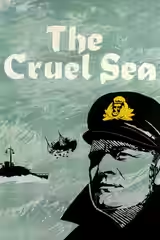
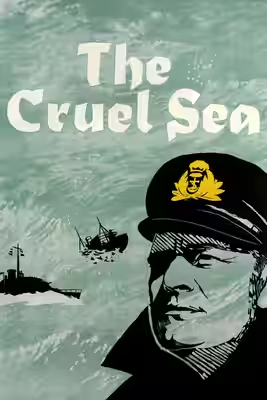
  2. The Cruel Sea (1953) · not reviewed yetThe British version of a tired ship and a tired captain, without the trial.

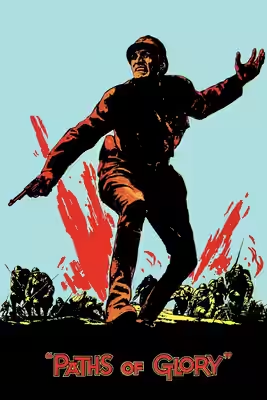
  3. Paths of Glory (1957, Fi1m 93)Kubrick’s military court-martial, where the men in the dock never had a chance.

  4. Breaker Morant (1980) · not reviewed yetAustralian officers on trial for following orders; angrier and shorter than Wouk.

  5. Das Boot (1981, Fi1m 89)A submarine crew coming apart under a captain who mostly holds; no shore leave.

Free account

Know what to watch tonight

Two lists that know where things are streaming, collections you can share, your own score beside ours, and Discover that remembers what you have seen.

  • Want to see, sorted by what is streaming now
  • Seen, with your score out of ten
  • No adverts, ever