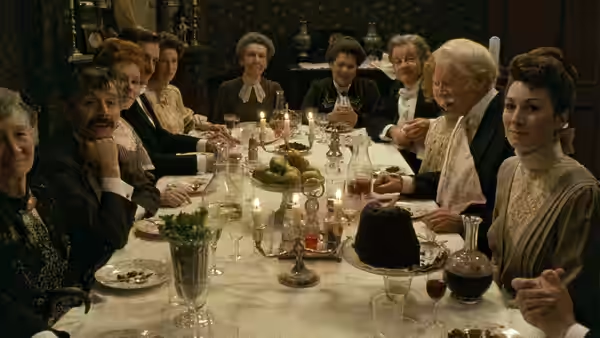
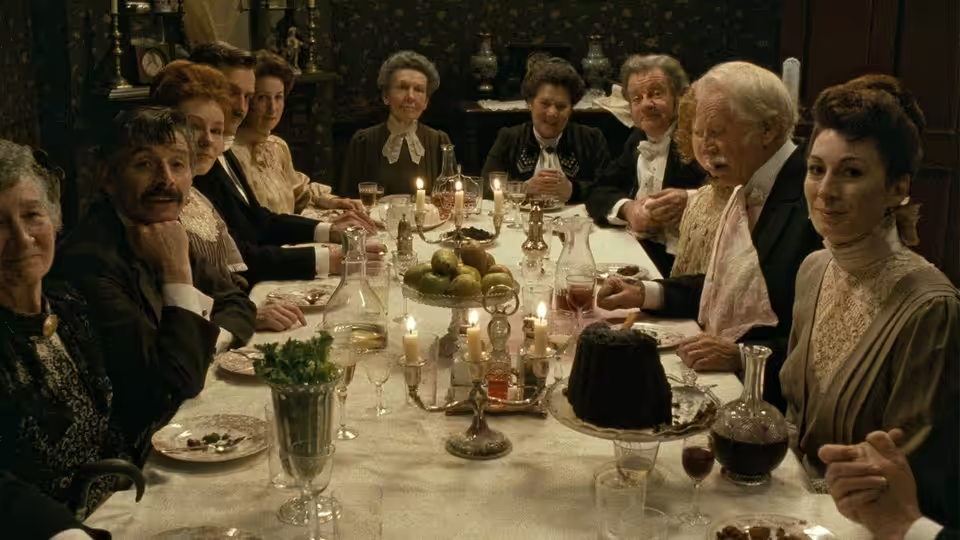
Guests gather around a candlelit dinner table in a Victorian drawing room
Film review

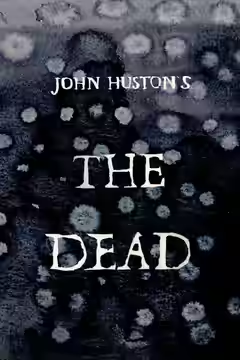
The Dead

1987 · Directed by John Huston · 1h 23m

In a sentenceA Dublin dinner party in which everybody speaks beautifully and nobody says a true word until the coats are on

Dublin, a snowy night in January 1904. Aunt Kate (Helena Carroll) and Aunt Julia (Cathleen Delany) are giving their annual party with their niece Mary Jane (Ingrid Craigie), and the weather has them fretting about late arrivals. Their nephew Gabriel Conroy (Donal McCann), who teaches and writes book reviews, arrives with his wife Gretta (Anjelica Huston). Freddy Malins (Donal Donnelly) turns up drunk and is handed to his mother (Marie Kean). Mr Browne (Dan O’Herlihy), the one Protestant in the house, attends to the young women. Lily the maid (Rachael Dowling) snaps at Gabriel when he asks about her wedding prospects. The tenor Bartell D’Arcy (Frank Patterson) has a cold and will not sing. There are quadrilles, a song from Aunt Julia, a goose to carve and a speech Gabriel is turning over in his head.

Fi1m review

John Huston’s last film is Joyce’s story done plainly and well: a Dublin party in 1904, watched with patience, and a closing stretch that says more about a marriage than most films twice its length. Small, now and then stiff, and it lasts.

John Huston’s last film adapts the story that closes James Joyce’s Dubliners. Almost nothing happens. Two elderly sisters and their niece give their annual party in Dublin in January 1904; the guests eat, dance, sing and make speeches; then one couple goes back to their hotel. Tony Huston’s script keeps nearly all of it and adds little. His father directs it as if he were a guest who had decided to stand by the wall and watch.

It is a fine film, and easy to underrate, because it looks like a filmed play. Fred Murphy lights the house by lamp and candle so the faces are warm and the corners go dark, and he moves the camera only when somebody crosses the floor. Stephen B. Grimes and J. Dennis Washington fill it with the things two old music teachers would own: a piano, photographs, embroidered chairs, a cabinet of china nobody uses. You believe the aunts have lived here for forty years and that the house is slightly too small for the party they insist on giving.

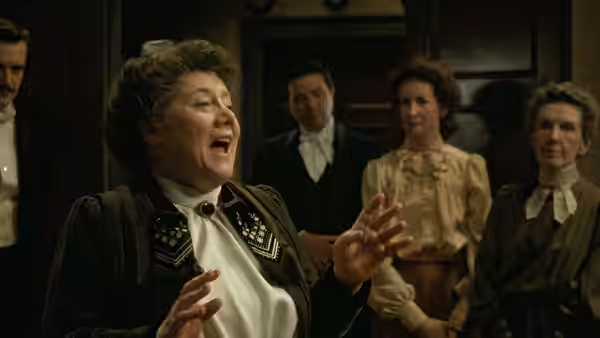
The scene that settled it for us comes when Aunt Julia (Cathleen Delany) is coaxed to the piano to sing “Arrayed for the Bridal”. Her voice is old and it wavers, and she gives the song everything she has left. Huston does not stay on her. He and the editor Roberto Silvi drift upstairs, past photographs, an empty bed, a pair of slippers, the possessions of a woman who will not see many more Januaries. It hurt more than we were ready for, because Huston never tells us to be sad; he shows us what she owns and lets the song run. When the camera returns, the guests applaud and Freddy Malins tells her she has never sung better.

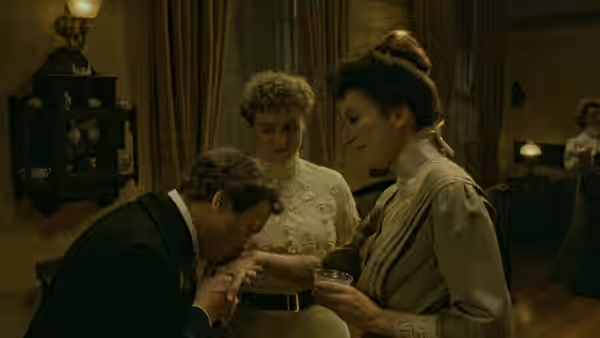
Around her the party is a gallery of small performances. Donal Donnelly’s Freddy arrives late and full and spends the evening being managed by his mother (Marie Kean). Dan O’Herlihy’s Mr Browne, the one Protestant in the house, works the young women with a gallantry twenty years past its use. Rachael Dowling has one scene as Lily the maid, telling Gabriel, when he asks about her wedding prospects, that men are all talk; Donal McCann’s flinch, and the coin he pushes at her, tell you most of what you need about Gabriel.

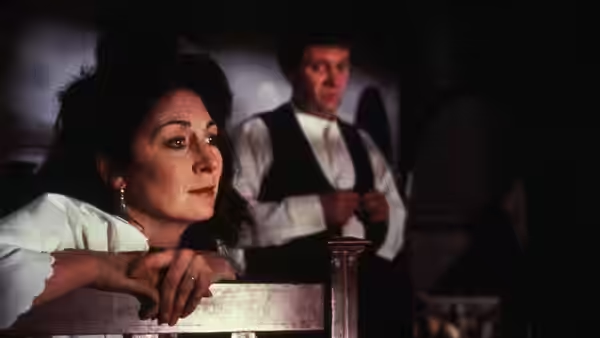
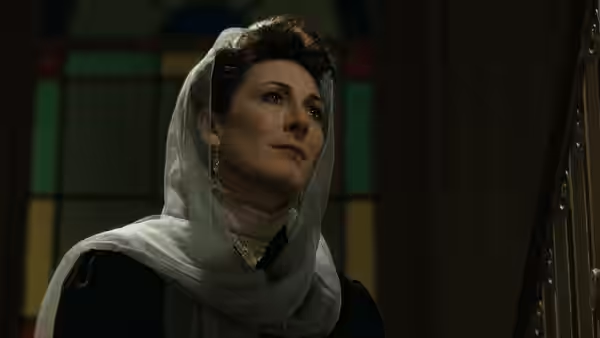
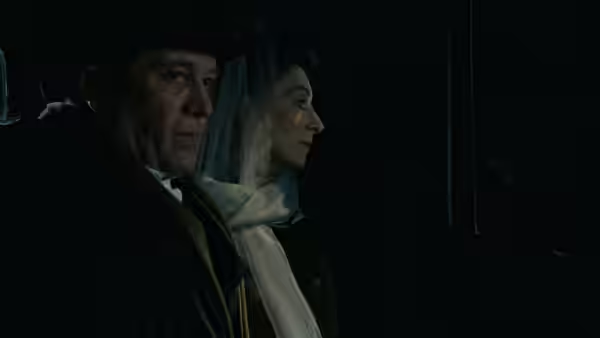
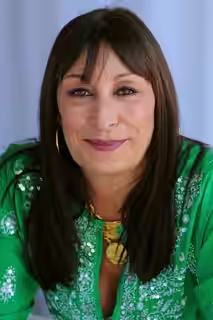
McCann holds the film together. Gabriel is the clever nephew who reviews books, and McCann plays him as a man forever half a second from saying the wrong thing and knowing it. His after-dinner speech, about hospitality and the dead who are not there to hear it, is given with the tiredness of a man who has made it before. Anjelica Huston has little to do for an hour beyond stand on staircases and listen. Then the party ends, the Conroys take a cab to their hotel, and the last twenty minutes belong to her. We will not say what she tells him. We will say it is done in the hotel, with almost no cutting, and that it changed how we thought about everything before it.

It is not without faults. Tony Huston adds a recitation of an old Irish poem about a woman betrayed; it is well spoken and it sits in the middle of the film like a signpost. Donnelly’s Freddy is a turn rather than a person, funny but pitched a notch louder than the party around him. Alex North’s score is mostly absent, which is right, and when it does arrive in the final stretch it nudges at a feeling the pictures have already earned. Some of the party talk is stiff, actors delivering Joyce rather than chatting.

Huston had been directing since 1941 and he finished with the smallest picture he ever made: 83 minutes, one house, one hotel, one night. Most critics have taken it as a farewell, and perhaps been a little generous for that reason. We think it does not need the biography. It would be a fine film if a stranger had made it. Watch it in winter, in the evening, and do not put anything on afterwards.
Critical consensus AI synthesised

83
Positive
4
Mixed
1
Negative
0
Los Angeles Times
17 December 1987 · Sheila Benson
95*

Benson finds the film an exquisite, deeply moving farewell that honors Joyce’s story. She especially praises Anjelica Huston’s simple, stirring performance and the ensemble cast.

Read the full review →
Empire
24 November 2006 · David Parkinson
85*

Parkinson finds Huston’s final film moving and perceptive, with an achingly sad view of shattered illusions. He particularly praises the closing scenes for revealing how little people may know about those closest to them.

Read the full review →
Slant Magazine
15 January 2026 · ★★★★ · Jake Cole
80

The critic calls the film one of the finest literary adaptations and artistic swan songs ever made. They praise Criterion’s 4K restoration for preserving its dark, naturalistic image while improving clarity.

Read the full review →
Time Out
28 November 2006 · Dave Calhoun
64*

The available page text gives no critical verdict. It notes that the film was John Huston's final picture and a family affair.

Read the full review →
Eye for Film
9 May 2006 · Caro Ness
95*

Ness gives the film an enthusiastic verdict, calling it a graceful and moving testament to John Huston’s skill. She singles out Anjelica Huston’s poignant performance and the film’s intimate ensemble atmosphere for praise.

Read the full review →

Straight answers AI written, from our review

Is The Dead worth watching?
The Dead is worth watching for anyone with patience for a quiet film, and we scored it 86. John Huston's last picture keeps to one Dublin house and one hotel over a single night in 1904, and its final twenty minutes with Anjelica Huston and Donal McCann repay the wait. Some of the party talk is stiff, and viewers who want events will find almost none.
How long is The Dead, and what is it rated?
The Dead runs 1h 23m. It is a drama film.
Where can I watch The Dead in Switzerland?
The Dead is streaming on Amazon Prime Video in Switzerland. Availability is checked daily; the links above go straight to each service.
How does The Dead compare to Fanny and Alexander?
The Dead is the smaller and plainer of the two, and Fanny and Alexander is the greater film. Both hang on a family gathering where the cracks show, but Bergman's Christmas is warm, funny and frightening over a long running time, while Huston watches one Dublin party from the wall for 83 minutes. Choose Bergman for range, Huston for a single evening done with restraint.
Is The Dead based on a true story or a book?
The Dead is based on a book, not a true story: it adapts the story that closes James Joyce's Dubliners. Tony Huston's script keeps nearly all of Joyce and adds little, the one notable addition being a recitation of an old Irish poem that sits awkwardly in the middle. You do not need to have read the story; the film explains itself.
What should I watch after The Dead?
After The Dead, try Fanny and Alexander (1982, Fi1m 92): Bergman’s Christmas party is the other great screen dinner where a family’s fault lines show. Then Babette's Feast (1987, Fi1m 86): A Danish village, one meal, and grace arriving through the kitchen door; and The Remains of the Day (1993, Fi1m 88): A man who has spent a life being correct and discovers what it cost him.

Cast

Awards

Academy Awards, 1988

Nominated
Best Costume Design
Nominated
Best Writing, Adapted Screenplay

If you liked this, try…

  1. Fanny and Alexander (1982, Fi1m 92)Bergman’s Christmas party is the other great screen dinner where a family’s fault lines show.

  2. Babette's Feast (1987, Fi1m 86)A Danish village, one meal, and grace arriving through the kitchen door.

  3. The Remains of the Day (1993, Fi1m 88)A man who has spent a life being correct and discovers what it cost him.

  4. Late Spring (1949, Fi1m 92)Ozu’s father and daughter say almost nothing to each other and it is unbearable.

  5. The Long Day Closes (1992) · not on Fi1m yetTerence Davies’s Liverpool boyhood, told in songs, rain and light through a window.

The Dead (1987) review: Huston’s last film, small and lasting (Switzerland) | Fi1m