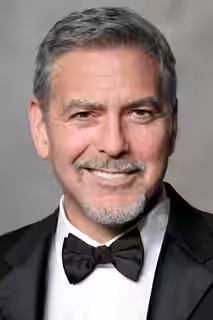
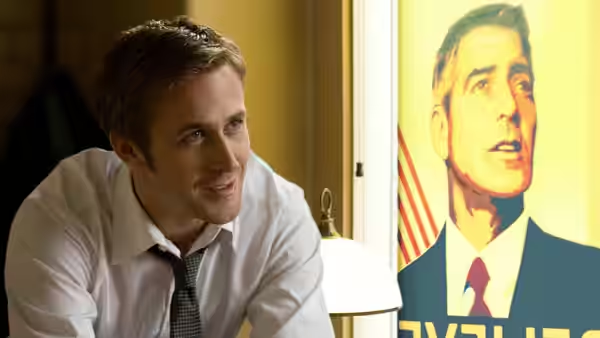
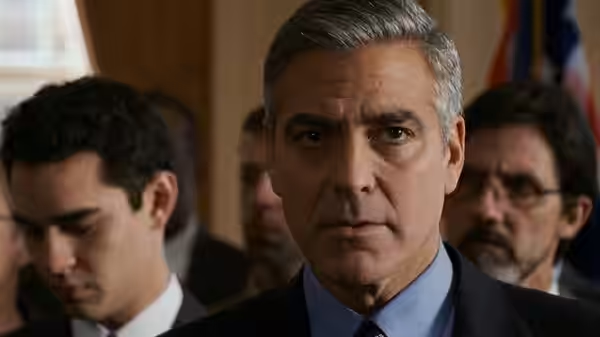
Mike Morris (George Clooney) stands at a lectern before an American flag
Film review

The Ides of March

2011 · Directed by George Clooney · 1h 41m

In a sentenceRyan Gosling’s faith in politics looks especially precarious whenever Philip Seymour Hoffman or Paul Giamatti opens his mouth

In a modern American political campaign, press secretary Stephen Meyers (Ryan Gosling) works for Mike Morris (George Clooney), an idealistic Democratic candidate. Stephen wants Morris to win and believes the man deserves to. Around him, Paul Zara (Philip Seymour Hoffman) and Tom Duffy (Paul Giamatti) offer a more practised understanding of political manoeuvring. Conversations become tests of judgement: who can be trusted, what should be said and what another person stands to gain. Stephen has to handle these professionals while trying to keep his confidence in the candidate he represents.

Plays from YouTube when you press play; nothing loads from them until then.

Fi1m review

George Clooney’s political thriller is worth seeing for Ryan Gosling, Philip Seymour Hoffman and Paul Giamatti, who make professional calculation absorbing. Its account of corrupted idealism is familiar, and the plotting sometimes forces changes the performances cannot quite justify.

The Ides of March is a well-acted political thriller with a rather ordinary view of corruption. George Clooney directs it with enough patience to make professional calculation interesting, even when the plot follows a familiar route. The pleasure is in watching people work out what they can say, what they should withhold and how much of themselves to put into a campaign. We recommend it for those exchanges, with no great expectation of learning anything new about power.

Ryan Gosling gives press secretary Stephen Meyers an earnestness that makes his confidence both appealing and faintly worrying. Working for Mike Morris, George Clooney’s idealistic Democratic candidate, Stephen has invested his judgement in someone he wants to believe deserves it. Ryan Gosling makes that attachment credible enough to hold our attention, although the character’s political innocence is harder to accept. A professional this assured ought to be less surprised by the business he has chosen.

Philip Seymour Hoffman, as Paul Zara, and Paul Giamatti, as Tom Duffy, supply the experience Stephen lacks. Both are particularly good at making political manoeuvring sound like an ordinary professional skill, and the dialogue gives them room to be persuasive. We were gripped by their verbal sparring with Ryan Gosling: the advice sounds plausible enough to make trust feel risky. The tension comes from wondering what each speaker expects to gain, even when the conversation sounds reasonable.

Phedon Papamichael’s close-ups suit this kind of acting, allowing a face to hold our attention without demanding a speech to explain it. George Clooney gives the dialogue-free stretches time to register, and those pauses help us consider the people doing the talking. Stephen Mirrione’s editing keeps the exchanges taut without making every pause feel expendable. This controlled pace serves the material well, especially when the writing trusts the actors to carry a scene.

Sharon Seymour’s production design is effective because it does not demand to be admired separately from the drama. The campaign remains a place of work, and the emphasis stays on the people doing it. Alexandre Desplat’s music helps sustain the unease, though the film’s solemnity occasionally makes an ordinary piece of intrigue seem more consequential than it is. The quieter passages are more convincing, giving us time to judge a calculation without insisting on its importance.

The screenplay by Beau Willimon, George Clooney and Grant Heslov is less convincing when it asks us to accept sudden changes in behaviour. There is a strain of melodrama here that sits awkwardly beside the patient attention to professional bargaining. Stephen’s vanity and idealism need more examination if the story’s harsher pressures are to feel earned; instead, some developments do that work for him. Even these actors cannot make all of those decisions convincing.

As a political thriller, it has the useful habit of making talk tense, but it treats familiar cynicism with rather more gravity than it needs. Its interest in the campaign’s insiders also leaves little sense of the voters whose lives are supposed to matter to them. That limits how much weight the film can reasonably place on its disappointment in politics. Choose it when a tense conversation sounds more appealing than a chase.

Critical consensus AI synthesised

65
Positive
10
Mixed
10
Negative
3

The reviews lean towards qualified approval, with praise clustering around the cast rather than the political insights. Ryan Gosling draws particular attention, while Philip Seymour Hoffman and Paul Giamatti earn repeated praise for making campaign manoeuvring convincing and entertaining. Critics also credit George Clooney’s controlled direction, tense pacing and attention to small exchanges of professional power. Even several mixed reviews find the film intelligent and watchable.

The main division concerns how much its account of political corruption has to offer. Little White Lies finds unsettling moral accuracy and an intelligent script; Variety regards the cynicism as familiar and the tone as heavy-handed. Across the reservations, predictable plotting, implausible turns and doubts about the protagonist’s naïveté recur. The spread is broad: admirers see a gripping morality thriller, while detractors find its seriousness disproportionate to its insights. Some favourable reviews also question how much of it stays with us afterwards.

IndieWire
9 September 2011 · B+ · Eric Kohn
83

Kohn finds the film a darkly entertaining, lean political allegory, though its plot runs on political-intrigue autopilot. He praises the cast’s performances and Clooney’s skillful use of close-ups and stretches without dialogue.

Read the full review →
Little White Lies
27 October 2011 · ★★★★ · Jonathan Crocker
80

The critic finds it a superb, dark political drama with unsettling moral accuracy. He particularly praises the intelligent script and the performances, especially Ryan Gosling, Philip Seymour Hoffman and Paul Giamatti.

Read the full review →
Radio Times
★★★★ · Stella Papamichael
80

Papamichael calls it a gripping thriller, with Ryan Gosling enthralling as the press secretary. She singles out his performance as the film’s standout strength.

Read the full review →
Total Film
25 October 2011 · ★★★★ · Neil Smith
80

Smith finds the film sleek, thoughtful, and likely to endure, despite some doubts about its protagonist’s naïveté. He praises its strong supporting performances and its smart nod to classic political thrillers.

Read the full review →
Slant Magazine
5 October 2011 · ★★★/4 · Jaime N. Christley
75

The critic finds the film’s confident, understated rhythm appealing, though its conventional melodrama does not always mesh with its subtler approach. They praise Clooney’s patient, nuanced direction and the film’s attention to small professional power dynamics.

Read the full review →
Evening Standard
10 April 2012
70*

The review finds the film a well-directed, splendidly acted political parable, though it never reaches great heights. It especially praises Philip Seymour Hoffman and Paul Giamatti, whose performances give the film a convincing feel for politics’ grubby business.

Read the full review →

Straight answers AI written, from our review

Is The Ides of March worth watching?
The Ides of March is worth watching for its tense political conversations and strong performances, and we score it 71 out of 100. Ryan Gosling, Philip Seymour Hoffman and Paul Giamatti make professional calculation absorbing, though the familiar account of corruption and some forced changes in behaviour limit its weight.
How long is The Ides of March, and what is it rated?
The Ides of March runs 1h 41m. It is a drama film.
Where can I watch The Ides of March in Peru?
The Ides of March is not on any streaming or rental service in Peru at the moment. It is available in 25 other countries; change your country at the top of the page to see where. Availability is checked daily.
How violent or frightening is The Ides of March, and is it suitable for children?
The Ides of March carries a UK 15 certificate, making it unsuitable for children under 15. The tension we describe comes from mistrust, political bargaining and verbal sparring, rather than specific violent or frightening scenes. The certificate signals adult material, but we cannot give a more detailed violence or scare warning from those exchanges alone.
How does The Ides of March compare to State of Play?
The Ides of March offers concentrated campaign intrigue, while State of Play gives its newsroom conspiracy six parts to develop. We recommend State of Play more readily for patient reporting and a complicated story, though its density can distance us from the characters. Choose The Ides of March for a shorter, actor-led drama, accepting its more familiar political cynicism.
What should I watch after The Ides of March?
After The Ides of March, try State of Play (2003, Fi1m 88): British political intrigue with patient reporting, divided loyalties and a strong ensemble. Then The Lives of Others (2006, Fi1m 84): For tense observation and performances that make small moral decisions matter; and No (2012, Fi1m 91): Campaign strategy becomes absorbing drama about the uneasy usefulness of political advertising.

Cast

Awards

Academy Awards, 2012

Nominated
Best Writing, Adapted Screenplay

BAFTA Film Awards, 2012

Nominated
Best Actor in a Supporting Role
Nominated
Best Adapted Screenplay

Golden Globes, 2011

Nominated
Best Actor – Motion Picture Drama
Nominated
Best Director
Nominated
Best Motion Picture – Drama
Nominated
Best Screenplay

If you liked this, try…

  1. The Candidate (1972) · not on Fi1m yetCampaign idealism meets practical compromise, with more attention to selling the candidate.

  2. State of Play (2003, Fi1m 88)British political intrigue with patient reporting, divided loyalties and a strong ensemble.

  3. The Lives of Others (2006, Fi1m 84)For tense observation and performances that make small moral decisions matter.

  4. No (2012, Fi1m 91)Campaign strategy becomes absorbing drama about the uneasy usefulness of political advertising.

  5. Z (1969, Fi1m 84)A political thriller that gives official corruption consequences beyond the campaign office.