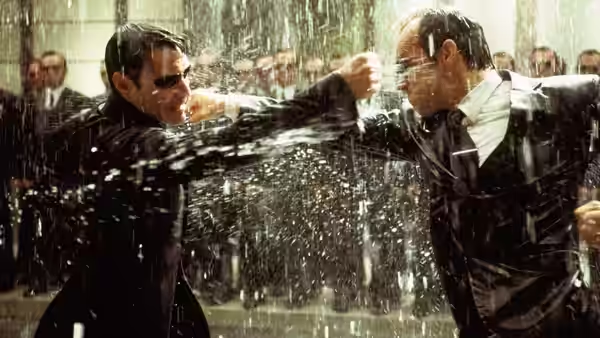
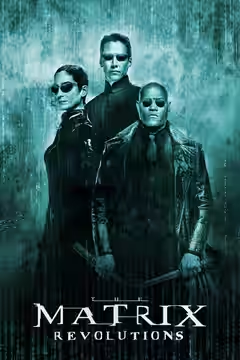
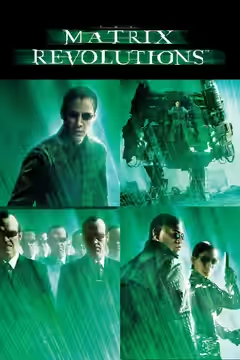
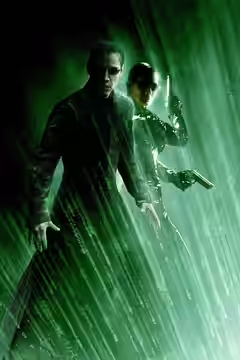
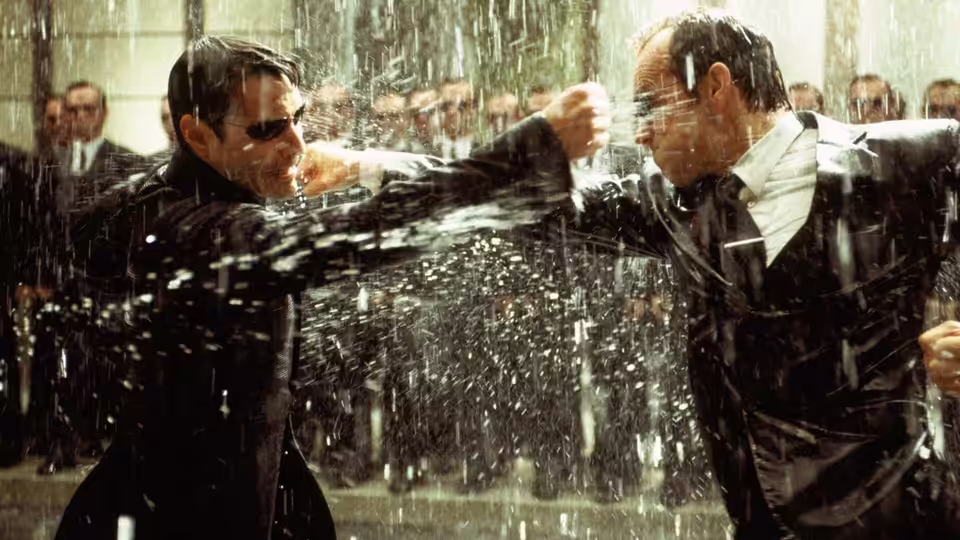
Neo and Agent Smith trade punches in a rain-soaked street
Film review

The Matrix Revolutions

2003 · Directed by Lilly Wachowski, Lana Wachowski · 2h 09m

In a sentenceThe train platform is intriguing; the trouble starts when everyone explains themselves

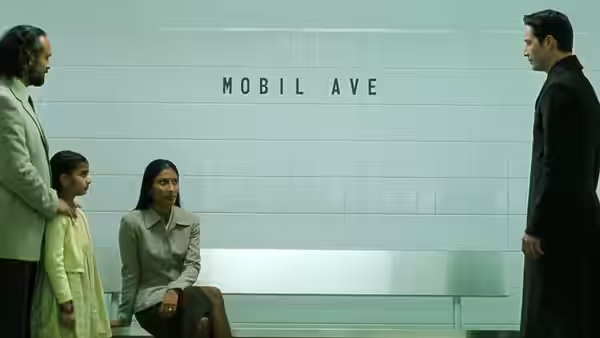
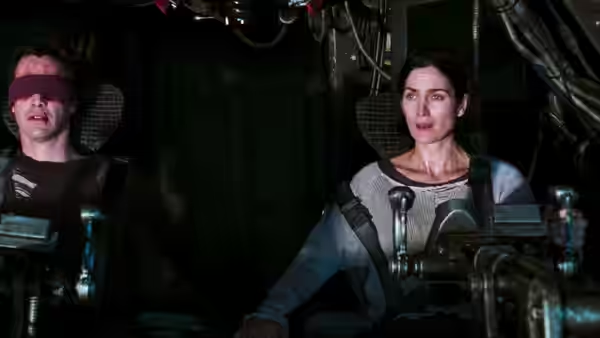
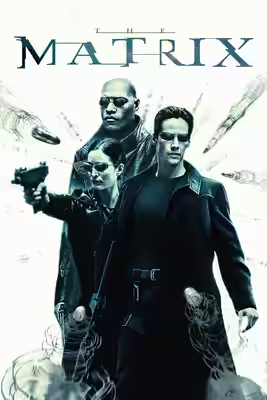
Neo (Keanu Reeves) struggles to understand his situation on a strange train platform. His relationship with Trinity (Carrie-Anne Moss) continues amid the human struggle centred on Zion, with Morpheus (Laurence Fishburne) among those involved. Neo needs answers, but remains bewildered by the conflict around him. Beyond the platform, a nightclub becomes a battleground, while Zion faces an attack by Sentinels. Neo and Trinity’s personal loyalties sit alongside the effort to defend the city, whose people must confront a threat that extends beyond the pair.

Fi1m review

Lana Wachowski and Lilly Wachowski retain a gift for strange places and large-scale action, but their finale struggles to make either matter. Hugo Weaving supplies the personality that the solemn dialogue keeps suppressing.

With The Matrix Revolutions, Lana Wachowski and Lilly Wachowski try to give a trilogy the weight of a last stand. The result is a disappointing science-fiction finale, inventive in isolated passages and laborious across much of its 129 minutes. There is a worthwhile change of emphasis in the attention paid to the people of Zion, whose shared danger ought to broaden the story beyond Neo. But the writing makes understanding what is happening hard work, then expects solemn dialogue to supply the emotion.

The train-platform sequence is the clearest reminder that these directors can make an unfamiliar place immediately interesting. Owen Paterson’s production design gives that setting a stronger hold on our attention than the film’s explanations, and Bill Pope’s cinematography helps the nightclub fight recover some sharpness. We were briefly excited by the platform, because we wanted to understand how this peculiar place worked. For a while, we wanted to know what would happen next. Too much of the rest encourages us to wait for somebody to explain what has already happened.

Keanu Reeves is left with too much bewilderment to play, and it makes Neo a difficult companion for a film already struggling to explain itself. Carrie-Anne Moss cannot make Trinity’s romance with Neo carry the emotional weight assigned to it. The relationship is asked to support so much solemn feeling that the people involved become difficult to recognise beneath it. We get too little sense of what these two people enjoy about each other, even allowing for the desperate circumstances. The spiritual language leaves little room for ordinary affection.

Hugo Weaving, as Agent Smith, is the welcome exception. He seems to enjoy the grandiosity, which is a considerable relief when almost everyone else treats it as a duty. His performance has enough bite to make the dialogue briefly entertaining. The contrast is damaging to the rest of the cast: once somebody makes this language sound playable, all the surrounding reverence becomes harder to excuse. A little more of that freedom might have helped the film’s humourless stretches.

The siege of Zion at least gives the film a clear practical problem: a city faces an attack. Its appeal is understandable, and the staging suggests real thought about how collective resistance might become the centre of an action film. Yet the attention lavished on secondary characters does not automatically make them compelling, and the battle keeps going after its immediate force has worn off. Zach Staenberg’s editing does not solve that problem; the action needs more changes of pace to sustain our interest through such a prolonged assault.

Don Davis’s music presses for a sense of momentous consequence that the script has not earned. That insistence compounds the heavy spiritual language, leaving too few scenes free to establish their importance without announcement. The directors plainly want a science-fiction adventure to accommodate belief, responsibility and love, and that ambition deserves some respect. The problem is how often those concerns arrive as declarations, while the plotting remains too weak to make them convincing.

A concluding chapter need not settle every philosophical question, but it should make the time spent with its characters feel worthwhile. This one devotes so much attention to the size and seriousness of its conflict that it neglects that simpler task. If finishing the trilogy matters, there are flashes of invention to reward the commitment. Do not expect the explanations to be as persuasive as the machinery.
Critical consensus AI synthesised

46
Positive
0
Mixed
6
Negative
5

The consensus leans towards disappointment, with the reviews divided between mixed and negative assessments rather than outright enthusiasm. Praise clusters around the visual effects and the staging of the siege of Zion, which several critics find exciting even when the surrounding story fails to engage them. The more receptive reviews see a stronger second half after a tedious opening, while Hugo Weaving’s performance earns a favourable mention from Total Film.

The main reservations concern confusing or weak plotting, drawn-out action and a conclusion that offers too little dramatic satisfaction. The sharpest disagreement concerns whether the spectacle supplies enough emotional involvement: Slant Magazine finds affecting collective human drama in Zion’s defence, whereas The Guardian finds the battles dull and the ideas exhausted. Even the warmer assessments retain substantial caveats, particularly about the spiritual allegory and the romance; the divide is over how much the film salvages, not whether it fully succeeds.

RogerEbert.com
64*

The page is blocked, so the critic’s verdict cannot be verified. No praise or complaint can be reliably identified from the available text.

Read the full review →
Screen Daily
3 November 2003 · Mike Goodridge
64*

The accessible page identifies this as Mike Goodridge’s review, but the paywall conceals his verdict. No specific element praised or criticized is visible.

Read the full review →
The New York Times
5 November 2003 · A. O. Scott
64*

The URL identifies a review of the film, but the page content is inaccessible. Its verdict and any specific praise or complaint cannot be verified.

Read the full review →
Slant Magazine
1 November 2003 · ★★½/4 · Ed Gonzalez
62

Gonzalez finds the first half rough but says the film becomes an exciting, emotionally engaging spectacle. He praises the collective human drama beneath Zion’s battle, while criticizing the heavy-handed spiritual allegory and the unconvincing romance between Neo and Trinity.

Read the full review →
Radio Times
★★★ · Jason Caro
60

Caro finds the first half tedious but says the film gets the trilogy back on track in its second half. He especially praises the technically and artistically impressive siege of Zion.

Read the full review →
Total Film
5 November 2003 · ★★★ · Total Film
60

The review finds the finale an average sci-fi film that falls short of its promised revelations and spectacle. It praises Hugo Weaving’s performance, while faulting the drawn-out action and weak plotting.

Read the full review →

Straight answers AI written, from our review

Is The Matrix Revolutions worth watching?
The Matrix Revolutions offers enough invention for those committed to finishing the trilogy, but we find it disappointing and score it 46/100. The strange train platform and Hugo Weaving’s performance provide welcome interest; the prolonged action, solemn speeches and unconvincing romance make it difficult to recommend more widely.
How long is The Matrix Revolutions, and what is it rated?
The Matrix Revolutions runs 2h 09m. It is an adventure and action film.
Where can I watch The Matrix Revolutions in Norway?
The Matrix Revolutions is available to rent from Amazon Prime Video from kr 39.00. Availability is checked daily; the links above go straight to each service.
How violent or frightening is The Matrix Revolutions, and is it suitable for children?
The Matrix Revolutions has a UK 15 certificate and contains a nightclub fight and a prolonged attack on Zion, making it unsuitable for children under 15. The review describes sustained combat rather than specific gore or scares; we would chiefly flag the length of the assault for viewers who find extended action overwhelming.
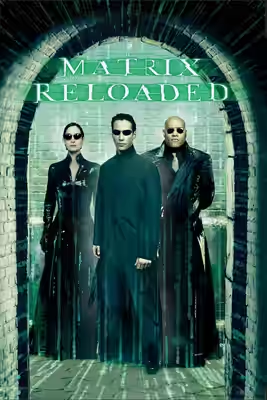
How does The Matrix Revolutions compare to The Matrix Reloaded?
The Matrix Revolutions is the less satisfying action choice beside The Matrix Reloaded, whose two standout sequences earn clearer praise from us. Both struggle with speeches, but the finale puts more weight on Zion’s collective defence and sustains its main battle beyond our interest; its strange train platform offers a more engaging change of pace.
Do you need to have seen the other The Matrix films before The Matrix Revolutions?
The Matrix Revolutions concludes the trilogy, and we recommend seeing the preceding films rather than starting here. It continues Neo and Trinity’s relationship and the struggle centred on Zion, while its explanations are already hard work; we do not find it a satisfying standalone introduction.
What should I watch after The Matrix Revolutions?
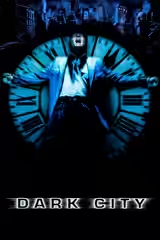
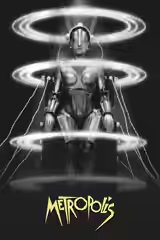
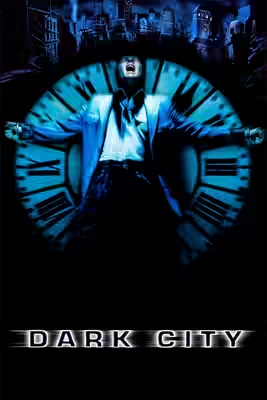
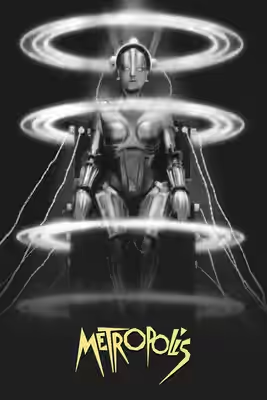
After The Matrix Revolutions, try Dark City (1998, Fi1m 76): Another enclosed reality to question, with a mystery that keeps moving. Then Ghost in the Shell (1995, Fi1m 83): Machine bodies and questions of identity, given more room for quiet; and Metropolis (1927, Fi1m 87): A divided city and mechanised spectacle, with people caught between the gears.
What order should I watch the The Matrix films in?
Release order is the safe choice for The Matrix, and it is the order our collection page lists them in. The Matrix Revolutions is the most recent of the 3 The Matrix titles on Fi1m; before it comes The Matrix Reloaded. The full order.

Part of · 3 of 3

The Matrix

3 films on Fi1m · 1999–2003 · average 65 · best The Matrix 88

All 3 in order

Cast

If you liked this, try…

  1. Dark City (1998, Fi1m 76)Another enclosed reality to question, with a mystery that keeps moving.

  2. Ghost in the Shell (1995, Fi1m 83)Machine bodies and questions of identity, given more room for quiet.

  3. Metropolis (1927, Fi1m 87)A divided city and mechanised spectacle, with people caught between the gears.

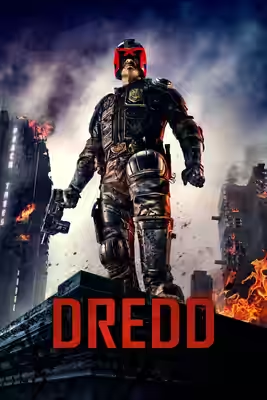
  4. Dredd (2012) · not reviewed yetFor a siege film that keeps its geography clear and its ambitions manageable.

  5. eXistenZ (1999) · not reviewed yetUnstable realities and bodily unease, with a welcome streak of grubby humour.

Free account

Know what to watch tonight

Two lists that know where things are streaming, collections you can share, your own score beside ours, and Discover that remembers what you have seen.

  • Want to see, sorted by what is streaming now
  • Seen, with your score out of ten
  • No adverts, ever