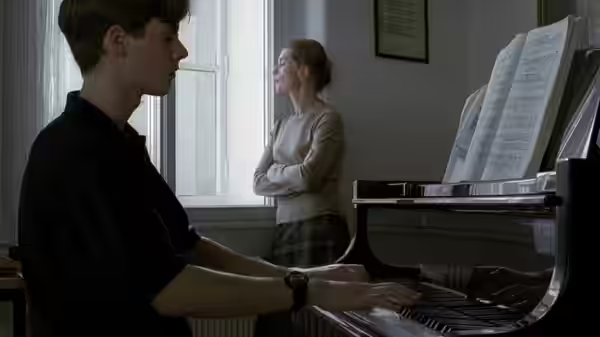
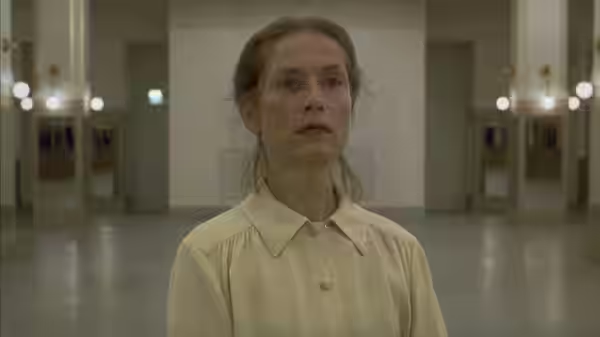
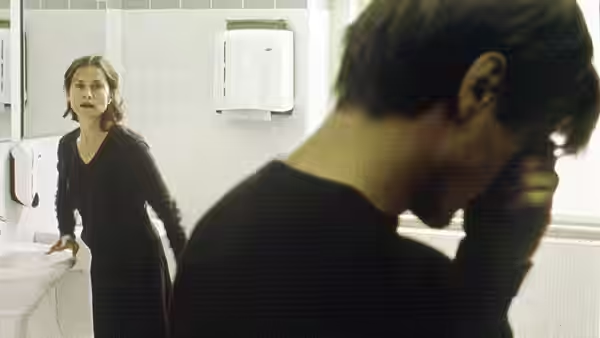
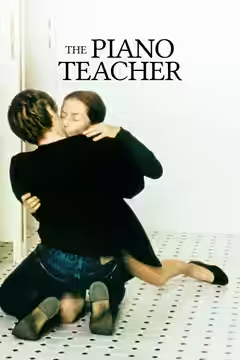
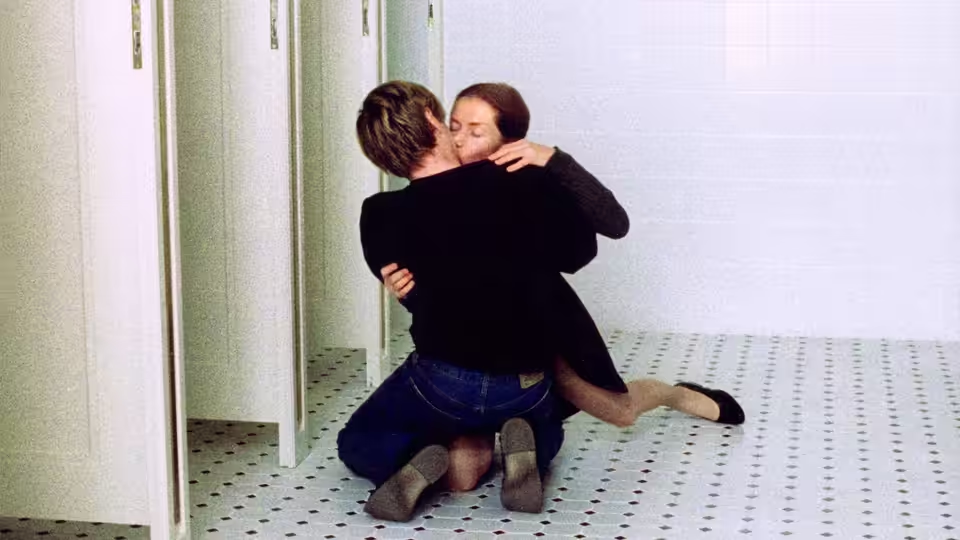
Erika Kohut (Isabelle Huppert) and her mother kissing on a tiled bathroom floor
Film review

The Piano Teacher

2001 · Directed by Michael Haneke · 2h 11m

In a sentenceIsabelle Huppert keeps a straight face while the rest of us look for somewhere else to look

Erika Kohut (Isabelle Huppert) keeps a fierce hold on what she allows other people to see. Her private sexual fantasies complicate a developing relationship with Walter Klemmer (Benoît Magimel), while her mother (Annie Girardot) is another central presence in her life. Erika wants intimacy on terms she can control, but desire makes that control difficult to maintain. Walter’s interest in her does not guarantee understanding. Between what Erika wants, what she can admit to wanting and what another person understands, the possibility of closeness becomes difficult to separate from the fear of exposure.

Fi1m review

Michael Haneke’s drama is punishing, precise and worth the discomfort for Isabelle Huppert’s fiercely controlled performance. Walter is less convincing as a character, but Erika’s vulnerability keeps the film from becoming merely an exercise in cruelty.

The Piano Teacher is a difficult film to recommend casually, but we recommend it. Michael Haneke’s adaptation of Elfriede Jelinek’s novel takes sexual shame and the need for control seriously enough to deny us an easy explanation for either. That can feel oppressive over 131 minutes, particularly when his insistence on discomfort starts to look like a habit. Isabelle Huppert gives us a reason to stay: Erika Kohut remains someone we want to understand, even when understanding her offers little relief.

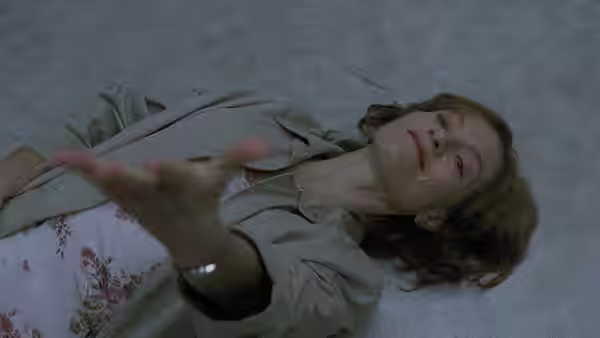
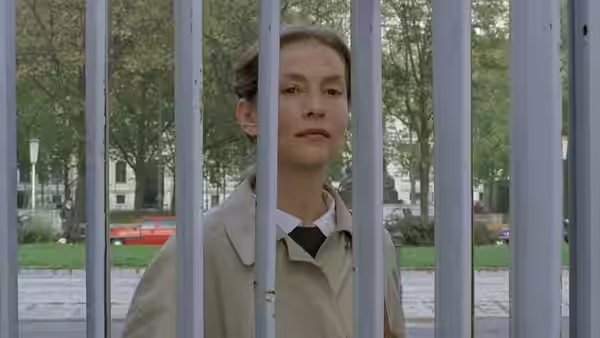
Huppert makes Erika’s self-command physically uncomfortable to watch. Her expression is so guarded that the smallest suggestion of vulnerability demands attention; we cannot settle for reading her as simply cold. We were unsettled by how exposed she seemed while barely changing her face. The performance gives us the awkward experience of noticing someone’s distress when they are trying hard to conceal it. Huppert never asks us to excuse Erika, but she makes it difficult to dismiss her as a collection of disturbing sexual fantasies.

Annie Girardot brings a comparable honesty to Erika’s Mother, and the two performances keep our attention on the people involved rather than the provocation. Benoît Magimel has a less rewarding task as Walter Klemmer. Haneke’s screenplay gives Walter too little independent weight, so that our interest in him depends heavily on Erika. We need a clearer sense of the man for the relationship to be as persuasive as her private distress. Magimel cannot quite supply what the writing withholds.

Christian Berger’s cinematography is restrained enough to let that guarded face hold our attention without making an occasion of every close look. Editors Monika Willi and Nadine Muse favour a similarly unobtrusive approach; the discomfort does not need conspicuous cutting to keep it alive. We value that plainness, especially with material so easily dressed up as something daring. Haneke leaves the performances to do much of the disturbing, and Huppert is more than capable of it.

Christoph Kanter’s production design also works through discretion, keeping our attention on the performers. Francis Haines is credited for music, though it is the discomfort between the actors that makes the stronger impression. The contributions around Huppert are effective largely because they do not compete with her for our attention. That restraint suits a drama which asks us to watch a woman trying to manage desires she cannot comfortably accommodate. It also means there is little distraction when Haneke’s sternness becomes wearing.

A more reassuring psychological drama might give us a neat cause for Erika’s behaviour and let us leave feeling informed. Haneke’s refusal to do that is worth defending, even when the provocations become repetitive. We keep watching because Huppert makes Erika’s pain matter without turning it into a plea for sympathy. That is enough to make this harsh, demanding film worth the effort. Give it your full attention, but do not choose it for comfort.

Critical consensus AI synthesised

70
Positive
8
Mixed
2
Negative
2

Most critics respond positively to The Piano Teacher, though even favourable reviews describe it as disturbing and difficult to watch. Praise centres on Isabelle Huppert: her precision, fierce restraint and vulnerability make Erika compelling, often even for critics who dislike the film around her. Haneke’s refusal of easy explanations also earns approval, with several reviews finding emotional force in his detached treatment of obsessive control and degradation.

The spread is wide, and the disagreements concern how much that severity achieves. Sympathetic critics sometimes find the provocations tiresome or the extremity exhausting, while others argue that the emotional rawness outweighs the calculation. Variety praises Huppert but finds the film increasingly ludicrous and short of climactic tension. The Guardian is more dismissive, finding it dull and unintentionally comic: a sharp contrast with the majority’s view that its discomfort serves a compelling study of its central character.

Time Out
★★★★★ · GA
100

The publication gives the film its top rating. The description notes its comparatively conventional shooting, editing and performances, though the full review text is unavailable.

Read the full review →
Los Angeles Times
20 September 2017 · Justin Chang
90*

Chang regards the film as a major achievement and Huppert’s finest performance for Haneke. He singles out her fearless, terrifying portrayal and the film’s riveting portrait of obsessive control.

Read the full review →
The New Yorker
24 March 2002 · David Denby
90*

Denby considers the film a shocking, beautifully made achievement that deserves a wide audience. He especially praises Isabelle Huppert’s precise, fiercely contained performance as Erika.

Read the full review →
Empire
1 January 2000 · Alan Morrison
85*

Morrison finds the film emotionally devastating and praises Haneke for refusing easy explanations. He singles out Isabelle Huppert’s performance as astonishing and one of the year’s standouts.

Read the full review →
Slant Magazine
2 October 2017 · ★★★★ · Clayton Dillard
80

Dillard regards the film as a calculated, often torturous work, but finds its provocations can become tiresome and equivocal. He singles out Isabelle Huppert’s performance as a defining achievement, now especially vivid on the Criterion Blu-ray.

Read the full review →
The AV Club
29 March 2002 · Scott Tobias
80*

The critic finds the film horrific and devastating, with its emotional rawness outweighing its mechanized violence and degradation. He especially praises Isabelle Huppert’s precise, vulnerable performance and the ambiguity that emerges as the central relationship develops.

Read the full review →

Straight answers AI written, from our review

Is The Piano Teacher worth watching?
The Piano Teacher is worth watching for Isabelle Huppert’s fiercely controlled performance, and we score it 82 out of 100. We recommend it to viewers willing to sit with sexual shame and emotional discomfort, though Walter is less convincing as a character and Haneke’s insistence on provocation can become wearing.
How long is The Piano Teacher, and what is it rated?
The Piano Teacher runs 2h 11m. It is a drama and romance film.
Where can I watch The Piano Teacher in the UAE?
The Piano Teacher is streaming on MUBI in the UAE. Availability is checked daily; the links above go straight to each service.
How violent or frightening is The Piano Teacher, and is it suitable for children?
The Piano Teacher carries a US R certificate, and we would not recommend it for children: its sexual themes and sustained psychological discomfort make it demanding adult viewing. The disturbing material centres on Erika’s private fantasies, shame and vulnerability; we find it unsettling rather than a film to choose for conventional scares.
Is The Piano Teacher based on a true story or a book?
The Piano Teacher is adapted from a novel by Elfriede Jelinek, rather than presented as a true story. We would not make reading the book a prerequisite: Huppert’s performance gives us ample reason to care about Erika, though Haneke deliberately offers no easy explanation for her sexual shame or need for control.

Cast

Awards

César Award for Best Actress, 2002

Nominated
César Award for Best Actress

International Submission to the Academy Awards, 2002

Nominated
International Submission to the Academy Awards

Cannes Film Festival, 2001

Won
Cannes Film Festival Grand Prix

European Film Award for Best Actress, 2001

Won
European Film Award for Best Actress

European Film Award for Best Film, 2001

Nominated
European Film Award for Best Film

European Film Award for Best Screenwriter, 2001

Nominated
European Film Award for Best Screenwriter

European Film Award - People's Choice Award for Best Director, 2001

Nominated
European Film Award - People's Choice Award for Best Director

Jameson People's Choice Award for Best Actor, 2001

Nominated
Jameson People's Choice Award for Best Actor

Jameson People's Choice Award for Best Actress, 2001

Nominated
Jameson People's Choice Award for Best Actress

If you liked this, try…

  1. Safe (1995) · not on Fi1m yetAnother tightly controlled performance makes ordinary surroundings feel difficult to endure.

  2. The Servant (1963) · not on Fi1m yetDomestic intimacy turns poisonous, with power changing hands in quietly alarming ways.

  3. An Autumn Afternoon (1962) · not on Fi1m yetA gentler examination of family duty and the difficulty of letting go.

  4. Secret Sunshine (2007) · not on Fi1m yetGrief, belief and an exposed central performance make reassurance hard to come by.

  5. Saint Omer (2022) · not on Fi1m yetA controlled, demanding drama that refuses to make a woman’s suffering easily comprehensible.