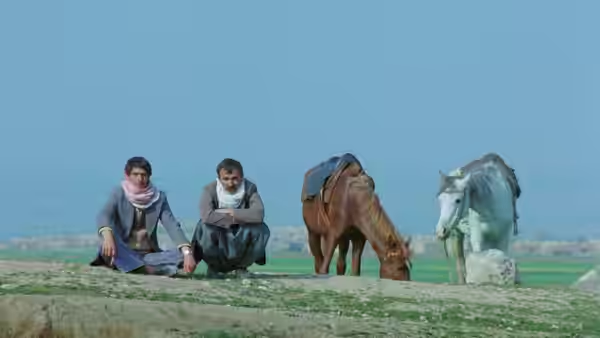
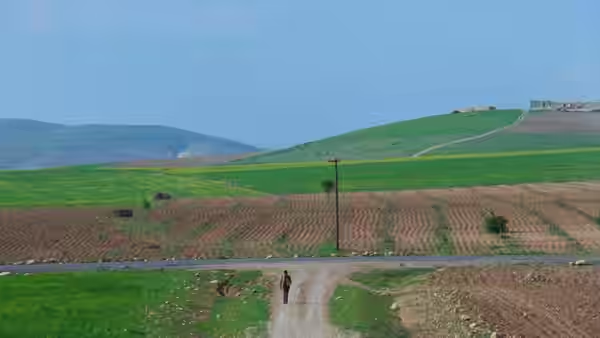
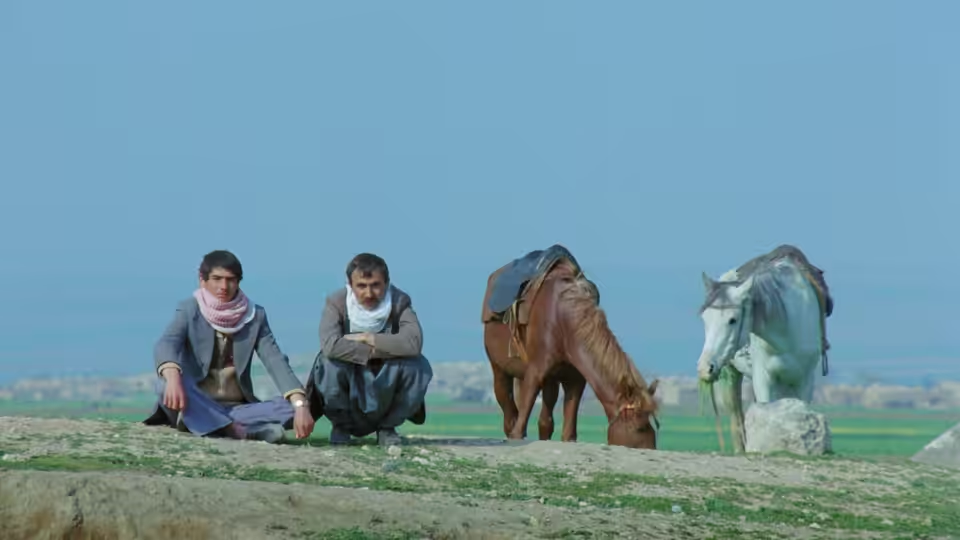
Two men sit beside a grazing horse and a loaded donkey in an open field
Film review

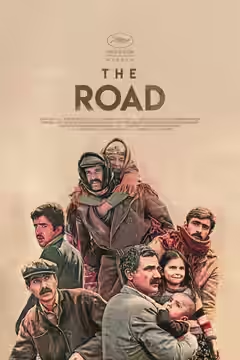
The Road

1982 · Directed by Yılmaz Güney, Şerif Gören · 1h 50m

In a sentenceFive men get a week off from prison and find the country is the bigger one

Five prisoners at Imralı, an island prison in Turkey, are granted a week’s leave to visit their families. Seyit Ali (Tarık Akan) travels east to his wife Zînê (Şerif Sezer) and the relatives who have been keeping her. Mehmet Salih (Halil Ergün) heads for his wife Emine (Meral Orhonsay) and a family that does not want him in the house. Ömer (Necmettin Çobanoğlu) returns to his village near the Syrian border, where the men smuggle and the army watches. Mevlüt (Hikmet Çelik) goes to see his fiancée Meral (Sevda Aktolga) under the guard of her aunts. Yusuf (Tuncay Akça) never gets that far; a soldier at the first checkpoint takes his leave papers. Buses, ferries, trains and identity checks fill the week, and a curfew empties the streets at night.

Fi1m review

Written in prison by Yılmaz Güney and shot for him by Şerif Gören, Yol follows five convicts home on a week’s leave and finds the country outside worse than the cells. Plain, hard and not easily forgotten; one of its five stories falls short of the rest.

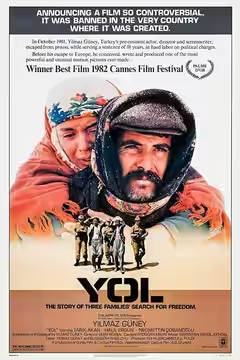
Yılmaz Güney wrote Yol in a Turkish prison, and Şerif Gören directed it from his instructions; Güney then edited it after getting out of the country. That is the story usually told about the film, and it is a good one, but the film does not lean on it. What is on screen is simpler and harder: five convicts are given a week’s leave, and each goes home and finds that outside is worse. It is a plain, unsentimental, fine film, and as clear an account as we know of what a military government does to ordinary marriages.

The setting is Turkey after the coup of 1980, though nobody in the film says so. Soldiers stand at the bus stations and check papers on the trains. A curfew empties the streets at night. The film gives the men their leave in the first ten minutes, at Imralı, the island prison where it opens, then puts them on the ferry and scatters them. Yusuf (Tuncay Akça) has his pass taken from him at the first checkpoint and is sent straight back before he has gone anywhere, and the film has already made its point.

Seyit Ali (Tarık Akan) is the spine of it. He travels east to his wife Zînê (Şerif Sezer), and the family he finds there has decided what he must do about her before he arrives. Akan plays him as a man who has been given an order by custom and cannot find the part of himself that wants to obey it. There is a journey the two of them make on foot, through snow, in the second half, and we will not say where it leads. We can say we watched it with our shoulders hunched and our hands cold, because Erdoğan Engin shoots it wide and white with the two figures small against the slope, and because Sezer, barely speaking, makes every step a plea. It is the most upsetting stretch of film we have sat through in some time, and the camera does nothing but keep looking.

The other threads are shorter and not all of them hold. Mehmet Salih (Halil Ergün) goes to his wife Emine (Meral Orhonsay), whose family will not have him in the house; Ergün plays the shame without asking for pity, and Orhonsay gives Emine the film’s one stubborn flicker of wanting something for herself. Ömer (Necmettin Çobanoğlu) goes to a Kurdish village near the Syrian border where the men make their living smuggling and the army makes its living stopping them; his scenes have the widest skies and the least dialogue, and after the snow they are the ones that stayed with us. Mevlüt (Hikmet Çelik) visits his fiancée Meral (Sevda Aktolga) under the eyes of two veiled aunts, and this strand is played closer to comedy than the film can quite manage. It is the one place where Gören’s touch goes heavy.

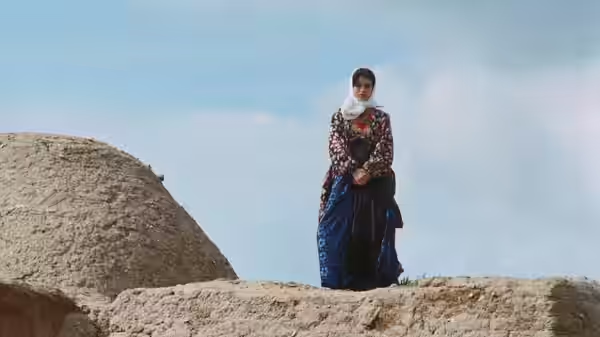
Engin’s photography is the reason the film looks the way it does in the memory: winter, mud, grey rooms with one window, and then a mountain. He keeps the horizon in the frame nearly always, so that wherever a man stands there is somewhere further he cannot go. Zülfü Livaneli’s music, with Sebastian Argol also credited, is sparse, a plucked line under the bus journeys and silence in the houses, and that is the right choice. Güney is one of five credited editors, and the cross-cutting between the journeys is patient rather than neat; a scene will end a beat before it has finished, and once or twice we lost a day of the week. The dialogue is post-dubbed and you can hear the seam.

The two reviews we have been able to consult score it as merely decent. We think they undersell it. The film is uneven, Mevlüt’s story is thin and the dubbing dates it, but the Seyit Ali thread alone would put it in the upper reaches, and the whole hangs together better than a five-way structure usually allows.

It carries a 15 certificate and runs 110 minutes, and it reached British cinemas on 13 January 1983. It is not a comfortable evening. Watch it with someone who will not want to talk over it, and do not expect to sleep straight away.

Critical consensus AI synthesised

2 of 6
Positive
0
Mixed
2
Negative
0

With only 2 reviews in so far, there is no consensus to report on this 1982 film, and we would be wary of pretending otherwise. Both notices, one from RogerEbert.com and one from The New York Times, register as mixed on our scale, but in each case the text itself is not available to us, so we cannot say where the praise falls, which department or performance draws attention, or what the reservations are. What we have is two lukewarm numbers and no argument behind them. Until more critics weigh in, or those two pieces can be read in full, treat the picture as unassessed rather than unloved.

RogerEbert.com
65*

The page content is unavailable, so the critic’s verdict cannot be determined. No specific praise or complaint can be reliably identified.

Read the full review →
The New York Times
18 January 2018
64*

The page is identified as a movie review of the 1982 film. Its text is inaccessible, so the critic’s verdict and specific praise or complaint cannot be determined.

Read the full review →

Straight answers AI written, from our review

Is The Road worth watching?
The Road, released in Turkey as Yol, is worth watching for anyone prepared for a plain, hard drama about five convicts on a week's leave under military rule, and we scored it 84. The Seyit Ali thread, a journey on foot through snow, is the most upsetting stretch of film we have sat through in some time. It is not a comfortable evening, and one of the five stories falls short.
How long is The Road, and what is it rated?
The Road runs 1h 50m. It is a drama and romance film.
Where can I watch The Road in Austria?
The Road is not on any streaming or rental service in Austria at the moment. Availability is checked daily.
How violent or frightening is The Road, and is it suitable for children?
The Road carries a UK 15 certificate and is not suitable for children, less for anything graphic than for how bleak it is. The threat throughout is what families and custom decide to do to wives, and the second half has a sequence we found hard to watch without flinching. Older teenagers who can sit with a slow, distressing film will manage; the squeamish will be upset rather than frightened.
How does The Road compare to Bicycle Thieves?
The Road is the harder and colder of the two films, following five men home from prison across a Turkey full of checkpoints, where Bicycle Thieves follows one father and son through one city. De Sica's film is the tighter and more consistent; Güney and Gören's is more uneven but reaches further into despair. Watch Bicycle Thieves to be moved, The Road to be shaken.

Cast

Awards

International Submission to the Academy Awards, 1983

Nominated
International Submission to the Academy Awards

Cannes Film Festival, 1982

Won
Palme d'Or

Silver nugget for the best foreign film, 1982

Won
Silver nugget for the best foreign film

If you liked this, try…

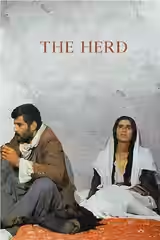
  1. The Herd (1978) · not on Fi1m yetGüney’s script, another family on the move across Turkey, and the same unblinking eye.

  2. A Time for Drunken Horses (2000) · not on Fi1m yetKurdish children smuggling across a snowbound border; Ömer’s village, seen from the other side.

  3. The Round-Up (1966) · not on Fi1m yetJancsó’s prisoners on the Hungarian plain, and a state that watches everything they do.

  4. Once Upon a Time in Anatolia (2011) · not on Fi1m yetA night drive through the same steppe, slower and drier, with the same weather in it.

  5. Bicycle Thieves (1948, Fi1m 93)One man, one city, one week, and a system that has no room for him.

The Road (1982) review: five prisoners, one week, nowhere free (Austria) | Fi1m