Written in prison by Yılmaz Güney and shot for him by Şerif Gören, Yol follows five convicts home on a week’s leave and finds the country outside worse than the cells. Plain, hard and not easily forgotten; one of its five stories falls short of the rest.
Yılmaz Güney wrote Yol in a Turkish prison, and Şerif Gören directed it from his instructions; Güney then edited it after getting out of the country. That is the story usually told about the film, and it is a good one, but the film does not lean on it. What is on screen is simpler and harder: five convicts are given a week’s leave, and each goes home and finds that outside is worse. It is a plain, unsentimental, fine film, and as clear an account as we know of what a military government does to ordinary marriages.
The setting is Turkey after the coup of 1980, though nobody in the film says so. Soldiers stand at the bus stations and check papers on the trains. A curfew empties the streets at night. The film gives the men their leave in the first ten minutes, at Imralı, the island prison where it opens, then puts them on the ferry and scatters them. Yusuf (Tuncay Akça) has his pass taken from him at the first checkpoint and is sent straight back before he has gone anywhere, and the film has already made its point.
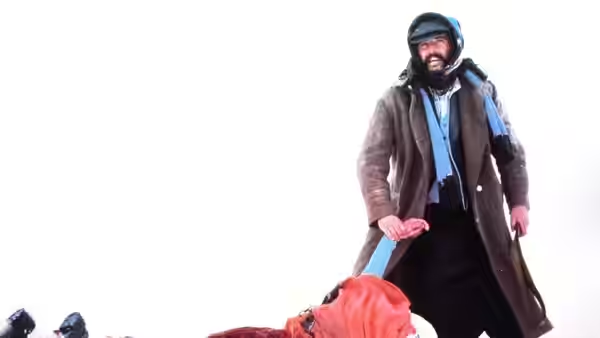
Seyit Ali (Tarık Akan) is the spine of it. He travels east to his wife Zînê (Şerif Sezer), and the family he finds there has decided what he must do about her before he arrives. Akan plays him as a man who has been given an order by custom and cannot find the part of himself that wants to obey it. There is a journey the two of them make on foot, through snow, in the second half, and we will not say where it leads. We can say we watched it with our shoulders hunched and our hands cold, because Erdoğan Engin shoots it wide and white with the two figures small against the slope, and because Sezer, barely speaking, makes every step a plea. It is the most upsetting stretch of film we have sat through in some time, and the camera does nothing but keep looking.
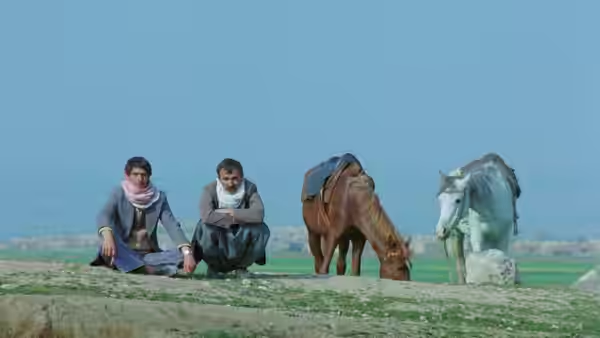
The other threads are shorter and not all of them hold. Mehmet Salih (Halil Ergün) goes to his wife Emine (Meral Orhonsay), whose family will not have him in the house; Ergün plays the shame without asking for pity, and Orhonsay gives Emine the film’s one stubborn flicker of wanting something for herself. Ömer (Necmettin Çobanoğlu) goes to a Kurdish village near the Syrian border where the men make their living smuggling and the army makes its living stopping them; his scenes have the widest skies and the least dialogue, and after the snow they are the ones that stayed with us. Mevlüt (Hikmet Çelik) visits his fiancée Meral (Sevda Aktolga) under the eyes of two veiled aunts, and this strand is played closer to comedy than the film can quite manage. It is the one place where Gören’s touch goes heavy.
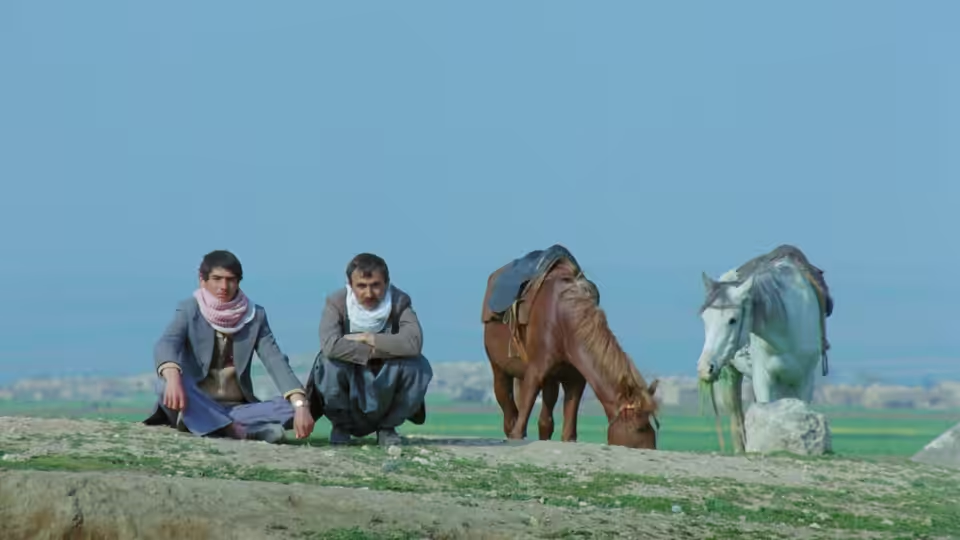
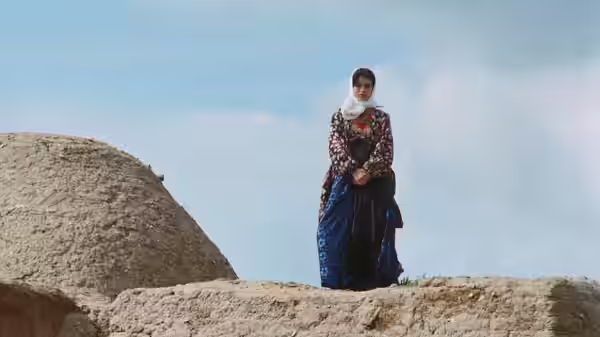
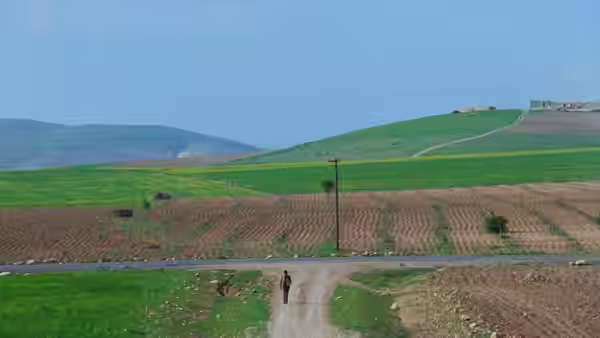
Engin’s photography is the reason the film looks the way it does in the memory: winter, mud, grey rooms with one window, and then a mountain. He keeps the horizon in the frame nearly always, so that wherever a man stands there is somewhere further he cannot go. Zülfü Livaneli’s music, with Sebastian Argol also credited, is sparse, a plucked line under the bus journeys and silence in the houses, and that is the right choice. Güney is one of five credited editors, and the cross-cutting between the journeys is patient rather than neat; a scene will end a beat before it has finished, and once or twice we lost a day of the week. The dialogue is post-dubbed and you can hear the seam.
The two reviews we have been able to consult score it as merely decent. We think they undersell it. The film is uneven, Mevlüt’s story is thin and the dubbing dates it, but the Seyit Ali thread alone would put it in the upper reaches, and the whole hangs together better than a five-way structure usually allows.
It carries a 15 certificate and runs 110 minutes, and it reached British cinemas on 13 January 1983. It is not a comfortable evening. Watch it with someone who will not want to talk over it, and do not expect to sleep straight away.